Clemence Orsini


From movement to meaning
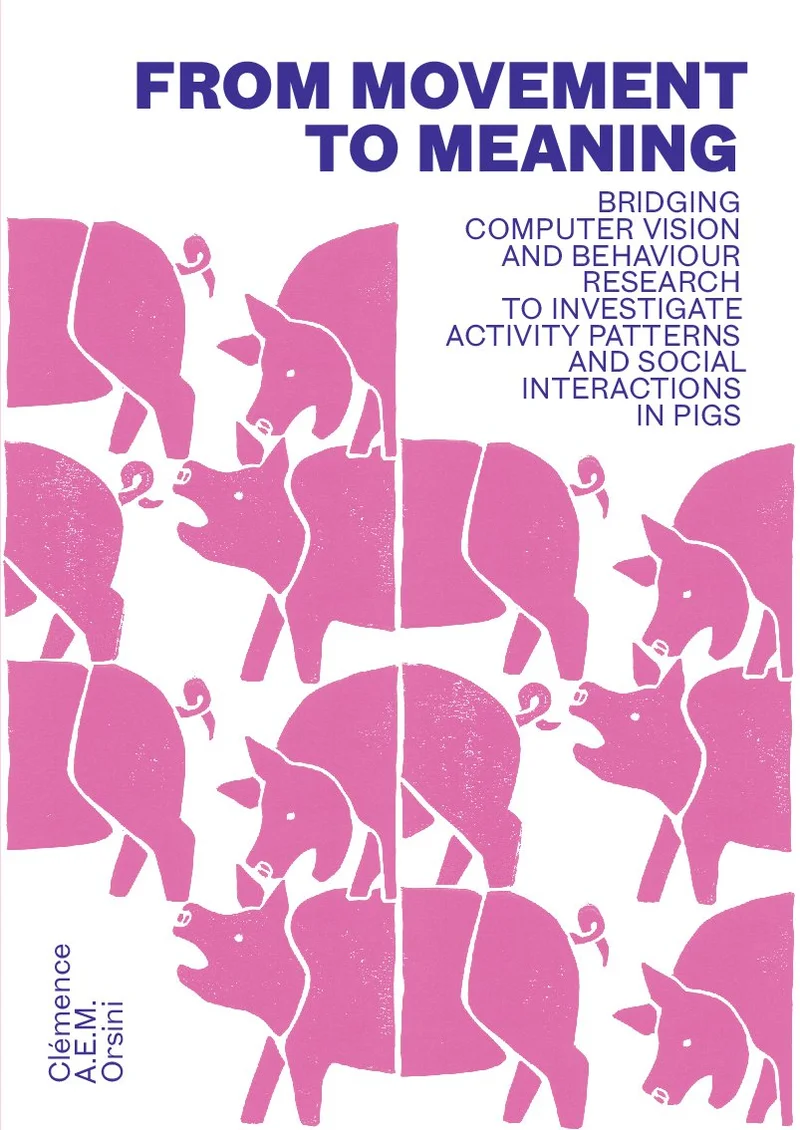
In commercial systems, domestic pigs are kept in groups and develop social structures that are influenced by management practices and housing conditions. Pigs are highly social animals, and understanding their social interactions is important, as these interactions are a key component of welfare. Positive social interactions, such as playing or lying in close proximity, can promote welfare, whereas negative interactions, such as ear and tail biting, can severely compromise it. Activity also plays a key role in welfare assessment, as disruption in activity patterns can indicate welfare issues. In large commercial farms, identifying social structures, ear and tail biting, and activity patterns is nearly impossible by human observation. Computer vision algorithms may provide a promising solution by enabling continuous data collection and long-term monitoring of individual behaviour. However, current systems are not yet able to reliably detect all ear or tail biting events and to maintain identity over long periods of time for monitoring individual behaviours. Furthermore, it remains unclear how such methods can be applied in practice or what measures can be derived from computer vision algorithms to characterise behaviour. Therefore, this thesis explored the potential of using computer vision algorithms to monitor social interactions and activity patterns in pigs, with the overarching goal of improving pig welfare. The data presented in Chapter 2 were collected from three batches of growing-finishing pigs housed at the research facilities of Wageningen University & Research (The Netherlands), with pigs allocated to either barren or enriched pens (n = 21 pens, 6 pigs per pen). The data presented in Chapters 3-6 were collected from three batches of tail-docked pigs housed on a commercial growing–finishing farm in Germany (n = 30 pens, 11 pigs per pen). On this commercial farm, the health status of each pig, including ear and tail damage scores, was assessed twice per week. All chapters included data collected either partially or entirely through computer vision techniques. Proximity between pigs (Chapters 2 and 5) and activity patterns (Chapters 3 and 4) were derived using tracking-by-detection algorithms based on bounding boxes. Ear and tail biting were manually annotated from videos (Chapters 4 and 5) and used to develop and validate a video-based behaviour recognition algorithm presented in Chapter 6. Chapter 2 explored how a tracking-by-detection algorithm can be used to investigate social networks in pigs based on spatial proximity and how methodological choices regarding proximity definitions and sampling rates affect social networks. Five proximity definitions were proposed, either based on the distance between the centroids or the overlap of the surfaces of the bounding boxes. Four of those definitions were binary, using a minimal threshold to distinguish pairs of pigs in close proximity from other pairs. The fifth definition was a novel quantitative definition of proximity, measured as the average distance between pairs of pigs over frames. For each proximity definition, the tracking data was downsampled at different sampling rates (with intervals between frames ranging from 2 seconds to one hour). Social networks were constructed for each combination of proximity definition and sampling rate, and four network metrics were calculated (i.e., degree centrality, eigenvector centrality, clustering coefficient, and radius). Our results demonstrate that social network metrics are influenced by both proximity definition and sampling rate and that their impact varies for different network metrics. For example, the direct network metric degree centrality was less affected by proximity definitions and downsampling compared to the indirect network metrics eigenvector centrality and clustering coefficient. Furthermore, the effect of the sampling rate on the network metrics depended on the proximity definition chosen. To preserve the structure of the social network and obtain reliable estimates of network metrics, downsampling should not exceed one frame every six minutes. This chapter proposed novel methods for investigating social networks in pigs based on spatial proximity derived from computer vision tracking data and highlighted important methodological considerations regarding the definition of proximity and sampling. In the literature, changes in activity have been reported as a potential indicator of tail biting outbreaks. However, before such deviations can be reliably identified, it is essential to first characterise baseline activity patterns to distinguish normal fluctuations from changes associated with welfare issues. Therefore, Chapter 3 investigated the consistency of group-level activity patterns over time, while accounting for the temperature-humidity index (THI). The tracking-by-detection algorithm was run throughout the growing-finishing period in two batches, on two days (24h) per week, every two weeks. Three group-level activity metrics were derived from the tracking data: the average activity, relative amplitude, and intra-daily variability. We found that activity metrics changed significantly over time, although the direction of these changes varied between the two batches. In one batch, characterised by high THI, particularly during the final two weeks, activity shifted from a monophasic to a biphasic pattern over time, with decreasing average activity, relative amplitude and increasing intra-daily variability. The differences between the two days of the week in activity metrics were minimal. In contrast, the other batch, characterised by a relatively stable and low THI, showed fluctuating trends over weeks and more pronounced variation in activity metrics between the two days of the week. Overall, these findings suggest that the consistency of group-level activity patterns over time is influenced by environmental factors, with THI contributing to fluctuations in activity. Therefore, these factors should be considered when selecting days and interpreting activity patterns for the development of reliable early warning systems for welfare problems. After characterising group-level activity patterns and their variation over time, the next step was to explore whether activity patterns could indicate early tail-biting outbreaks. Although changes in activity before tail-biting outbreaks have been reported in the literature based on manual observations, they have not yet been investigated using computer vision approaches. Therefore, Chapter 4 investigated whether activity and synchrony patterns derived from a tracking-by-detection algorithm can predict tail damage at the group level and whether individual activity is associated with performing or receiving tail biting. Nine pens with pigs with tail damage (damage pens) were retrospectively selected based on damage scores recorded on farm. Each pen was matched with a control pen with pigs without tail wounds (control pens) on the same day. A tracking-by-detection algorithm was applied in both damage and control pens on four days around the tail damage to quantify average activity and synchrony at the group level and, within the damage pens, at the individual level. Tail biting events and identities of biters and victims were scored from video on three of these days. At the group level, average activity did not affect the probability of a pen becoming a damage pen. However, at the individual level, higher activity on days preceding tail damage was associated with increased tail-biting frequency on the following days. No associations were found between activity synchrony and the frequency of tail biting at both individual and group levels. Chapter 5 investigated whether individual pigs differ in their proximity to pen mates and in performing and receiving ear and tail biting, and whether, beyond individual variation, specific pairs of pigs spend on average more time in proximity or engage in biting more frequently than others. It introduced a novel modelling approach for assessing individual differences and preferences by partitioning variation in social interactions into individual and dyadic random effects. The analysis was performed on the same dataset collected in damage pens for Chapter 4, with additional annotations for ear biting. Proximity was measured using a quantitative definition similar to the one developed in Chapter 2. Individual pigs explained a high proportion of the variance of tail and ear biting, and a statistically significant but much lower proportion of the variance of proximity. This indicates that pigs differ in their propensity to bite, receive bites, and in their tendency to be in proximity to (or further apart from) other pigs. Moreover, a non-random distribution of interactions among pig pairs was found, while accounting for individual variation, with certain dyads being more frequently involved in tail and ear biting or spending on average more time in proximity (or further apart) than others within the group. This last result suggests that pigs have preferences for specific individuals in ear biting, tail biting, and proximity. Overall, this study demonstrates that social interactions are shaped by both individual and dyadic factors, and introduces a dyadic modelling approach that can be applied in future research to better understand variation in social interactions. Chapter 4 demonstrated that individual activity in the days preceding the occurrence of tail wounds can be used to identify tail biters, which may allow earlier intervention to limit outbreaks. As a complementary approach, focusing on automatically recognising the biter, rather than indirect predictors, could also support earlier intervention before escalation. Therefore, Chapter 6 proposed a video-based behaviour recognition algorithm for the automated monitoring of individual tail and ear biting. Two state-of-the-art action recognition models were evaluated for recognising tail and ear biting. The annotations used to develop and validate these models varied substantially in the postures of victims and biters, pig age, and lighting conditions. The best-performing model achieved detection accuracies of approximately 72% for both damaging behaviours. Most misclassifications occurred between tail and ear biting, rather than between either of these behaviours and other non-damaging behaviours. Chapter 7 synthesised the findings from the previous chapters and reflected on how this thesis contributes to bridging the gap between computer vision and behavioural research. First, the technical challenges associated with using computer vision approaches to monitor behaviour and potential solutions and recommendations for future work were discussed. For example, in tracking-by-detection algorithms, maintaining the identity of individual pigs over time remains a key challenge, and a solution for identity switches could be to integrate RFID data from feeding stations. I then examined how computer vision outputs can be translated into meaningful behavioural metrics. In particular, I reflected on sampling strategies for data collected at the frame level and proposed recommendations to guide the selection of appropriate sampling approaches in future studies. Furthermore, I summarised how spatial proximity and distance moved, derived from a tracking-by-detection algorithm, can be used as proxies for social interactions and activity, and discussed the limitations. Finally, the broader implications of this research and its potential applications were discussed, particularly for future behaviour research, farm management and animal breeding. Finally, I discussed the societal relevance of this work by considering the role automated monitoring systems may play in supporting farmers, informing consumers, and facilitating the transition toward more sustainable and animal-centred production systems, while also addressing the ethical considerations required for their implementation. To conclude, this thesis contributes to bridging the gap between computer vision and behavioural research. It demonstrates the potential of using computer vision data for behavioural research while highlighting important methodological considerations for its application. This thesis proposed novel methods that extend beyond traditional approaches to quantify and statistically analyse behaviour. This opens the door to new opportunities to better understand animal behaviour and, ultimately, to improve animal welfare.
| Publicatiedatum | 26 oktober 2026 |
| Universiteit | Wageningen University |
| Auteur | Clemence Orsini |
| DOI nummer | 10.18174/681594 |