Yali Bai
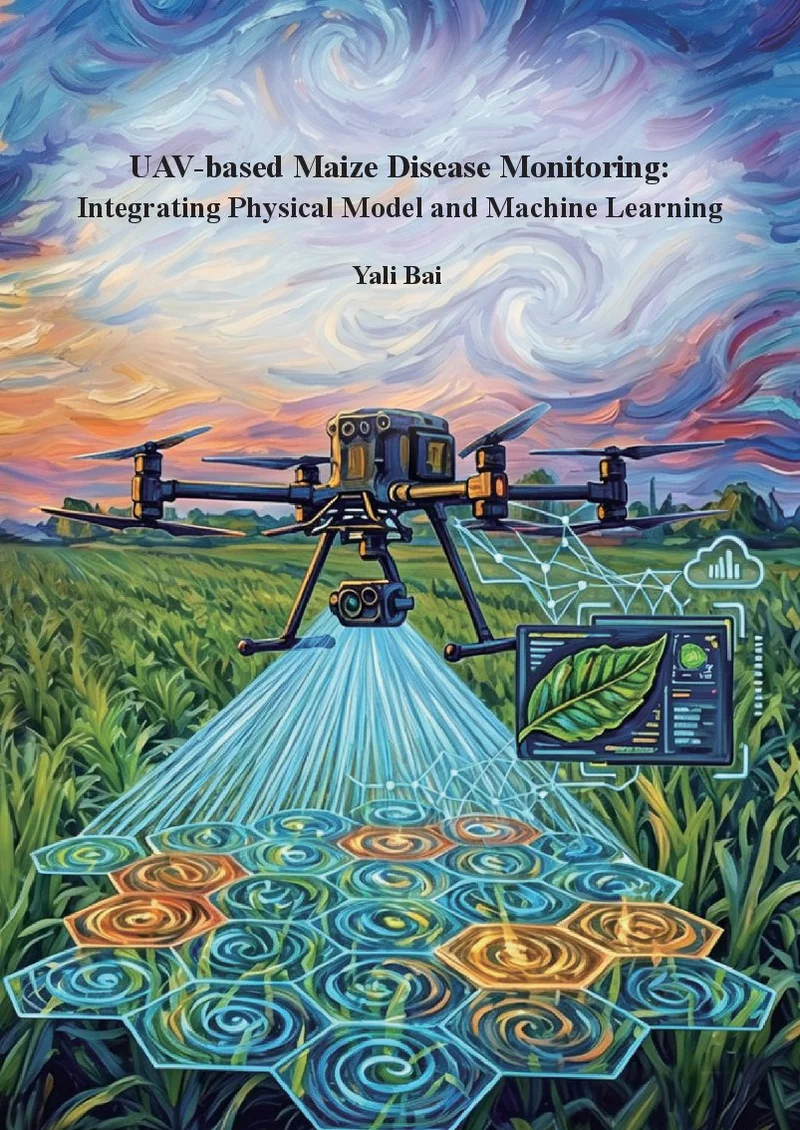


UAV-based Maize Disease Monitoring
The emergence and spread of crop diseases pose not only a severe threat to food security, but also undermine the sustainability of agricultural ecosystems and the economic well‑being of farmers. Achieving efficient and precise early detection of disease has thus become a critical challenge for modern precision agriculture. With the rapid advancement and adoption of technologies such as hyperspectral remote sensing, unmanned aerial vehicles (UAVs), and artificial intelligence models, researchers are increasingly able to assess crop health from the leaf to the canopy, and across both spatial and temporal scales. However, despite promising progress, the complex spectral mechanisms underlying disease response remain poorly understood. Moreover, data‑driven models can achieve high accuracy in disease monitoring, but often lack physical constraints, leading to overfitting and poor generalization. In response to these gaps, this doctoral study unfolds across five interlinked dimensions—symptom characterization, hyperspectral feature extraction, index development, model fusion, and spatiotemporal extension—to build a robust monitoring system specifically tailored for maize leaf spot disease. Chapter 2 reviews recent advances in hyperspectral remote sensing for crop disease monitoring; Chapter 3 investigates the temporal sensitivity of multi‑source hyperspectral features; Chapter 4 proposes a novel canopy‑scale disease sensitive index Chapters 5 and 6 introduce two integrative frameworks: PGDL (physical model-guided deep learning) and RS‑DeepSpread (Synergistic RS–deep learning and epidemic framework). Through this comprehensive approach, the study aims to enable early disease detection. Chapter 2 reviews hyperspectral remote sensing in crop disease monitoring. The chapter begins by describing the observable spectral symptoms of major crop diseases, then delves into key hyperspectral features—such as spectral–textural traits, pigment absorption, solar-induced chlorophyll fluorescence, and temporal dynamics. It then examines the detection algorithms in use, spanning traditional statistical methods, machine-learning approaches, and physically-based frameworks. The strengths of these methods—early disease detection, stressor differentiation, resistance assessment and large-scale monitoring—are highlighted. The chapter concludes by proposing future directions: integrating physical models with deep learning, enhancing the robustness and sensitivity of features, and developing open-access shared datasets to accelerate global progress in disease monitoring. Chapter 3 introduces the Disease Sensitive Index (DSI), a novel canopy‑scale metric specifically designed to detect early maize leaf diseases. The DSI exhibits strong responsiveness to pigment variation, rather than plant spacing, thereby offering the ability to isolate early disease onset. We applied this index to multispectral UAV data collected over multiple years and sites, demonstrating its robustness (R² = 0.69 in 2021 and R² = 0.62 in 2022 for disease‑index estimation). Time‑series analysis of vegetation indices revealed that the DSI can identify infection onset as early as 10 days post‑infection. These findings suggest that the DSI is a promising tool for precision agriculture, enabling reliable early maize leaf spot monitoring. Chapter 4 investigates how sensitive UAV-based hyperspectral features are to maize leaf spot disease. We tracked maize over 30 days post-infection using high-resolution UAV hyperspectral imaging, extracting biophysical parameters (via the PROSAIL model) and spectral features (reflectance, vegetation indices, and wavelet features). We found that wavelet features detected disease as early as day 6 after infection, followed by VIs at day 8 and changes in chlorophyll content at day 10. Classification models combining chlorophyll content, VIs, and wavelet features performed best, achieving up to 9.36 % higher accuracy than models using only VIs or spectra in early and severe stages. In mild and early severe stages, however, spectral-only models reached 86.21 % accuracy. These findings show that multi-source features are complementary in early and severe stages of disease but become redundant in the mild and early severe stages. Chapter 5 introduces a PGDL framework to improve UAV-based hyperspectral monitoring of maize leaf spot disease. We first generate three types of radiative transfer simulations — (1) uniformly varied chlorophyll content, (2) measured disease leaf spectra, and (3) mixed endmember spectra — to serve as physically informed priors. We then train deep neural networks using these simulations and transfer them to UAV-collected hyperspectral data across four disease stages (early, mild, moderate, severe). Our results show that simulations based on real diseased leaf spectra (SIM #2 and SIM #3) align closely with UAV measurements (R² ~0.97–0.99). In disease-index retrieval, the PGDL models, especially when pre-trained on SIM #2, outperform both purely data-driven and physically based approaches (early stage: R² = 0.76 in 2021, 0.70 in 2023). This study demonstrates that PGDL enhances early disease detection. Chapter 6 presents the RS‑DeepSpread framework, a novel integration of remote‑sensing‑driven deep learning and stochastic epidemic modelling for spatiotemporal monitoring of maize leaf spot disease. We combined the deep‑learning component predictive output with a stochastic epidemic spread model. RS‑DeepSpread significantly outperformed the standalone deep network: in 2021 it achieved quadratic weighted kappa (QWK) = 92.54 % and overall accuracy (OA) = 85.37 %, and in 2023 QWK = 89.71 % and OA = 91.67 %. Moreover, it reduced under‑ and over‑estimation rates (2021: 5.36 % under, 8.93 % over; 2023: 3.97 % each) and forecasted epidemic peak timing up to three days earlier than field observations. These results demonstrate that coupling remote‑sensing deep learning with epidemic modelling offers a promising solution for timely, spatially explicit prediction of disease dynamics, supporting a shift from reactive to preventive disease management.
| Publicatiedatum | 3 juni 2026 |
| Universiteit | Wageningen University |
| Auteur | Yali Bai |
| Order nummer | 18824 |