Raquel Gonzalez Armas
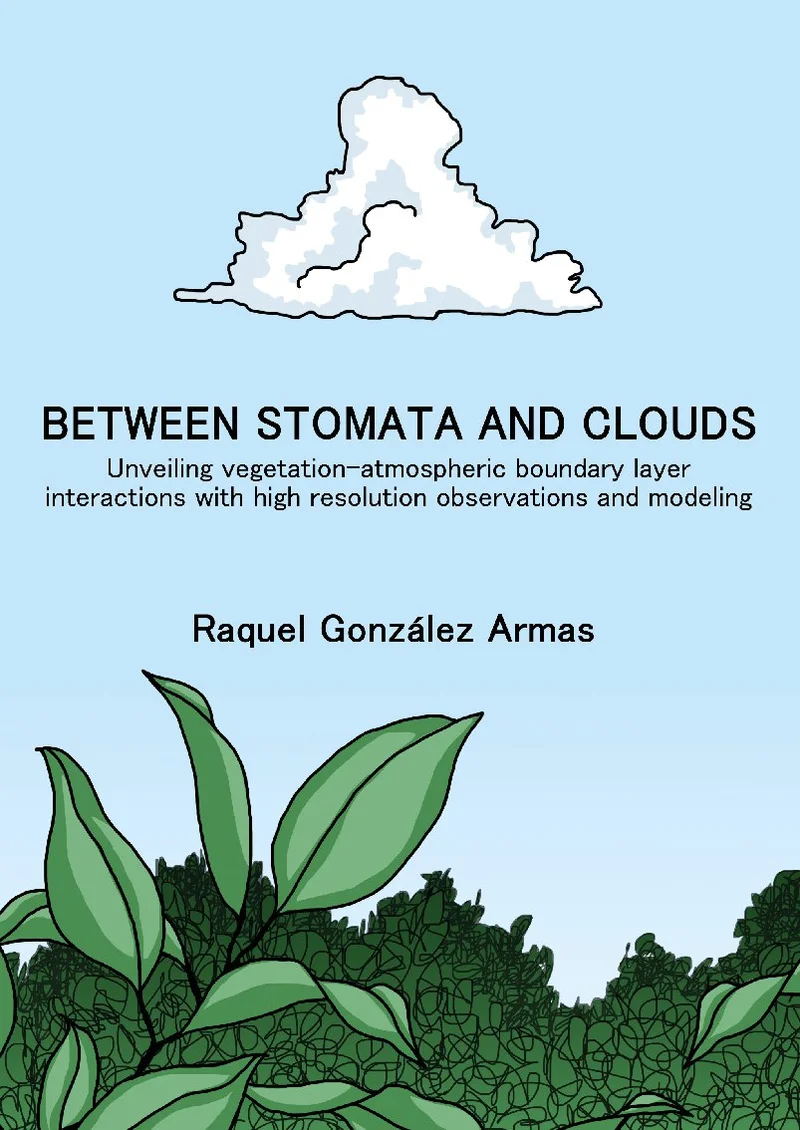


Between stomata and clouds
Vegetation covers a large proportion of the world’s land. On those areas, vegetation and atmosphere interact by exchanging energy, heat, water vapor, carbon dioxide (CO2), and other chemical compounds. These interactions importantly alter both the state of the vegetation and the state of the lower atmosphere, the so-called atmospheric boundary layer. While these interactions have been studied for many years, challenges on its understanding and representation in Earth system models still abound. A major challenge is reducing the current uncertainties on the exchanges of energy and matter, which requires the study of the vegetation and atmosphere as a coupled and continuum system. To meet that goal, research approaches need to represent the relevant biophysical processes across scales and scientific disciplines. In this thesis, we contribute to the understanding of vegetation-atmosphere interactions by linking leaf-scale ecophysiology, canopy microclimate, turbulence, radiation, and cloud processes within a unified diurnal and multi-scale framework. We do so by conducting studies that combine comprehensive observational datasets and modeling approaches at kilometric spatial scales. In terms of observations, we participated in field campaigns in three diverse ecosystems: an agricultural alfalfa field (La Cendrosa site, Spain), a tropical Amazon rainforest site (ATTO site, Brazil), and a temperate forest site (Loobos site, The Netherlands). Studying multiple sites enabled us to investigate the vegetation-atmosphere interactions across canopy structures and atmospheric regimes. To investigate the interactions, we used multiple model approaches: (1) a conceptual atmospheric mixed-layer model (CLASS model) which is structurally analogous to a grid cell in a global Earth system model, (2) a multi-layer canopy scheme which captures vertical variability often neglected in land-surface schemes, and (3) a canopy-resolving Large-Eddy Simulation model (can-DALES model) which attains high realism by explicitly solving air transport within and above canopies. As a first step, Chapter 2 examines how four canopy environmental variables - photosynthetically active radiation (PAR), vapor pressure deficit (VPD), air temperature (T), and atmospheric CO2 concentration (Ca) - control leaf level and canopy-scale exchanges of water and CO2. Our objective was to understand the influence of atmospheric conditions on stomatal regulation, photosynthesis, and transpiration at the leaf level, and to assess how these responses propagate to the ecosystem scale. To this end, we develop a mathematical framework that quantifies how leaf level exchange processes depend explicitly on atmospheric drivers. Results revealed that the diurnal evolution of stomatal regulation, photosynthesis, and transpiration was primarily governed by PAR, T, and VPD, with Ca minimally contributing. The framework enabled us to disentangle interactions between the atmospheric boundary layer and the vegetation. For example, we could differentiate how cloud shading reduced CO2 assimilation through both diminished radiation and associated temperature decreases. As such, the proposed framework proved a useful tool to analyze temporal vegetation exchange dynamics in weather and climate models. In Chapter 3, we investigated the diurnal and vertical variability of forest microclimate, transpiration and CO2 assimilation for a tropical Amazon forest. Building on the temporal perspective of Chapter 2, this chapter introduces vertical variability within the canopy as a key dimension controlling ecosystem exchange. The study integrates (1) observations acquired in a tropical Amazon forest, and (2) a multi-layer canopy approach which is driven by the acquired measurements, during a cloudy day. We found distinctive observed vertical profiles of leaf traits and microclimate, which were maintained during most of the daytime. In particular, we found a persistent inversion of temperature within the canopy, which hindered air mixing between the upper third of the canopy and the lower layers. The modeling approach revealed that the forest transpiration and CO2 assimilation was dominated by the dynamics of the upper third of the canopy. Differences between the modeled CO2 assimilation and the observed CO2 surface transport underscored the importance of CO2 storage and ventilation events within the canopy, particularly during the morning. In Chapter 4, we focused on a key microclimatic factor for ecosystem fluxes, radiation. Solar shortwave radiation drives the surface heating and the evapotranspiration, while a part of it, the PAR radiation, controls the photosynthesis. In turn, longwave radiation emitted by the vegetation, soil and sky regulates air and canopy temperatures. In this chapter, we investigated how radiation is transmitted through the vegetation by improving and evaluating a canopy radiative transfer scheme for a canopy-resolving Large-Eddy Simulation model. The scheme simulates shortwave and longwave radiation, and make the important step of accounting for the plant preferential use of radiation by resolving four shortwave spectral bands: ultraviolet (280-400 nm), PAR (400-700 nm), far-red (700-750 nm), and near infrared (750-4000 nm). We also explored how the shortwave radiative transfer varied depending on external forcings, related to the sun position and the direct and diffuse proportion of solar radiation, and on internal canopy factors, related to the leaf biomass and its distribution across the canopy. Results showed that the scheme reproduced spectral differences in canopy reflectance and vertical profiles of the radiative fluxes. The canopy radiative transfer scheme now enables the investigation of the effect of ultraviolet and far-red radiation on photosynthesis and surface fluxes. In Chapter 5, we explored the forest-atmosphere interactions by integrating four interconnected aspects of the coupled system: forest microclimate, leaf-scale fluxes, ecosystem-scale fluxes, and the clear-to-cloudy boundary-layer transition. To that end, we combined (1) observations acquired in a tropical Amazon forest and (2) a canopy-resolving Large-Eddy Simulation. This work builds upon the previous chapters by simultaneously linking, at diurnal scales, leaf ecophysiology, vertical structured canopy microclimates, and detailed radiative canopy transfer with canopy-scale and atmospheric boundary layer-scale turbulence. Additionally, to our knowledge, this study reports the first canopy-resolving Large-Eddy Simulation which includes boundary layer clouds. The simulation results validated well for the four themes, demonstrating its realism. The simulation reproduced a stable air layer within the canopy which expanded and shrunk following a diurnal cyle, and which affected the storage and ventilation of within canopy air. Furthermore, the simulation captured the transition from clear sky to a shallow-cumulus regime while resolving canopy-scale turbulence that modulates the surface forcings. This study paves the way to future studies regarding radiative and turbulent vegetation-cloud feedbacks. In Chapter 6, we analyzed the diurnal variability of carbon cycle tracers (CO2, O2, and δ 13C-CO2) in a tropical Amazon forest site and a temperate forest site. Carbon cycle tracers are often used to infer information about the biosphere by tracking the movement of carbon between the atmosphere and land. To contribute to interpret the atmospheric signals of the carbon cycle tracers, we focused on determining which (surface or atmospheric) processes are responsible for their diurnal variability. For doing so, we employed both (1) observations and (2) numerical experiments performed by the CLASS model. We calculated the diurnal range of the carbon cycle tracers and quantified the contribution of surface and atmospheric processes to that range. Results revealed the importance of atmospheric processes, namely entrainment of free tropospheric air, subsidence, and cloud ventilation, in shaping the diurnal variations of the carbon cycle tracers. The findings underscored the utility of using the diurnal range as a metric to evaluate atmospheric tracer transport models. Finally, Chapter 7 synthesizes the key findings of Chapters 2-6, placing them into context and identifying future research opportunities and practical applications. Future research directions include extending this work to nighttime conditions; deepening the exploration of turbulent and radiative vegetation-cloud feedbacks; incorporating horizontal heterogeneity in vegetation structure; investigating interactions during and after precipitation events; and including particles emitted by vegetation that act as cloud condensation nuclei. In conclusion, this thesis shows that vegetation-atmosphere interactions are mediated by a tight coupling between canopy ecophysiology, microclimate, turbulence, and cloud processes, operating across leaf, canopy, and atmospheric boundary layer scales, and evolving strongly over the diurnal cycle. By combining comprehensive observational datasets with modeling approaches, this dissertation highlights the importance of understanding and representing diurnal and vertical variability within and above canopies when studying land-atmosphere exchange. The results underscore the potential of canopy-resolving approaches to bridge ecosystem-scale processes and atmospheric dynamics, offering new ways to improve the physical realism of land-surface schemes in Earth system models.
| Publicatiedatum | 1 juli 2026 |
| Universiteit | Wageningen University |
| Auteur | Raquel Gonzalez Armas |
| Order nummer | 19004 |