RAJIV RADHAKRISHNAN
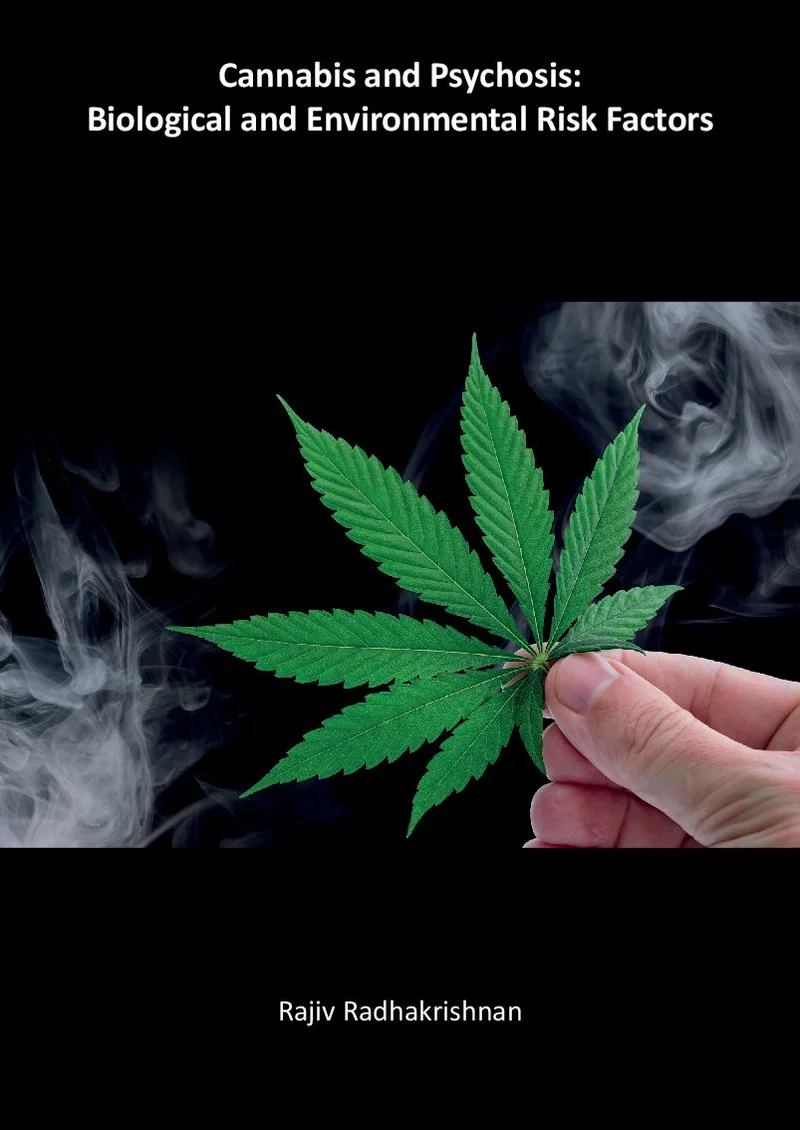


Cannabis and Psychosis
In chapter 1, a brief overview of research literature on the association between cannabis and psychosis was provided. I cover epidemiological studies examining the association between cannabis use and psychosis, efforts to define the cannabis-psychosis risk syndrome, biological risk factors, interaction between environmental and biological risk factors and examination of whether the relationship between cannabis use and psychosis is causal. Finally, the aims and outline of the thesis were presented.
Chapter 2 reviews the literature on cannabis-psychosis risk syndrome, including concepts of schizotypy and clinical-high risk (CHR) and examines their association with cannabis use. The review identified that while cannabis use increases the risk of conversion to psychosis in schizotypy and CHR, it also resulted in lower negative schizotypy, social anhedonia, and better social functioning. These paradoxical effects may partly explain the counter-intuitive finding of high rates of cannabis use among the CHR population.
In Chapter 3, I examined whether cannabis-psychosis risk can be identified by experimental, laboratory challenge-studies. Using Iomazenil, a GABA inverse-agonist, I showed that pharmacologically-induced GABA deficit increased the psychosis-like effects of delta-9 tetrahyrocannabinol (THC), the main psychoactive ingredient in cannabis. This challenge paradigm offers the opportunity to test cannabis-psychosis risk at the individual participant level.
While cannabis-psychosis risk has predominantly been defined in terms of positive psychotic symptoms, cognitive deficits, especially those related to verbal memory have been shown to be significantly impacted in schizophrenia.
In Chapter 4, I examined whether THC impairs verbal memory similar to that in schizophrenia and may hence serve as a laboratory challenge paradigm that identifies risk. I found that THC impairs encoding of information but not retrieval, at variance to that seen in schizophrenia.
Since the effects of THC are mediated via the cannabinoid CB1 receptor, in Chapter 5, I examined the effects of age, gender and body-mass index on CB1 receptor availability. CB1 receptors were found to be higher at younger age, providing a biological mechanism that explains why adolescents may be more vulnerable to the effects of cannabis.
Given the cognitive effects of cannabis, I examined the effects of cannabis on brain synaptic density using [11C]UCB-J PET imaging in Chapter 6. I found that chronic, heavy cannabis use was associated with lower hippocampal synaptic density and this correlated with lower verbal memory performance. Given the presence of lower hippocampal synaptic density in schizophrenia as well, this brain region may hence serve as a point of convergence of cannabis-psychosis risk.
In Chapter 7, I examined the interaction between environmental risk factors and familial affective liability in influencing cannabis-psychosis risk in the NEMESIS cohort. I found that childhood adversity and cannabis use, and to a lesser extent urbanicity, displayed greater-than-additive risk if there was also evidence of familial affective liability; and the risk was progressively greater across increasing levels of psychosis severity (none, attenuated psychosis, clinical psychosis) complicating affective dysregulation.
Finally, in Chapter 8 I examined the mediational relationship between cannabis use, anxiety/depressive symptoms and psychotic experience, and showed that there is a bidirectional relationship between cannabis use, anxiety/depressive symptoms and psychotic experiences. However, the contribution of anxiety/depressive symptoms as a mediator was greater than that of cannabis.
| Publicatiedatum | 27 november 2026 |
| Universiteit | Universiteit Maastricht |
| Auteur | RAJIV RADHAKRISHNAN |