Quinten Steffens
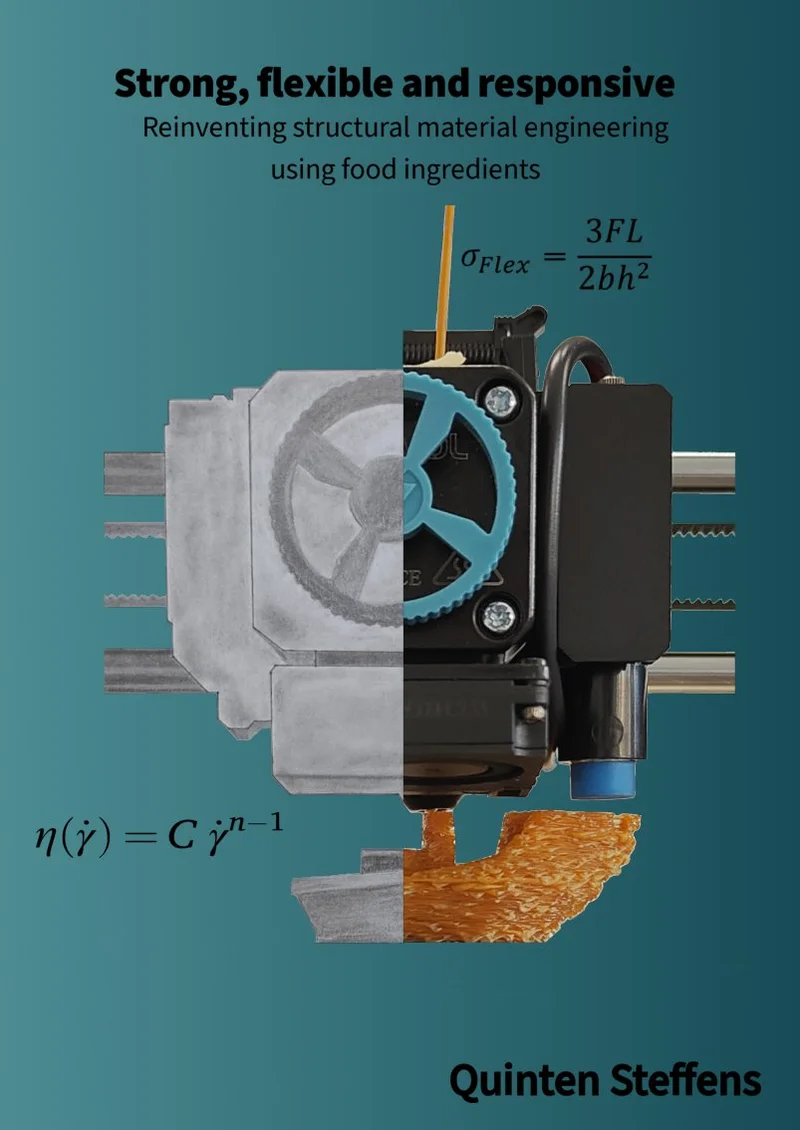


Strong, flexible and responsive
Edible materials offer many opportunities outside of direct consumption as they are renewable, break down in the environment and can be digested safely. Formulating and processing edible materials can yield composite materials that have the capability to revolutionize applications that benefit human health, society and environment. These composites can be used in simple applications, such as packaging, or in further assemblies to construct edible robots and robotics foods. Based on bioinspired soft robotic design principles, two main composite groups of interest were identified: one stiff and rigid, and one soft and flexible. However, a rational approach to design and evaluate performance of these edible composites was still missing. At the composite level, structure-function relationships can be used to describe material behaviour. Understanding the relation between formulation, processing and final product properties therefore allows design guidelines to be derived for edible composite materials.
The aims of this thesis were therefore to identify how food process engineering and manufacturing technologies could be combined to fabricate rigid and flexible composites with desired material characteristics and identify how characterization methods could be applied to study the performance of food materials in non-food applications.
In Chapter 2 an edible composite was developed which was suitable for fabrication of stiff and rigid objects using Fused Deposition Modelling 3D printing. Material requirements were established based on literature data. Properties of the composite were modulated by adjusting the formulation and processing, to match those requirements. The corn protein zein was found to be a suitable candidate due to its thermoplastic property, suitable melt flow behaviour, sintering ability and ability to be processed without crosslinking. Addition of plasticizer was required to decrease brittleness of the zein composite. To obtain homogeneous dispersion of the plasticizer, a pelletisation process was developed which involved solubilisation, drying and grinding. The glass transition temperature of the composite was identified as a crucial parameter for controlling its processability. Based on thermal and rheological measurements of zein composites plasticized to different degrees a state diagram with iso-viscosity lines was established, which mapped the material state as function of solids content and temperature allowing the identification of suitable processing temperatures, e.g. for 3D printing. A Fused Deposition Modelling 3D printer was subsequently modified to be able to utilise pelletized materials as feedstock. The zein composite pellets were subsequently utilized to fabricate several demonstrator models, demonstrating that overhang angles up to 45° could be achieved and that no postprocessing was required to stabilize the object after printing. This study proved the feasibility of fused deposition modelling 3D printing with edible thermoplastic protein composites.
In Chapter 3 the aim was to improve the compatibility of the zein composite with standardized FDM equipment that uses filament as feedstock in order to allow for easy adaptation in the marketplace. Filaments are long strands of extruded material wound on a spool. To provide the composite with sufficient flexibility for this winding process, the flexibility of the composite developed in Chapter 2 needed to be improved. For this purpose, amphiphilic fatty acids were added to the formulation in addition to the hydrophilic plasticizer glycerol to reduce attractive forces between zein polymer molecules. This combination provided a synergistic effect on glass transition temperature, allowing the glass transition temperature to be reduced more than using just glycerol while maintaining phase compatibility. Furthermore, a relation between glass transition temperature and viscosity was found. After optimisation of the composite formulation, filament was produced on a pilot scale continuous extruder, providing evidence that upscaling to industrial scale is possible. A standard, commercial FDM 3D printer was used to fabricate several objects with complex geometries using the manufactured zein filament to demonstrate its printing qualities. Additionally, mechanical properties of 3D printed specimens was compared to references made with common 3D printing plastics. This study showcased that thermoplastic protein filament can be produced on large scale and is compatible with commercial 3D printers, allowing more users to utilize the edible filament.
In Chapter 4 the focus shifted to the development of soft and flexible edible hydrogels. The extensional properties of single biopolymer network (SN), crosslinked network (CN) and interpenetrating network (IPN) hydrogels as function of plasticizer content were studied. To evaluate stress-strain relations under biaxial loading conditions a custom bulge test utilizing computer-vision deformation tracking was developed. Deformation of films during the bulge test was accurately matched using an ellipsoid shape function, which allowed calculation of stress-strain curves. For IPN hydrogels, plasticizer content was found to have a different effect on the stress-strain relation based on the deformation mode (uniaxial or biaxial). This highlights the importance of evaluating material properties under the type of stress loading relevant to the final application. Furthermore, IPN hydrogels were found to exhibit very high tensile strength. This study revealed that network structure and plasticization level could be used to modulate the tensile properties of hydrogel films.
In Chapter 5 the learnings from earlier chapters were reflected upon, general limitations were identified and directions for future research were provided. It was recommended to study the integration of the composites developed in this work in more complex assemblies to achieve a larger range of functionalities. To achieve this, the functionalities of the composites could be further extended through inclusion of active fillers, such as activated carbon to impart conductive properties. Additionally, the FDM process could be used to control the macroscale properties of objects fabricated using edible filaments, allowing the range of composite properties to be further extended.
The results of this thesis present a rational material science approach to formulating and processing edible composite materials with designed material properties. The insights will contribute to the advancement of the field of edible robots and robotic foods, and beyond.
| Publicatiedatum | 23 oktober 2026 |
| Universiteit | Wageningen University |
| Auteur | Quinten Steffens |
| DOI nummer | 10.18174/681733 |