Share this project
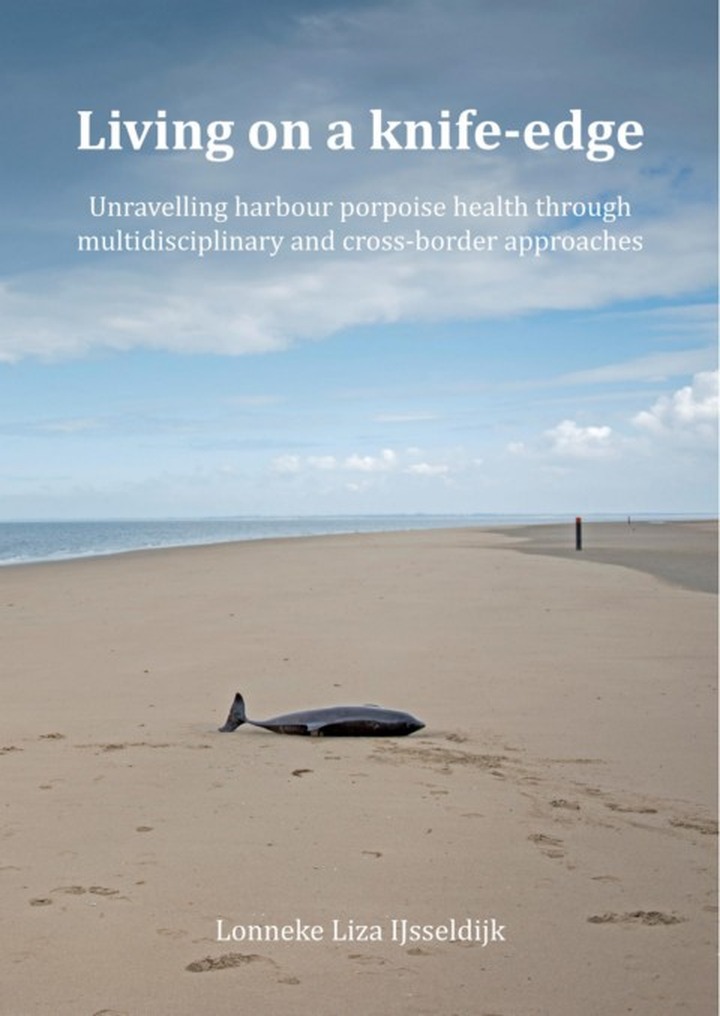
Lonneke Ijsseldijk
Universiteit Utrecht
Publication date: 2 november 2021
University: Universiteit Utrecht
Living on a knife-edge
Summary
Harbour porpoises are charismatic and protected animals. This has resulted in a wide social, scientific and political interest into their health and well-being. Porpoises are an integral part of the marine food web, and along with their general distribution, they are the focus species in many environmental monitoring and research programs. These programs generally focus on increasing knowledge about human-related marine activities that may affect harbour porpoise populations, and serve the ultimate goal of protecting and preserving harbour porpoises and their habitat.
The North Sea is one of the busiest marine areas in the world, where many human activities, often simultaneously, take place. Porpoises are the most common whale species in the North Sea, with an estimated number of about 350,000 individuals. A high number of porpoises combined with a lot of human activities means that many animals are exposed to various threats. These include fishing activities, chemical pollution and underwater noise from different sources, such as shipping, seismic surveys and unexploded ordnance detonations. In addition, there is an increase in the number of offshore activities for the construction of wind farms in recent years. Also, the large-scale effects of climate change, such as changes in prey quantity and quality, are becoming more and more apparent. Individual and cumulative stressors threaten the immediate survival of individual animals, but may also cause non-lethal effects that affect population viability and environmental health.
One fifth of the North Sea porpoise population lives on the Dutch Continental Shelf. A high number of porpoise sightings in The Netherlands corresponds to a high number of strandings. Stranding recording is done by volunteers of the stranding network. A proportion of the stranded animals is examined post-mortem. This is to determine their cause of death and health status. Samples are also taken for additional research, including on reproduction, diet and contaminants. These investigations should provide insight into the health of the population and, in a broader sense, into the health of the environment. However, the available knowledge about threats and the effects on harbour porpoises is still incomplete. This is mainly because most research and management efforts have been conducted at the national level. Cross-border and multidisciplinary approaches would provide a more accurate assessment of population and ecosystem health. After all, harbour porpoises do not stick to national borders. Combining multiple disciplines, including biology, ecology, toxicology, epidemiology and pathology, provides opportunities to develop methods and measurement tools that aid in the determination and assessment of the most relevant natural and human-related threats to harbour porpoises in the North Sea. The ambition of this thesis is to contribute to this development and its application.
In chapter 1, the harbour porpoise is introduced as one of the smallest whales (cetaceans), and a warm-blooded marine mammal fully adapted to live in the ocean. That does not come without its challenges, particularly with regard to energetics. Porpoises are opportunistic predators and require continuous food to meet their energetic requirements. They need up to 10% of their own body weight in prey per day. From a metabolic point of view, this gives them little 'leeway': they live on a knife-edge.
Chapter 2 describes the current knowledge gaps, future pressures or threats, and essential indicators for continuing research on harbour porpoises in the North Sea. This overview was gained by collecting the most recent expert knowledge on threats to harbour porpoises, using the so-called Delphi approach. The expert panel consisted of people working in various disciplines of harbour porpoise research and management and from all countries around the North Sea. The three main knowledge gaps listed by the experts were bycatch, population dynamics, and cumulative effects of multiple stressors. Bycatch was rated as the top concern for harbour porpoises over the next 20 years, followed by chemical and noise pollution, respectively. The most essential indicators, which can serve as means to monitor these threats and health status of harbour porpoises in the future, were: research into cause of death, distribution, abundance, habitat use and diet composition. These results guided the themes for the following research chapters of this thesis.
A large-scale and international research effort followed (chapter 3), investigating spatio-temporal patterns in population dynamics of harbour porpoises in the North Sea area. A dataset containing 16,181 stranding records over 28 years, obtained from national stranding networks of five countries adjacent to the North Sea, was analysed. There was a high density of new-born porpoises on the North Sea coasts of Denmark and Germany. This indicates that this area is important during and after the calving season. There were large numbers of young males found along the southern North Sea area, including on the Dutch coast. This may be a sign that weaker animals in the population are mainly found in the southern parts of the North Sea. It could also indicate a wider distribution of the young males in particular. Since 1990, the number of strandings increased throughout the region. This was most apparent since 2005 in the southern parts of the North Sea and emphasises the need to focus the research specifically on this area.
Bycatch was listed as the main concern for harbour porpoises in the North Sea area (chapter 2) and thus became the focus of chapter 4. Bycatch numbers can be determined by onboard observers, remote electronic monitoring, and when fishermen voluntarily report this. All is, however, not systematically done. Necropsies on stranded animals can additionally provide insight into bycatch numbers. However, there are uncertainties when it comes to assessing bycatch in stranded cetaceans, mainly due to the lack of diagnostic tools specific for underwater suffocation. Through a literature study, 25 criteria were listed that are used in the assessment of bycatch in small cetacean species. The presence or absence of these parameters were scored on harbour porpoises obtained from gillnets in The Netherlands (n=12). Presence of 'superficial incisions', 'circling marks' and 'recent food' were seen in the vast majority of the bycatch cases. Other criteria, such as 'pulmonary oedema', 'emphysema' and 'organ congestion' were also commonly diagnosed. These are, however, nonspecific features of underwater suffocation and commonly seen in cetaceans dying from other causes. It was striking that the previous parameters 'a favourable state of health', 'the absence of disease' and 'a good nutritional status' did not apply to the majority of the porpoises in this study. Cases with such notable pathological findings are often excluded as bycatch when assessing stranded animals. This can lead to an underestimation of the proportion of stranded porpoises which die as a result of fishery activities.
The next study (chapter 5) focused on chemical pollution, in particular the transfer of contaminants in harbour porpoises. Persistent organic pollutants, such as polychlorinated biphenyls (PCBs), bioaccumulate in marine ecosystems. Top predators, such as the harbour porpoise, therefore contain high levels of PCBs in their tissues. Analyses were done on different tissues, including blubber, of porpoises from all age groups. PCBs passed to foetuses via the umbilical cord, however, concentrations increase significantly after birth through lactation. Milk mainly contains lower halogenated substances, which are more toxic. New-born porpoises are thus exposed to high levels of pollutants already early in life. Of all animals, 38.5% had PCB concentrations that exceeded a threshold value for negative health effects. This was especially true for adult males (92.3%). Adult females had relatively low PCB levels (10.5%) because they were able to get rid of them through lactation. In addition, it became clear that nutritional stress leads to a higher release of PCBs through the milk, which resulted in a greater potential for toxicity in calves of nutritionally stressed females.
In a large body of literature it is advocated that reproductive disorders in small cetaceans are mainly due to PCB contamination. However, in chapter 5 reproductive disorders were observed in a minority of adult females. Therefore, the following study (chapter 6) focused on the life history parameters: age at sexual maturity, pregnancy rates and foetal growth of female harbour porpoises. It was investigated whether adult females abandon investment in their foetus when they themselves are in poor physical condition or experience deteriorating environmental conditions, presumably to prioritise their own survival. Data on disease, diet, fat reserves and reproductive status were collected from post-mortem examined porpoises. This was combined with life history parameters from sixteen other harbour porpoise habitats gained from literature. These data were then correlated with variables reflecting environmental condition: mean energy density of prey from local diets, cumulative human impact and PCB load. Maternal nutritional status was found to have significant effects on foetal size. Females in poor health had a lower chance of being pregnant and generally did not sustain the pregnancy throughout gestation. Pregnancy rates were best explained by the energy density of local prey: the group of mature females of populations which fed on fish of higher energy levels had a higher percentage of pregnancies compared to the group of mature females who fed on low caloric prey. The quality of the prey eaten therefore seems to determine the reproductive success of this species.
In addition to anthropogenic threats, natural stressors may influence the health and survival of harbour porpoises. Grey seals (Halichoerus grypus) are abundant in the North Sea. Previously, this marine mammal was revealed as a large-scale predator of harbour porpoises. But not all seals are successful in their predation attack. Using forensic microbiological approaches, in chapter 7 is described that the bite wounds inflicted by grey seals, from which harbour porpoises do not immediately die, can result in chronic and ultimately fatal infections, namely with the bacterium Neisseria animaloris.
Anthropogenic and other causes of death identified in stranded harbour porpoises from 2008-2019 were further described and analysed. Chapter 8 focussed mainly on the directly human-related threats such as bycatch and hearing loss. Bycatch was the largest human-related cause of death (17%), mainly affecting young animals. Peak periods were March and September, although there was a sign of a downward trend over the years. Other human-related causes of death were rarely diagnosed: trauma presumably from collisions with ships (2%), and ingestion and entanglement in marine litter (0.3%). Inner ear abnormalities could only be examined in fifty porpoises, but were found in two of these. Infectious diseases was by far the largest cause of death category (32.5%), mainly for adult porpoises. Grey seal attacks were the suspected cause of death for 23.5%. Previously, more acute predation cases were noted, while recently more harbour porpoises with pathology associated with interactions that did not immediately lead to death were diagnosed. Two-thirds of the neonates died following problems during pregnancy, birth or lactation. Acute starvation or severe emaciation of unknown origin (non-neonates) was the most important finding for a further 8.6% of all stranded harbour porpoises examined.
Assessing patterns in biological, ecological and pathological profiles of individuals is very important to detect changes over time and space. However, chapter 8 lacked an analytically robust approach. Therefore, and as a final study, an exploratory analysis was performed of combined biological, ecological and pathological data collected during post-mortem investigations (chapter 9). Using different statistical methods, the most relevant post-mortem findings to categorise and predict the cause of death were determined. Three clusters were defined, with age class, respiratory pathology and multiple-organ inflammation being the most important in the subdivision of those clusters. External incisions (from fishing nets), grey seal wounds, and nutritional status were the main variables for predicting causes of death. Other data, such as plants and litter in the stomach, iron accumulation in the liver and sex, may be considered uninformative to explain or predict cause of death. These data analyses were based on a large number of individuals and thus make it possible to detect robust trends that are unaffected by small, individual variation. The database should be completed by adding information on chemical pollution, among other factors. The results can then provide information about threats that are relevant at the population level.
Extensive research of stranded, dead harbour porpoises provides us with a general understanding of their biology, demographics and ecology, and also gives us insight into the health of these animals and threats to individuals and populations. Currently, monitoring of stranded animals is one of the very few ways to effectively investigate and quantify the effects of new, emerging and cumulative stressors on harbour porpoises. Continuing this monitoring work will be crucial to gain and increase knowledge about the state of the animals and the North Sea. This knowledge is vital in order to take targeted measures that aid in the protection and conservation of harbour porpoises in our waters.
See also these dissertations

Lorena Grondhuis Palacios
Sexual health care in prostate cancer
13 februari 2024
Universiteit Leiden
Open Ebook
Lonneke Van Vught
Sepsis in the intensive care unit
14 oktober 2016
Universiteit van Amsterdam
Open Ebook
Lodewijk Vijftigschild
Novel diagnostic and therapeutic opportunities for Cystic Fibrosis
7 december 2016
Universiteit Utrecht
Open Ebook
Liset Elstgeest
Nutrition and depressive symptoms: a longitudinal perspective
4 juli 2019
Vrije Universiteit Amsterdam
Open Ebook
Lisanne Van Dessel
Unravelling the Genomic Landscape of Metastatic Prostate Cancer
1 juni 2021
Erasmus Universiteit Rotterdam
Open Ebook
Lisa Caulley
Evidence-Based Strategies to Support Diagnostic and Therapeutic Decision-Making in Endocrine Tumors of the Head and Neck
20 december 2022
Erasmus Universiteit Rotterdam
Open EbookWe print for the following universities