Jeroen Veraart
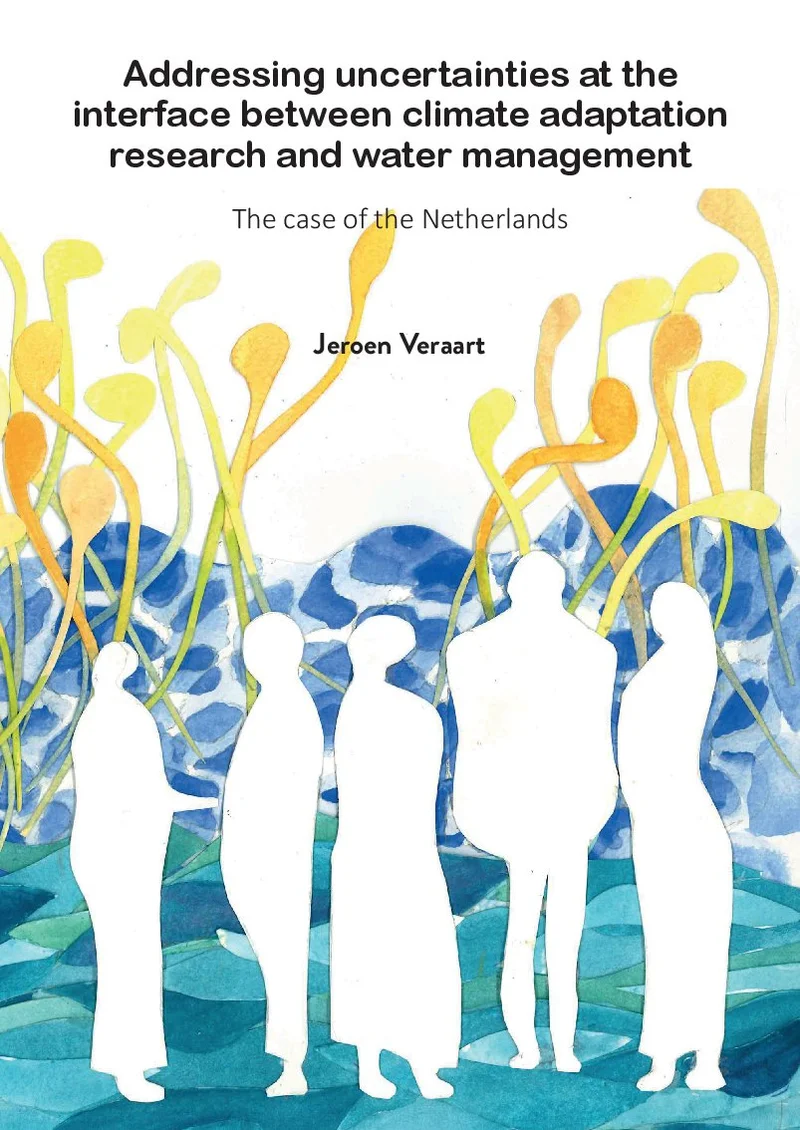


Addressing uncertainties at the interface between climate adaptation research and water management
SUMMARY Introduction Human activities have caused global warming, with surface temperatures rising 1.1°C above pre-industrial levels. In the Netherlands, climate change necessitates changes in infrastructure, water systems, and spatial planning. Water managers and researchers are developing climate adaptation strategies, yet decision-making at the interface between research and practice is complicated by various forms of uncertainty. This thesis investigates how uncertainties are addressed in interactions between climate adaptation research and Dutch water management, particularly within co-existing and nested science-policy interfaces across spatial scales. The research, as described in this dissertation, aims to improve knowledge exchange and enhance the usability of climate adaptation research. Research Questions • Q1: What are the type and role of uncertainties at the interface between climate adaptation research and Dutch water management? • Q2: What is the role of boundary objects in knowledge exchange between climate adaptation research and water management across spatial scales? • Q3: What are strategies to address uncertainties from the perspectives of research and practice respectively, and how to enhance the usability of climate adaptation research in water management? Approach and framework A nested longitudinal case study was conducted, examining freshwater management in the Netherlands in detail from 2000 to 2014, with a forward-looking outlook extending to 2025. Eight interfaces were examined at national, regional (Rhine-Meuse-Scheldt Estuaries), and local (farm-level water supply) scales. The study engaged professionals involved in strategic freshwater planning, primarily within the Delta Programme and national climate research initiatives. The thesis applies a typology of uncertainty - ontic, epistemic, and ambiguity - to analyse how each type of uncertainty is addressed in decision making regarding climate adaptation strategies. In this way, specific strategies can be identified that are employed by the various knowledge systems (water managers, researchers, water users), as well as the mechanisms through which knowledge is exchanged among them. The dissertation comprises an introduction (Chapter 1), a case study description (Chapter 2), and six chapters detailing the research (Chapter 2-8). It concludes with a synthesis (Chapter 9). Chapter 2 presents a temporal analysis of the evolving interface between climate adaptation research and water management policy across spatial scales. It traces the trajectory of developments from the inception of Dutch climate research in the 1960s, the formulation of climate adaptation strategies in the period 2000- 2014 and subsequent developments between 2014 and 2025. The chapter explores how uncertainties were addressed in these three periods and what the boundary role of climate scenarios and climate adaptation was. Across three decades climate scenarios and the term climate adaptation have repeatedly functioned as boundary objects, but their roles have evolved in line with institutional shifts, scientific developments, and changing governance priorities. The chapter concludes that, although the exchange of knowledge between the domains of water management and climate adaptation research has strengthened over time, significant challenges remain in formulating cross-sectoral climate adaptation strategies. Furthermore, the current approaches to address epistemic and ontic uncertainties, as well as ambiguity within nested interfaces, could be improved. Chapter 3 analyses a survey assessing stakeholder and expert perceptions of climate change impacts on Dutch water management that was conducted in 2001. Consensus was found regarding flood risks, with alignment in knowledge, values, and objectives. However, divergent views from experts and stakeholders proved present regarding freshwater resource impacts, complicating prioritization, and climate adaptation strategy formulation. The chapter concludes that climate adaptation scientists in 2001 increasingly engaged stakeholders in co-designing regional and sectoral adaptation strategies. Chapter 4 conceptualizes “climate proofing” as a strategic framework integrating risk thresholds, uncertainty, and long-term resilience. It contrasts the foundational paradigm - based on hydrological stationarity and structural measures - with adaptive water management, which embraces uncertainties and the precautionary principle. Climate proofing also involves scenario-based visioning, experimental learning, and evaluation through decision-support tools. Boundary organizations are identified as essential for facilitating science-policy-society dialogue. The chapter positions climate proofing as a dynamic, interdisciplinary process aimed at enhancing adaptive capacity and resilience. Chapter 5 investigates how scientific uncertainties were managed during decision-making processes concerning water quality and climate adaptation in the Rhine-Meuse-Scheldt estuaries, with a focus on Lake Volkerak-Zoom (2000–2014). Based on interviews, participant observation and literature research the status of scientific knowledge was classified as negotiated, disputed and uncertain. It highlights the role of consensus about knowledge, shaped collaboratively by scientists, water managers, NGOs, and agricultural stakeholders. One proposed water management strategy - introducing saline tidal inflow in lake Volkerak-Zoom - was based on this shared understanding. However, an unexpected decline in algal blooms, introduced new ontic uncertainty and ambiguities regarding future climate-proof freshwater supply for agriculture revealed persistent. The chapter identifies strategies for addressing uncertainties, such as joint fact-finding, deadline setting, and applying the no-regret principle. Tailor-made approaches were recommended to improve the usability and legitimacy of results of climate adaptation research in complex governance settings. Chapter 6 examines socio-economic factors shaping the adoption of innovative drainage systems in the southwestern part of the Netherlands in response to anticipated reductions in freshwater availability due to climate change and salinisation. Researchers and farmers conducted three pilot experiments collaboratively to evaluate the hydrological performance of novel drainage systems. Complementary, a participatory feasibility assessment and a regional drought risk survey were undertaken. Findings indicate that while participating farmers gained confidence in the reliability of the recent technologies, broader stakeholder scepticism remained. Factors such as reliable access to freshwater, supportive legislative conditions, economic incentives (subsidies) and sector specific crop planning strategies were identified as critical to adoption of the investigated drainage systems at farm level, alongside with addressing uncertainties by improving agro-hydrological modelling. These elements collectively influenced farmers’ willingness and capacity to implement the investigated drainage measures. Chapter 7 presents a comparative case study examining the adoption of Nature-based Solutions for food production and water resource management in both countries. Employing the Food System Approach, the analysis focuses on rainwater harvesting, innovative drainage systems and wastewater reuse. Although these technologies are technically feasible and socially acceptable, their implementation is constrained by a range of biophysical, technical, institutional, and socio-cultural barriers. Spatial information, co-produced with stakeholders, was identified as a pivotal enabler of adoption. The study highlights persistent ontic uncertainties in rendering spatially explicit scenarios for freshwater demand in the Netherlands based on national climate scenarios, due to limitations in data availability and quality. These ontic uncertainties and data limitations were a result of the difficulty to become spatial explicit about the future land use and the calculation of associated crop evaporation with the National Hydrological Model. Chapter 8 reflects on a decade of Dutch climate adaptation research by two large research programmes: Climate changes Spatial Planning (2004–2012) and Knowledge for Climate (2008–2014). These initiatives bridged science, policy, and practice, evolving from scenario driven impact assessments to integrated approaches from local and regional spatial scale. The interdisciplinary and demand-driven nature of these programs enriched both fundamental and applied climate adaptation research in the Netherlands. Within this 10-year period, a trend emerges. Climate impact assessments based at national scale are increasingly being complemented by ‘bottom-up’ approaches that enrich top-down approaches with experiences from local en regional level. This shift is evident in the development of climate adaptation strategies in different sectors, including water management. Conclusions (chapter 9) Over the past 25 years, Dutch climate adaptation research has evolved significantly, developing strategic approaches to address ontic, epistemic, and ambiguity-related uncertainties. Early efforts focused on climate scenario development and exploratory research, supported by national programmes such as Climate Changes Spatial Planning and Knowledge for Climate. These initiatives fostered knowledge exchange about climate adaptation in water management across national, regional, and local scales, though uncertainties about climate change remained. Events like the 2018 drought and 2021 Meuse floods heightened urgency, while ontic uncertainties regarding sea level rise remained persistent. Tensions between nature-based and engineered solutions further intensified ambiguity. Furthermore, the current approaches to address epistemic and ontic uncertainties, as well as ambiguity within nested interfaces, could be improved. Since 1990, climate scenarios and the concept of climate adaptation have repeatedly functioned as boundary objects in the Netherlands, but their bridging roles have shifted over time. They played a significant role in facilitating communication across disciplines and governance levels in Dutch water management. Before 2000, IPCC climate scenarios linked climate science to international climate policies, but those scenarios were too coarse for Dutch water management. The first KNMI scenarios (1998) functioned as a boundary object between climate research and water management at national level. Between 2000 and 2014, KNMI scenarios became formally embedded in national water policy, and climate adaptation emerged also as a boundary object. The term climate proofing supported strategic planning but often lacked operational clarity for local stakeholders. Climate scenarios became more usable by the development of climate services such as scenarios for river discharge and additional drought indicators, yet water users continued to struggle with interpretation of these climate services. Institutional reforms, including KNMI scenario updates and Delta Programme reviews, reflect progress in embedding climate knowledge into water governance. Despite formal mechanisms for climate scenario updates and climate adaptation strategy reviews as a way to address uncertainties, the interface reverted partially to a sectoral structure. The emergence of the Sea Level Rise Knowledge Programme (KP-SLR) in 2019 highlighted renewed urgency in face of ontic uncertainties. Although the exchange of knowledge with support of both boundary objects between water management and climate adaptation research has strengthened over time, significant challenges remain in formulating cross-sectoral climate adaptation strategies for both water management and land use. A range of strategies emerged to address uncertainties since 2000 at the interface of climate adaptation research and water management. Epistemic approaches were common at national and regional levels, whereas developing strategies at the interface with water users was more complex due to the diversity of stakeholders involved. Shared strategies between climate adaptation research and water management included joint fact-finding, narrowing solution options, and integrating experimental knowledge. Water managers and policy makers also employed procedural tools such as Environmental Impact Assessments and decision deadlines - less common in research settings. Recognizing the distinction between scientific and negotiated knowledge is essential for improving the usability of climate adaptation research. This dissertation’s nested longitudinal case study illustrates how climate adaptation research has navigated diverse knowledge needs. The Delta Programme’s three national strategies - flood risk management, freshwater supply, and spatial adaptation - are tailored to regions like the Southwestern Delta and Wadden Sea, yet local stakeholders require more context-specific insights. Despite increased integration between research and practice, a coordinated strategy to embed transdisciplinary knowledge into research programming strategies is still lacking. Final recommendations emphasize the need for context-sensitive research design, expanded joint fact-finding, and early stakeholder engagement. Strengthening climate services and aligning formal procedures with exploratory monitoring can enhance adaptive capacity in water management. Future case study research should adopt structured, comparative methodologies to support transformational adaptation across scales.
| Publicatiedatum | 21 september 2026 |
| Universiteit | Wageningen University |
| Auteur | Jeroen Veraart |
| Order nummer | 18454 |