Deborah Martinez
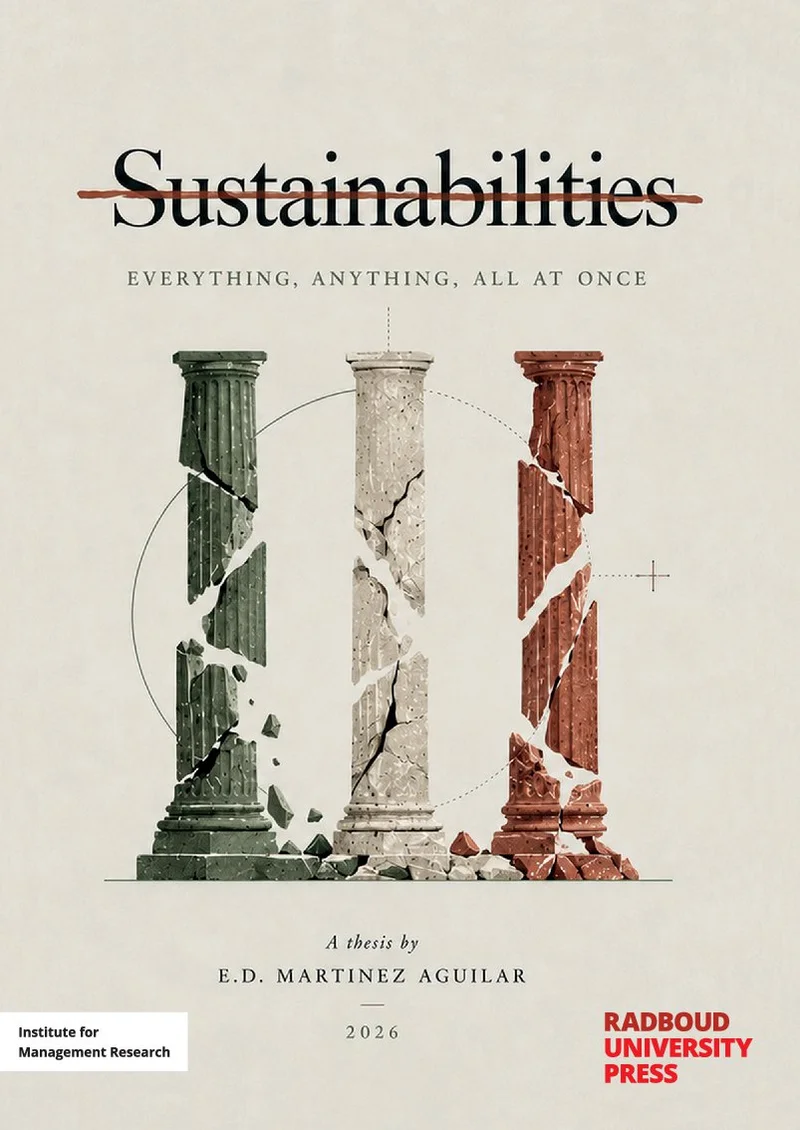


SUSTAINABILITIES
This thesis arose from the question: What is sustainability? The term conventionally has being used as a promise for the future of humanity and the planet. A discourse seemingly capable of harmonizing economic, social, and environmental dimensions into a complete, balanced and intelligible unit (Purvis, 2018). It speaks in the language of peace, continuity, inclusive development, and shared purpose. Yet this apparent universalism conceals the exclusions, uncertainties, and contradictions that destabilize its foundations when examined closely. Sustainability does not fix meaning; it disperses it while performing an illusion of coherence. It does not resolve tensions; it organizes them. Therefore, what appears as unity is, in reality, an effect constructed through hierarchies, silences, and continuous acts of closure and discursive supplementation. A façade that allows the sign to give rise not to one, but to multiple sustainabilities.
This dissertation emerges precisely at the point of tension between the multiple forms that sustainability takes and their persistent temptation to treat the term as if it possessed a single, essential, and static meaning. And confronted with the scope of this challenge, we found ourselves compelled to expand our examination of sustainability discourses beyond the limits of our initial inquiry. For if sustainability is traversed by what it excludes and refuses to name, if it proliferates through plural and often incompatible definitions, then the question is not what sustainability is, but how it is constructed so as to become possible. Addressing this new question required moving beyond what is visible in its stated articulations, and instead also examining what must be excluded for sustainability to appear coherent, the discursive architectures that authorize certain interpretations while marginalizing others, and what surfaces when these tensions remain unresolved. In short, it required studying its structures, internal logics, and the articulatory practices that stabilize some meanings while deferring or erasing others.
It was at this juncture that the need for a different mode of reading became evident, one not limited to describing the discourse of sustainability, but capable of interrogating its conditions of possibility. To trace how sustainability coheres through exclusions, deferrals, and contingent acts of articulation, we needed an analytical approach attentive to instability, ambiguity, and the productivity of absence. For this reason, the dissertation adopts deconstruction, not as a scientific method but as a reading practice that unfolds within discourse itself. Our use of deconstruction follows Derrida’s foundational work, supplemented by Laclau and Mouffe’s discourse theory, critical and postcolonial approaches, and social systems theory. Together, these perspectives rendered sustainabilities legible as discursive practices of contingent, iterable, and partial articulations structured through differentiation, equivalence, deferral, and power.
The need to further develop our reading approach leads directly to Chapter 2, which elaborates deconstruction as an aporetic and iterable double‑reading practice composed of two movements (Derrida, 1967; Kakoliris, 2018): a Double Commentary, which reconstructs dominant and marginalized meanings within a discourse; and a Disruptive Reading, which unsettles the binary structures that sustain those meanings. This approach does not yield stable interpretations; rather, it opens discourses to their own conditions of impossibility, revealing meaning as always deferred, contested, and contingent. While the chapter contributes to the literature by proposing a model of deconstructive reading, its main function in this thesis is to familiarize the reader with deconstruction not only as a reading strategy, but also as an ethical commitment and a conceptual framework, approaches that are used in our research.
Having presented the lens through which we read sustainability, Chapter 3 turns to the articulation of the term across ten institutional texts, ranging from global frameworks such as the Brundtland report (WCED, 1987) to religious articulations like Laudato Si’ (Francis, 2015) and corporate agendas such as Vision 2050 (WBCSD,2021) The chapter shows that despite the term’s signification "fuzziness” (Shi, 2019), sustainability achieves coherence and legitimacy through backcasting‑oriented architectures that stage stability by projecting envisioned futures, diagnosing present conditions, and prescribing pathways for action. These architectures delimit what can be thought, said, and enacted in the name of sustainability, revealing tendencies toward closure, imposition, and deferral, mechanisms that allow sustainability to motivate action and designate responsibilities, but in doing so also impose priorities, silence and marginalize certain voices, tensions, and elements, making certain futures unthinkable.
To examine more closely the mechanisms that produce these closures, Chapter 4 analyzes two texts: one hegemonic, Agenda 2030 (UN, 2015), and one counter‑hegemonic, Care Society (ECLAC, 2022). The aim was to determine whether the tendencies toward closure identified earlier persist across different ontologies and geographies, including those historically marginalized within dominant sustainability discourses (Stegemann and Ossewaarde, 2018). Our reading demonstrates that, despite their contrasting positions, both texts rely on similar logics of stabilization. They organize meaning through what this dissertation conceptualizes as Organizational Arrangements (OA) and Moral Articulations (MA). Two discursive mechanisms that we explored through the articulation of "Leave No One Behind" and "Care", proving how they authorize certain interpretations while marginalizing others, mask contradictions, and defer alterity. The findings suggest that closure is not confined to hegemonic discourse, challenging the assumption that alternative or peripheral voices inherently provide more open or inclusive articulations of sustainability. Rather, the analysis shows that closure operates as a structural condition of sustainability discourse itself.
This finding highlighted the need to investigate whether sustainability can be articulated through alternative architectures and logics. Consequently, Chapter 5 turns to populist discourse as a site where stability is both mobilized and unsettled, offering a space to examine possibilities for articulating sustainability otherwise. Through an analysis of political speeches by two ideologically divergent Latin American politicians: Javier Milei (Argentina), positioned on the right, and Claudia Sheinbaum (Mexico), positioned on the left, we found that sustainability does not appear as a fixed and closed discourse. Yet it also does not behave like the “empty,” “floating,” or ambiguous signifiers typically associated with populist articulation (Laclau, 1985; Zicman de Barros, 2025; Rovira, 2013). Instead, sustainability emerges as an undecidable articulatory strategy (Derrida 1967; Laclau 1985; Luhmann 1995), one that exploits the apparent ideological mappings of both Libertarianism and the Fourth Transformation to be simultaneously affirmed and denied, mobilized and contested. And in doing so, we saw how sustainability can operate as a pharmakon: remedy and poison, opening and closing meaning at once. This does not resolve the term's tensions; it intensifies them, shifting our understanding of sustainability from a sign of closure to a field of possibilities.
In this way, the journey through these chapters brought us back to the initial question, not to repeat it, but because our readings had transformed what the question itself could mean. What, then, can sustainabilities be? Chapter 6 explores the different approaches and interpretations advanced by a collective group of researchers (Martínez, 2025), whose findings reinforce our discoveries that what appears as a stable concept is instead one that is structured, supplemented, differentiated, and perpetually open to revision. Sustainability thus emerges as something that requires a collective and ongoing effort to read through its closures and search for new openings.
Taken together, the chapters in this thesis show that sustainability is not problematic because it lacks a stable meaning, nor because it remains too open. Its tension lies precisely in the interplay between both. Sustainability is neither a fixed concept nor only an open one, but an articulation continually produced through the dynamic between logocentric closure and radical openness. What appears as coherence is not inherent; it is constructed through operations that delimit what can count as sustainability and, just as importantly, what must fall outside its boundaries.
Closures, therefore, are not distortions or ideological misuses to be corrected. They are the very conditions that make sustainability possible. Without closure, there would be no object to reference, no policy to design, no future to imagine. Yet this necessity is also a limitation: every closure is partial and inherently unstable. It depends on exclusions it cannot fully erase, on meanings deferred rather than resolved, and on traces that continue to haunt the discourse. Sustainability is thus accompanied by what it cannot contain, shaped as much by its absences as by its affirmations. And because of this, we found sustainability functions as a pharmakon, a signifier that simultaneously stabilizes and destabilizes meaning. Closure acts as a remedy by making sustainability communicable and actionable; yet it also operates as poison by foreclosing alternatives, silencing alterity, and imposing limits that defer tensions and incoherences. This dual movement does not alternate. It coexists. Sustainability does not shift from coherence to contradiction; it inhabits both at once, as there is a trace always already haunting it.
The contribution of this dissertation thus lies not in resolving this aporia but in making it visible and inescapable through deconstructive readings. Readings that are committed to tracing how sustainability is continuously stabilized and destabilized across discourses, challenging the assumption that its contradictions can be overcome through clearer definitions, broader inclusion, or stronger consensus. Such efforts, however well-intentioned, often reproduce the logocentric impulse they seek to escape: the desire to secure meaning, fix boundaries, and close the field of interpretation. Instead, this dissertation demonstrates that sustainability’s inconsistencies and exclusions are not obstacles but expressions of its undecidability, where it can be everything, anything, all at once.
Rather than paralyzing meaning, this undecidability makes it possible. Sustainability can be articulated only because it cannot be fully determined. Every attempt to fix its meaning remains provisional, exposed to displacement, and open to rearticulation. For this reason, sustainability must be read sous rature: written because it cannot be avoided, crossed out because it never fully coincides with itself. This reorientation carries significant implications. If sustainability cannot be closed without violence, without excluding other ways of knowing, being, and organizing life, then its potential does not lie in achieving coherence, but in remaining attentive to its own limits. Yet such openness is not a romantic ideal. It does not eliminate conflict, nor does it guarantee inclusiveness, and it certainly does not reverse power asymmetries. On the contrary, openness exposes us to undecidability: to the necessity of acting without final grounds, deciding without certainty, and engaging with meanings that cannot be stabilized once and for all. In this interplay, inclusion becomes an act of decision, and power asymmetries become structured conditions that must be continually negotiated.
To read sustainability from a deconstructive approach, therefore, becomes necessary—not to refine its definition, supplement it, or expand its inclusiveness. It is to remain with its tensions, recognizing that what sustainability excludes is constitutive of what it claims to be. Radical openness is not a solution; it is a commitment to resist the impulse to stabilize meaning once and for all. This dissertation does not close the study of sustainability. It returns it to the reader otherwise: unsettled, fragmented, and irreducibly open. What is offered is not a conclusion but an invitation to engage sustainability as a field in which meaning is never secured, where presence always carries the trace of absence, and where every articulation bears the imprint of what it leaves behind. To read, then, is not to resolve these dynamics but to inhabit them.
| Publicatiedatum | 14 december 2026 |
| Universiteit | Radboud Universiteit |
| Auteur | Deborah Martinez |
| ISBN nummer | 9789465152981 |
| DOI nummer | 10.54195/9789465152981 |