Daan van Keulen
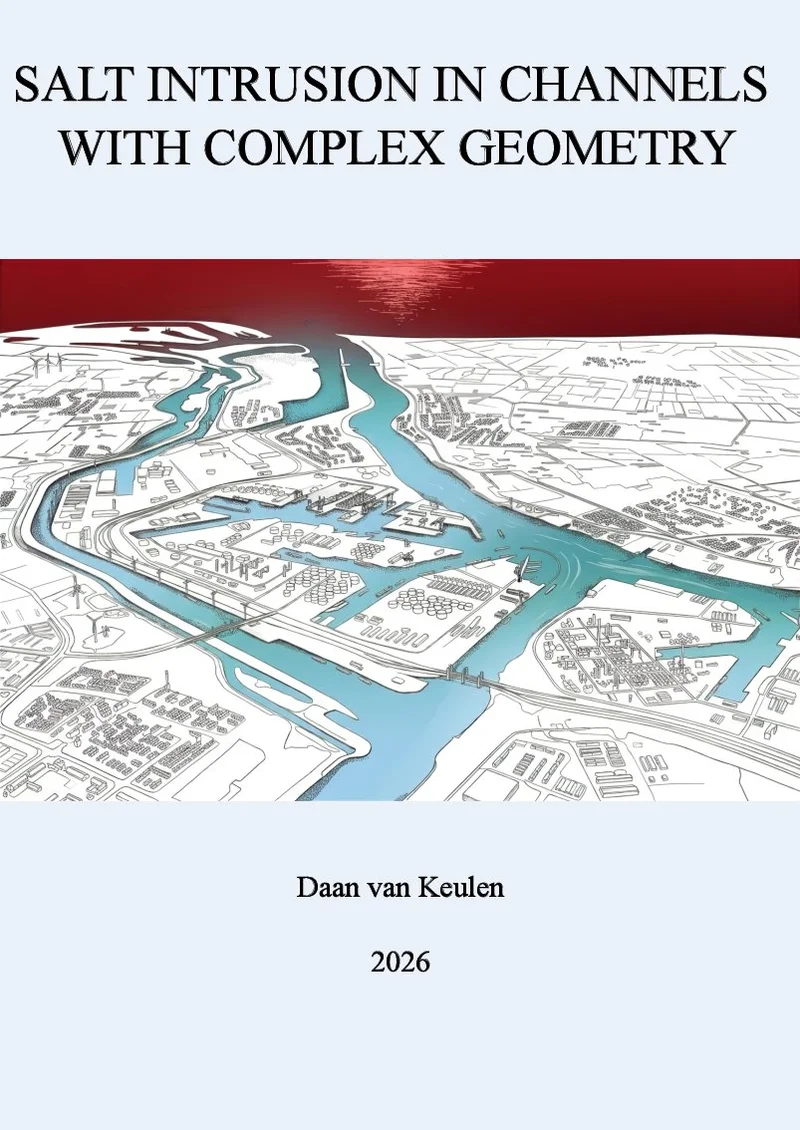


SALT INTRUSION IN CHANNELS WITH COMPLEX GEOMETRY
This thesis advances the mechanistic understanding of salt dispersion in estuaries by examining how tidal trapping, density-driven exchange, and bathymetric discontinuities contribute to up-estuary salt transport. Through a combination of idealised numerical modelling, field observations, 3D simulations, and data analysis, the work clarifies ambiguities in existing parameterisations, provides new insights into the processes governing salt intrusion and contributes to fast predictive tools.
Chapter 1 sets out to motivate and describe the objectives of this thesis. Chapter 2 revisits classical tidal-trapping theory by isolating the additional up-estuary salt transport generated by exchange with dead-end side basins using an idealised model set-up. Building on earlier work, a conceptual framework is introduced to analyse the individual contributions of different channel–trap exchange mechanisms to the up-estuary salt transport in the main channel. It is shown that the additional up-estuary salt transport due to the advective exchange associated with the barotropic filling and emptying of traps (advective out-of-phase exchange) produces the strongest dispersive effect when the velocity phase difference between the trap and the main channel down-estuary of the trap reaches 1/2π. This behaviour aligns with early theoretical formulations, but contradicts more recent, widely used, analytical models that neglect differences in tidal-velocity phasing between both sides of the trap, as discussed in Chapter 3. Extending the model to include both barotropic and diffusive channel-trap exchange reveals that their combined effect cannot be represented as a simple superposition, and that a Péclet number specific to tidal trapping provides an appropriate measure to evaluate the relative importance of the two mechanisms.
Chapter 4 of the thesis examines the contribution of harbour basins to the dispersion of salt in the Rhine-Meuse estuary. Observations and 3D modelling show that channel–harbour exchange is dominated by density currents rather than by barotropic filling and emptying. The strength of this exchange varies strongly between harbours due to spatial differences in the tidal salinity range (the depth-averaged salinity variation over a tidal cycle) which controls the baroclinic pressure gradient between the main channel and the harbour. The salt transport resulting from the vertically sheared exchange was found to scales with the tidal salinity range raised to the power of 3/2, consistent with analytical expressions derived from theory. Applying the tidal-trapping framework tested in Chapter 2 to individual harbours in the Rhine-Meuse estuary reveals that their net contribution to up-estuary salt transport is modest (5–10%), and that the largest harbours contribute least because they are located where the tidal salinity range is weakest. A new parameterisation for density-driven tidal trapping is proposed, showing that the resulting dispersive effect depends explicitly on the subtidal salinity gradient. This new parametrisation reflects the baroclinic nature of the exchange mechanism, unlike classical formulations for tidal trapping which are independent of the subtidal salinity gradient.
Chapter 5 investigates how the steepness of the bed slope in the transition area between maintained bed levels, which resemble a stair-case-like bathymetry, influences salt intrusion. Numerical experiments with idealised bathymetries (inspired by bathymetries such as that of the Rotterdam Waterway) show that the slope of this transition zone strongly affects the salt intrusion length. For weakly to partially stratified estuaries, milder slopes, that create an overall deeper estuary reduce salt intrusion, while steeper slopes increase it. The remarkable observation that a mild slope can reduce salt intrusion is explained by two processes: (1) enhanced tidal reflection at sharp depth transitions reduces tidal currents and vertical mixing, strengthening estuarine circulation; and (2) steep slopes promote frontal formation near the depth transition, which locally enhances the estuarine circulation and strengthens the tidal-oscillatory salt transport upstream of the frontal region. The dynamics in the idealised bathymetric set-up resemble observations in the New Meuse, where a salinity front forms near the depth transition, a strong increase in tidal-oscillatory salt transport is observed upstream of this transition, and the limited spring–neap modulation of the salt intrusion length matches the model behaviour for sharp bed slopes.
In Chapter 6 explores whether a hybrid-harmonic regression method can be reformulated to provide fast short-to-medium-term salinity predictions at monitoring stations. The proposed model embeds a semi-empirical salinity formulation into harmonic base functions and accounts for surge-induced variability and unsteadiness in the salt balance. Applied to the well-mixed Ems and Scheldt estuaries, the method yields accurate predictions and provides physically interpretable best-fit parameters, including a new interpretation of the Van der Burgh constant. However, the approach requires sufficient training data, does not resolve the vertical salinity structure, and assumes a single dominant longitudinal axis, limiting its applicability in stratified or geometrically complex systems such as the Rhine-Meuse. For such systems, (physics informed) machine-learning models are likely more suitable for obtaining accurate salinity predictions at monitoring stations.
Overall, this dissertation resolves key ambiguities in existing parameterisations of tidal trapping, provides new analytical tools to assess the dispersive influence of density-driven tidal trapping, clarifies why larger basins do not necessarily contribute more than smaller ones, and identifies bathymetric steps as a dominant control on salt intrusion in engineered estuaries. Together, these findings advance the mechanistic understanding of tidal-dispersion processes in geometrically complex estuaries and support the development of reliable predictive tools for estuarine salinity.
| Publicatiedatum | 14 oktober 2026 |
| Universiteit | Wageningen University |
| Auteur | Daan van Keulen |
| DOI nummer | 10.18174/681660 |