Anirudh Gaurang Gudlavalleti
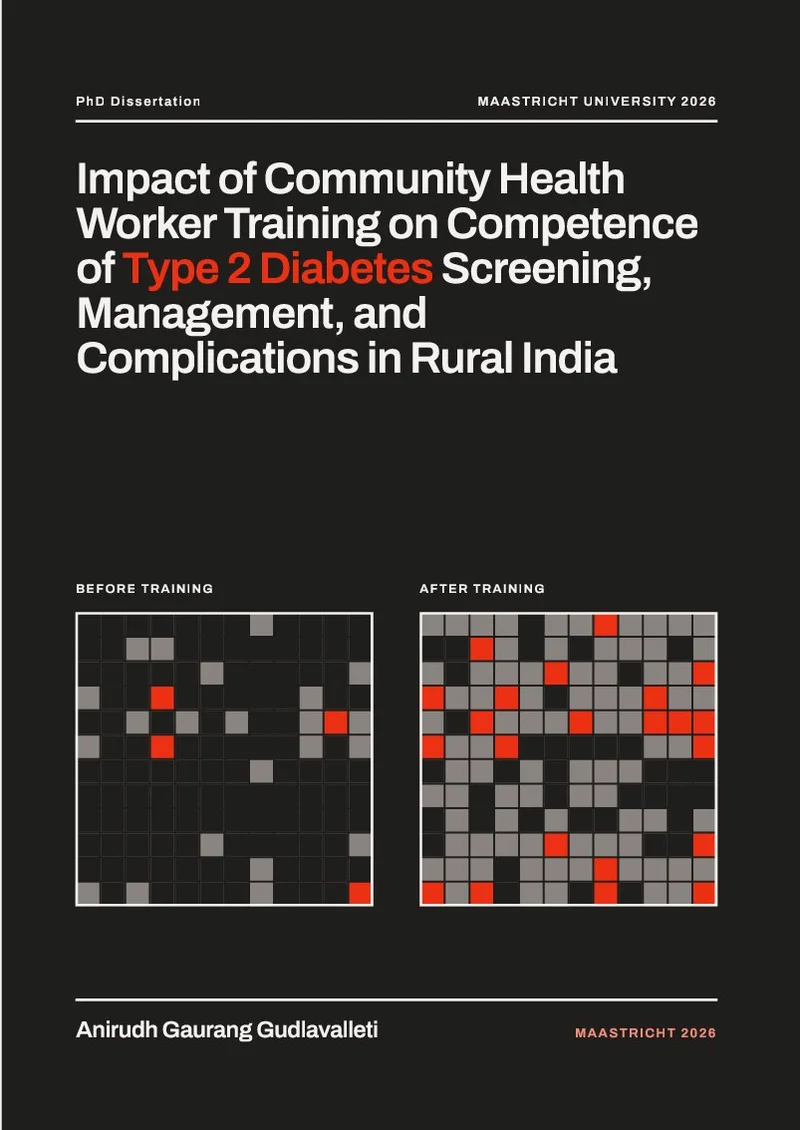


IMPACT OF COMMUNITY HEALTH WORKER TRAINING ON COMPETENCE OF TYPE 2 DIABETES SCREENING, MANAGEMENT, AND COMPLICATIONS IN RURAL INDIA
The first chapter of this Thesis provided an overview of the background of the research questions. It highlighted that Type 2 diabetes mellitus is becoming a major global public health concern. According to the International Diabetes Federation’s 2025 atlas, an estimated 589 million adults worldwide will have diabetes, with low- and middle-income countries carrying the highest burden of the disease. India has the second-largest number of people living with diabetes globally, with the Indian Council of Medical Research’s (ICMR) ICMR-INDIAB study reporting a weighted national prevalence of 11.4%, which equates to nearly 101 million people. In India, the South Indian state Telangana has a higher-than-average diabetes prevalence, with an increasing burden in rural areas, where over 60% of the state's population resides. Rural populations face multiple barriers to diabetes care, such as geographical inaccessibility, affordability of treatment, limited availability of trained health personnel, and socio-cultural barriers (acceptability) that discourage health-seeking behaviour. To address these barriers, the Indian government institutionalised a cadre of community health workers known as Accredited Social Health Activists (ASHA) in 2005, now numbering over one million nationwide. Although their roles in diabetes screening, enumeration, referral, and follow-up under the National Programme for Prevention and Control of Non-Communicable Diseases (NP-NCD) were well-defined, existing evidence identified significant gaps in their knowledge and practice. After reviewing available literature, we identified a significant gap: very few randomised controlled trials have evaluated the impact of a structured Community Health Worker (CHW) competency training program on diabetes care pathways and patient level outcomes in rural low- and middle-income countries (LMICs), particularly in India. Our dissertation addressed that gap by following a structured research process, progressing from needs assessment to protocol development, systematic review, trial implementation, and synthesis to evaluate the effectiveness.
The second chapter outlined the protocol for the systematic review. Utilising the PICOTS framework, the protocol specified an assessment of how CHW training interventions impacted diabetes management outcomes in low- and middle-income countries (LMICs), with glycosylated haemoglobin (HbA1c) designated as the primary outcome. The review included randomised and non-randomised controlled trials, as well as observational studies, with comprehensive searches conducted across PubMed, Ovid MEDLINE, Scopus, EBMR, and CINAHL for studies published from January 2000 to December 2023. Two independent reviewers undertook the screening of studies and data extraction, with a third reviewer designated to resolve disagreements. Quality assessment was conducted utilising the Cochrane Risk of Bias 2 tool and the ROBINS-I framework. The results were presented in a PRISMA flow diagram, and the protocol was registered with PROSPERO (CRD42022341717) and subsequently published. This established a transparent, prespecified framework for the subsequent systematic review.
The third chapter summarised the results of the systematic review. An extensive search identified 3,387 studies, of which 69 were selected for full-text evaluation. Ultimately, four studies were considered eligible for inclusion. Of these, three were randomised controlled trials (RCTs), and one was an observational stepped-wedge study, involving totally 1,000 patients. The certainty of the studies was low to moderate, with their risk of bias ranging from some concerns to serious concerns. Only one of the three RCTs reported a statistically significant effect, with a mean reduction of -0.24% (p=0.001), although HbA1c was not its primary outcome, and the sample included normoglycaemic and prediabetic individuals as well as patients with diabetes. The remaining studies reported reductions in HbA1c values; however, these reductions were not statistically significant between the groups. In line with the Cochrane handbook's guidelines, a meta-analysis was not conducted due to the small number of studies and the variability in design and interventions. The review concluded that training CHWs in diabetes management reported limited, mostly indirect, effects on improving HbA1c control in LMIC settings and recommended more rigorous trials with clearer reporting of training content, intensity, and well-defined outcomes.
The fourth chapter described the study protocol for the cluster randomised controlled trial (RCT). Type 2 diabetes mellitus poses a significant burden of mortality and disability globally and within India. In this latter country, the extensive rural population has limited access to healthcare services. Accredited Social Health Activists (ASHAs), initially trained for maternal and infant care, were identified as a cadre requiring improved competency training to improve diabetes screening and management. The protocol described the RCT to be conducted across eight health centres in the Ranga Reddy district of Telangana. A training tool was developed from existing resources, with a focus on areas needing improvement, and delivered over six months through classroom-style training. The baseline and post-intervention competencies were evaluated using a validated questionnaire administered by trained public health experts. The trial was registered with the Clinical Trials Registry of India (CTRI/2020/07/026828) and received ethical approval from the Institutional Ethics Committee of the Indian Institute of Public Health Hyderabad (IIPHH/TRCIEC/218/2020).
The fifth chapter described the baseline cross-sectional survey conducted before the trial to assess the existing knowledge and practice behaviour competencies of the CHWs responsible for diabetes management in Telangana. Using a customised questionnaire developed with input from diabetes and public health experts, government officials, and CHWs, the study assessed the competencies of 275 CHWs. The study reported significant gaps in knowledge (95% inadequate) and practice behaviours (97% inadequate). The areas of insufficiency broadly represent core competencies needed for diabetes management: diabetes diagnosis and referral, HbA1c testing, diabetes diet, self-management, screening for microvascular complications, and diabetes risk assessment. Notably, a relatively large number of CHWs reported correct practice behaviours despite providing incorrect answers to related knowledge questions across many domains, such as referral to health centres and adequate self-management. These results guided us in developing and refining the content and design of our structured training intervention (detailed in the next chapter).
The sixth chapter presented the findings of the cluster randomised controlled trial involving 240 CHWs across eight health centres. Of these, 113 were in the intervention arm and 127 in the control arm. The intervention included a structured, competency-based training module on diabetes and diabetic retinopathy (DR), including their screening and referral pathways. Throughout the study, CHWs screened over 25,000 individuals, the diagnostic testing rate decreased from 49.5% to 48.9% in the control arm. Confirmed diabetes detection rate increased from 51.6% to 78.4% in the intervention arm compared with 48.8% to 49.7% in the control arm, with a DiD odds ratio of 3.27 (95% CI 2.73 to 3.92; p<0.001). The DR screening rate increased from 7.3% to 13.8% in the intervention arm while decreasing from 5.9% to 3.9% in the control arm, with a DiD odds ratio of 3.10 (95% CI 1.06 to 9.07; p=0.039). The intervention health centres reported an 86% increase in patient-level diabetes screening coverage and a 183% increase in new diagnoses. These results highlight that a structured, competency-based CHW training program significantly enhances diabetes and DR screening and referral outcomes compared to standard care in India.
The seventh chapter discussed all our research findings in relation to the existing literature. Our baseline study had reported gaps in CHW knowledge and practice behaviours, while our intervention study reported that the training effectively addressed these gaps rather than just making minor improvements. Compared with existing CHW training focused on HbA1c, our trial provided additional evidence on process and clinical outcomes across the screening and referral pathway. It used a cluster randomised controlled trial design with difference-in differences analysis and was integrated into the government’s NP-NCD structure. Methodological strengths were the study design, a low intraclass correlation coefficient, and robust sensitivity analyses. The limitations included the confined district setting, a small number of clusters, potential secular confounding from COVID-19-related changes in health seeking behaviour, and the lack of longer-term outcomes, such as glycaemic control or complication incidence.
The policy implications involved a recommendation for the government to assess the feasibility of scaling this structured CHW training across the state-level NP-NCD guidelines for rural healthcare centres, utilising existing cadres and supervisory structures. The priorities for future research include long-term outcome evaluations, implementation research on optimal training frequency and delivery modes, and cost-effectiveness assessments of the training, as well as process and clinical outcomes.
The eighth chapter reflected on the impact of our research. Combining the baseline competency assessment, the system review, and the cluster randomised controlled trial, this Thesis presented a continuum of care from needs assessment to training design, implementation, and evaluation across multiple levels of the health system. Our trial was one of the few cluster randomised controlled trials to link CHW competency gains to patient-level outcomes for both diabetes and DR in a real-world setting. The results provided scientific evidence for integrating a structured, competency-based CHW training into both national and state-level NCD programmes across Indian states and similar LMICs. The outputs comprised a registered systematic review protocol with PROSPERO, a published study protocol, a baseline CHW competency assessment, and both a systematic review and an intervention trial submitted to JMIR Diabetes and PLOS Global Health, respectively. All of these collectively demonstrated that structured, carefully implemented training can improve CHW competencies and the capacity of existing healthcare systems to detect and manage diabetes and DR in low-resource settings.
| Publicatiedatum | 8 september 2026 |
| Universiteit | Universiteit Maastricht |
| Auteur | Anirudh Gaurang Gudlavalleti |