Share this project
Monika Rech
Universiteit Maastricht
Publication date: 23 mei 2018
University: Universiteit Maastricht
ISBN: 978-94-6295-898-2
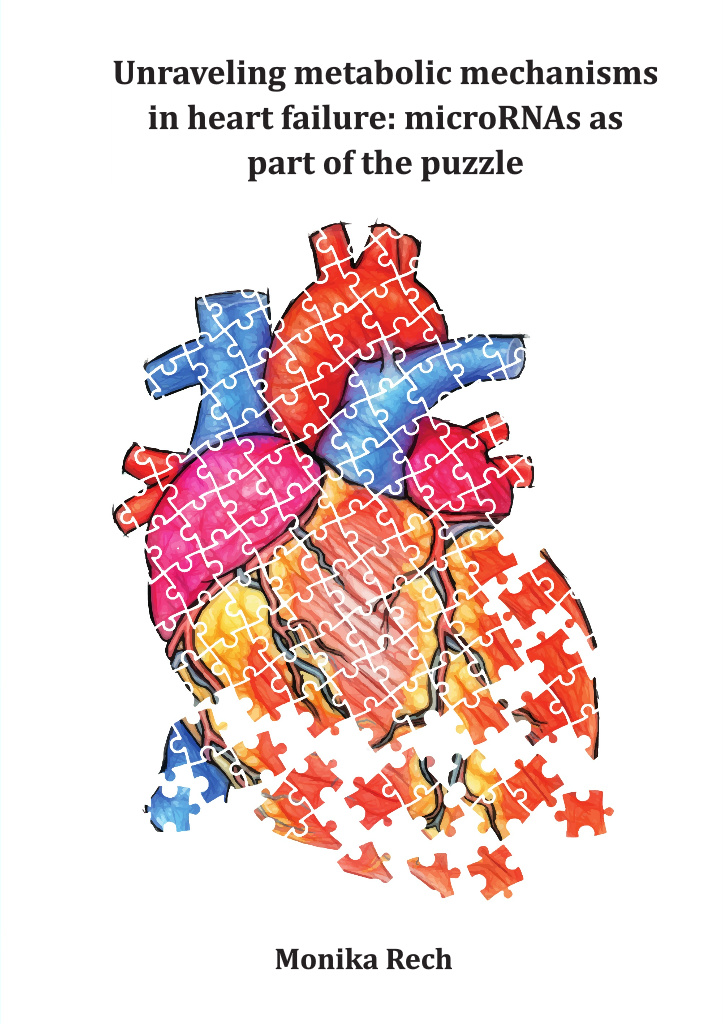
Unraveling metabolic mechanisms in heart failure: microRNAs as part of the puzzle
Summary
Heart failure is a major global health problem with an estimated prevalence of over 37.7 million individuals globally. Its prevalence is dramatically projected to increase in western society due to the aging of the population and better survival of acute cardiovascular incidents. This underlines the importance if conducting research in order to develop new treatment strategies to lower the burden of heart failure globally. Despite advances in care management, the prognosis of heart failure is still poor and carries substantial risk of morbidity and mortality. Moreover, heart failure can develop from several pathological conditions and this makes the understanding of the molecular mechanisms behind it a crucial milestone. One of the main goals of the cardiology community is to identify new molecules as targets for clinical therapies and diagnostic strategies. To this end, the aim of this thesis was to extend our understanding on the mechanistic roles of novel molecules, microRNAs, in cardiac function in health and disease. MicroRNAs are small molecules that have a central role in the regulation of gene expression in our body. They might serve as potential therapeutic targets for heart failure and a large number of diseases.
To address the aim of this work in chapter 2a we summarize the current knowledge and the advances on microRNA in the field of cardiology with special focus on heart failure caused by the most common systemic diseases like obesity and diabetes. Then in chapter 2b we propose a view on how basic researchers and clinicians could work together with this knowledge to improve diagnosis and treatment of heart failure patients.
A major determinant of cardiac function is cardiomyocyte metabolism. Cardiomyocyte nutrient metabolism can be affected by a number of conditions during health and disease and changes are known to impact on cardiac function and lead to heart failure. Chapter 3 presents a protocol for researchers to mimic the conditions that disturb the metabolism of the cardiomyocyte and gain understanding of the processes that lead to cardiac dysfunction. In this same context, in chapter 4 of this thesis, we investigated the role of a microRNA-targeting drug in balancing cardiomyocyte metabolism and cardiac function in mice. This drug targets a specific microRNA, miR-103/107, and is currently being tested in patients in a clinical trial for liver disease and diabetes. We specifically investigated the yet unexplored effects of this proposed anti-diabetic drug on cardiac function. Unfortunately, upon chronic administration, we found a detrimental effect of this microRNA-targeting drug on cardiac metabolism which led to cardiac dysfunction. This knowledge is important in the context of safety in the current clinical trials with diabetic patients, but also for the development of potential therapeutic strategies for heart failure. Interestingly, we also found effects of the inhibition of this microRNA on blood pressure responses in mice (chapter 5). Our data encourage further research to address the inhibition of this microRNA as a therapeutic strategy.
Besides cardiomyocyte dysfunction, comorbidity-induced changes in other cell types contribute to cardiac remodeling and failure, including immune cells. In chapter 6 of this thesis we investigated the contribution of immune cells during the development of metabolic syndrome-induced diastolic dysfunction. Importantly, we have set up a new model of heart failure that recapitulates the most common comorbidities in the western society that are pre-diabetes, obesity and pressure overload. Our data indicate that an inflammatory microRNA, miR-155, contributes to metabolic remodeling and cardiac dysfunction in the setting of the metabolic syndrome and systemic inflammation.
In conclusion, this thesis presents important biological contributions of microRNAs in heart failure. These findings extend the current knowledge on heart failure pathophysiology and may contribute to the development of novel therapeutic strategies.
See also these dissertations


Mengxiao Sun
The role of service plants in promoting biological pest control and pollination in Xinjiang pear
3 juni 2026
Wageningen University
Open Ebook
Sherril Phyllis
Wild meat in the city, health risks and implications
1 juni 2026
Wageningen University
Open Ebook
Wisenave Arulvasan
Developing Breathomics for Clinical Application
29 mei 2026
Universiteit Maastricht
Open Ebook


Evi Koene
Pharmacological inhibition of ketohexokinase in inborn and acquired metabolic disorders
4 juni 2026
Universiteit Maastricht
Open Ebook
Isaura Wayop
Enhancing antimicrobial stewardship in veterinary medicine
4 juli 2025
Universiteit Utrecht
Open Ebook
Lidongsheng Xing
Identifying Sound Features from Brain Activity
6 mei 2026
Universiteit Maastricht
Open Ebook
Hongchen Li
Microbubble Oscillations and Microstreaming
21 mei 2026
Erasmus Universiteit Rotterdam
Open EbookWe print for the following universities