Share this project
Martijn De Vries
Overig
Publication date: 1 december 2023
University: Overig
ISBN: 978-94-6469-646-2
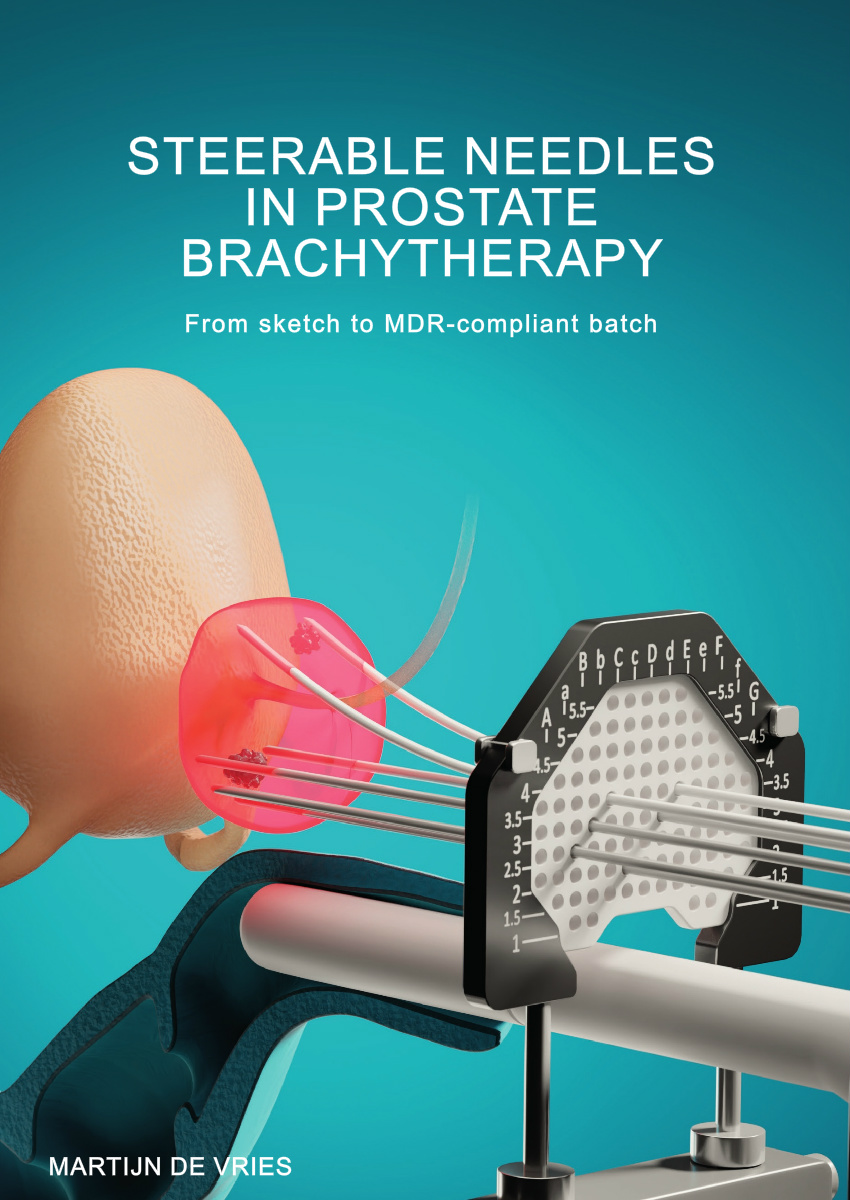
Steerable needles in prostate brachytherapy
Summary
Brachytherapy (BT) is a safe and effective technique to treat prostate cancer that has not spread outside the prostate gland (localised prostate cancer). Nonetheless, in current clinical practice hazards can arise in positioning the BT needles in the prostate for the purpose of irradiation. Intermediate structures can block access to the prostate and needle-tissue interactions can result in unexpected deflection of the needle inserted. These situations are undesirable because they lead to insufficient radiation of the prostate, potentially reducing treatment outcomes or resulting in patients being excluded from this treatment. Various techniques have been proposed in the literature to mitigate these hazards, of which actively steerable needles are considered very promising. However, manufacturing and cleaning such designs is often complex, while the low rigidity of the needles limits control and increases the risk of buckling when penetrating stiffer tissues such as the prostate. These factors have made implementation in BT protocols challenging.
A unique steering technique is proposed in this thesis that aims to provide improved flexibility in needle positioning while preserving high needle rigidity. This design solution will enable adaptive tip steering to control the unexpected deflections in tissue and create controlled curved needle trajectories to circumvent intermediate structures. Our investigation focuses on determining if our solution can facilitate the use of high-dose-rate (HDR) BT for a wider range of patients. Furthermore, we explore two other steering techniques for BT of prostate and brain cancers.
The hazards in literature were studied to define the requirements for the proposed steering solution, focusing on: (1) limitations in accessing the prostate gland due to interference from the pelvic bone, commonly referred to as pubic arch interference (PAI), and (2) errors in needle positioning. The level of PAI has been quantified to determine the magnitude of steering required and clinical guidelines gave us insight into the limits of the maximum allowable needle positioning error. In addition, datasets of patients with a large prostate volume have been analysed because this group of patients is traditionally expected to be at higher risk of PAI. These patients are frequently rejected in advance from undergoing BT. Contrary to the probability reported in literature, we found no clear relation between prostate volume and PAI. Our analysis showed that the level of PAI varied between patients ranging from no restriction to a significant level of access limitation. This variation implies that the current approach may exclude patients who could potentially be eligible, resulting in false positive outcomes. The findings of this study encouraged the more intraoperative approach with increased flexibility in needle positioning provided by our steering solution.
Prototypes of the needle design have been developed and tested in phantoms and ex-vivo tissue. Results showed that the steerable needle has similar targeting accuracy as the conventional rigid HDR BT needle, while adding the ability to insert the needle along a curved trajectory. A preclinical validation test was performed in the clinical setting by experienced physicians in the field of BT with the steerable needles and a developed prostate phantom. The planning of curved trajectories to circumvent the pubic arch was easily accomplished, and the implantation of steerable needles yielded successful results. There was an excellent consistency observed between the pre,- and post-implant treatment plans. This experiment provided compelling evidence that steerable needles can effectively achieve a highly conformal dose distribution in the prostate.
We completed all the necessary steps to conduct the first in human trial using this non CE-marked medical device. We compiled the Investigational Medical Device Dossier (IMDD) in accordance with the Medical Device Regulation 2017/745 (MDR) to ensure the safe application of the steerable needle in human patients.
This thesis presents a unique steerable needle that is ready for clinical investigation, with experiments and geometric and dosimetric analyses demonstrating the added value of this instrument in BT approaches. The design solution provides the physician improved control and flexibility in needle positioning to ensure a more intraoperative and patient-specific approach. Consequently, this breakthrough enables HDR BT as a treatment option for prostate cancer patients that are currently considered non-eligible because of a large prostate and/or PAI. Simple adjustments to the design parameters allow the steering principle to be used for other medical applications that may benefit from steerability.
See also these dissertations


Mengxiao Sun
The role of service plants in promoting biological pest control and pollination in Xinjiang pear
3 juni 2026
Wageningen University
Open Ebook
Sherril Phyllis
Wild meat in the city, health risks and implications
1 juni 2026
Wageningen University
Open Ebook
Wisenave Arulvasan
Developing Breathomics for Clinical Application
29 mei 2026
Universiteit Maastricht
Open Ebook


Evi Koene
Pharmacological inhibition of ketohexokinase in inborn and acquired metabolic disorders
4 juni 2026
Universiteit Maastricht
Open Ebook
Isaura Wayop
Enhancing antimicrobial stewardship in veterinary medicine
4 juli 2025
Universiteit Utrecht
Open Ebook
Lidongsheng Xing
Identifying Sound Features from Brain Activity
6 mei 2026
Universiteit Maastricht
Open Ebook
Hongchen Li
Microbubble Oscillations and Microstreaming
21 mei 2026
Erasmus Universiteit Rotterdam
Open EbookWe print for the following universities