Share this project
Martha Topete
Universiteit van Amsterdam
Publication date: 22 september 2023
University: Universiteit van Amsterdam
ISBN: 978-94-6469-415-4
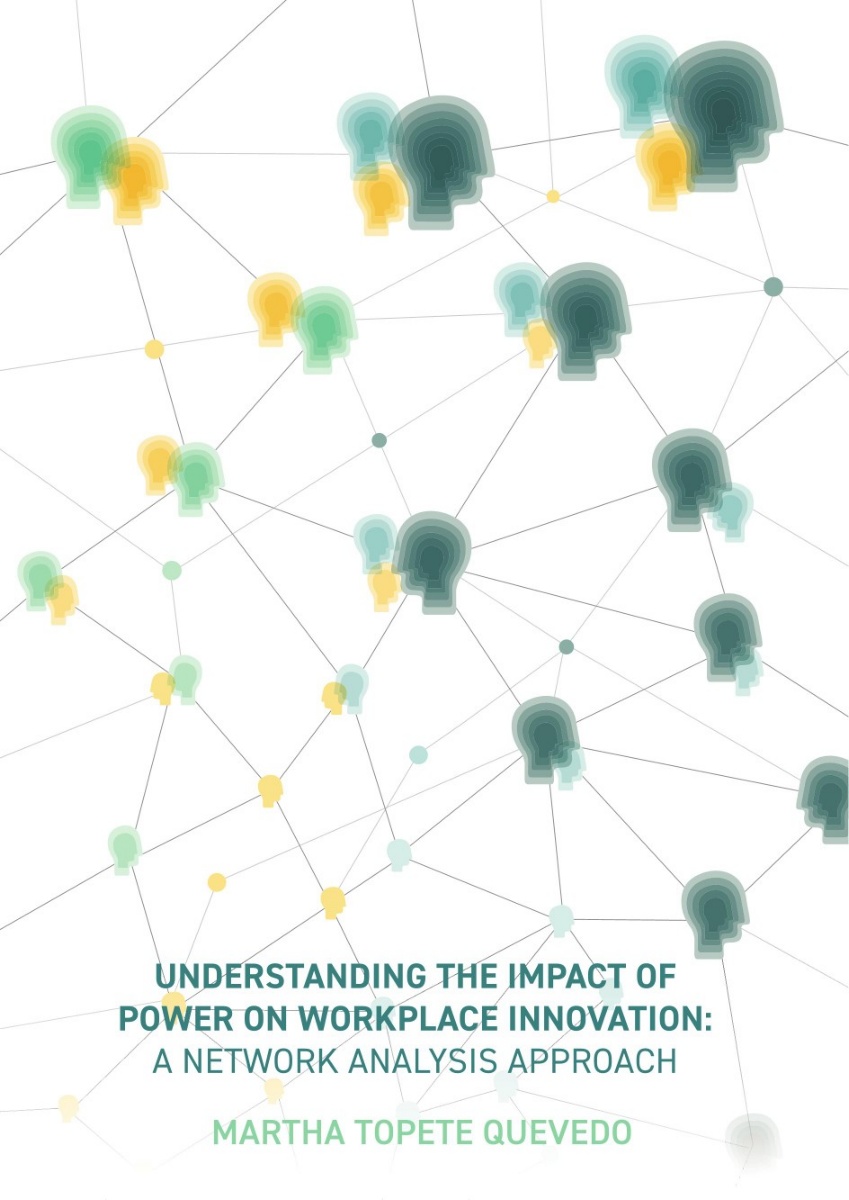
UNDERSTANDING THE IMPACT OF POWER ON WORKPLACE INNOVATION: A NETWORK ANALYSIS APPROACH
Summary
Workplace creativity and innovation are essential to organizations’ performance. While creativity refers to the generation of novel and useful ideas by employees, innovation also encompasses their implementation. Employees rarely innovate completely independently from other employees; they innovate with others or are influenced by their social environment. One crucial and pervasive characteristic of social relationships in the workplace is power, which refers to the ability to control or influence another’s thoughts, feelings, or behaviors. However, we do not know enough about how power impacts creativity and innovation. This dissertation aims to advance our knowledge regarding when and how power influences creativity and innovation. We do so in three essays (Chapters 2 to 4) where we examine the effects of different facets of power and informal social network structures on workplace creativity and innovation.
In Chapter 2, we developed a more nuanced view of the relationship between position power (i.e., the power deriving from individuals’ role in the organization) and joint creativity (i.e., the creative outcome of a pair of collaborators) by simultaneously assessing behavioral and psychological attributes of collaborations. We hypothesized that power struggles, or competition for formal and informal control, interact with position power to affect joint creativity via autonomous motivation—a motivation that is experienced as initiated and regulated by oneself. A laboratory experiment revealed that power struggles are problematic for high (and valuable for low) position power collaborations when striving for higher joint creativity and that this can be explained by the negative (positive) impact of power struggles on autonomous motivation. In addition, a subgroup analysis provided initial evidence that when power struggles are absent or infrequent, high position power collaborations may achieve higher joint creativity than low position power collaborations because of the positive impact of power on autonomous motivation.
In Chapter 3, we examined the moderating effect of Simmelian friendship ties (i.e., a type of informal social structure where two friends have a friend in common) on the relationship between power asymmetry (i.e., a formal social structure where employees have different hierarchical ranks) and joint creativity. We found support for our hypotheses in two intraorganizational network studies: joint creativity is higher in power asymmetric dyads than in power symmetric dyads and Simmelian friendship ties reduce the difference in joint creativity between the two types of dyads. Additional analyses provided some evidence for the theoretical mechanisms linked to power asymmetry and Simmelian friendship ties: conflict resolution and positive affect. Contrary to our expectations, however, Simmelian friendship ties also enhanced the creativity of power asymmetric dyads.
In Chapter 4, we investigated the interplay between focal actors’ perceived power over alters (i.e., the level of power they perceive to have over the people to whom they are connected) and brokering network positions (i.e., an open network structure where individuals are tied to disconnected individuals) on individual innovation. We found support for our theory in an intraorganizational network analysis: employees perceiving higher power over alters achieved higher innovation in brokering network positions than employees in these positions who perceived lower power over alters. For closed networks, while we expected employees perceiving lower power over others to be more innovative, we did not find individual innovation to differ according to employees’ power perceptions.
Overall, this dissertation shows that formal and perceived power help to explain variance in workplace creativity and innovation and that they interact with (affective and instrumental) social network structures to shape these outcomes. We extend prior research by showing that, at the dyadic level, the relationship between power (high levels or asymmetric) and joint creativity and individual innovation is not strictly negative. Working with colleagues who are (formally or perceived as) more or less powerful can, under certain conditions, enhance outcomes that are crucial to organizations’ performance. Similarly, high power collaborators can, with infrequent power struggles, achieve creative outcomes.
See also these dissertations


Mengxiao Sun
The role of service plants in promoting biological pest control and pollination in Xinjiang pear
3 juni 2026
Wageningen University
Open Ebook
Sherril Phyllis
Wild meat in the city, health risks and implications
1 juni 2026
Wageningen University
Open Ebook
Wisenave Arulvasan
Developing Breathomics for Clinical Application
29 mei 2026
Universiteit Maastricht
Open Ebook


Evi Koene
Pharmacological inhibition of ketohexokinase in inborn and acquired metabolic disorders
4 juni 2026
Universiteit Maastricht
Open Ebook
Isaura Wayop
Enhancing antimicrobial stewardship in veterinary medicine
4 juli 2025
Universiteit Utrecht
Open Ebook
Lidongsheng Xing
Identifying Sound Features from Brain Activity
6 mei 2026
Universiteit Maastricht
Open Ebook
Hongchen Li
Microbubble Oscillations and Microstreaming
21 mei 2026
Erasmus Universiteit Rotterdam
Open EbookWe print for the following universities