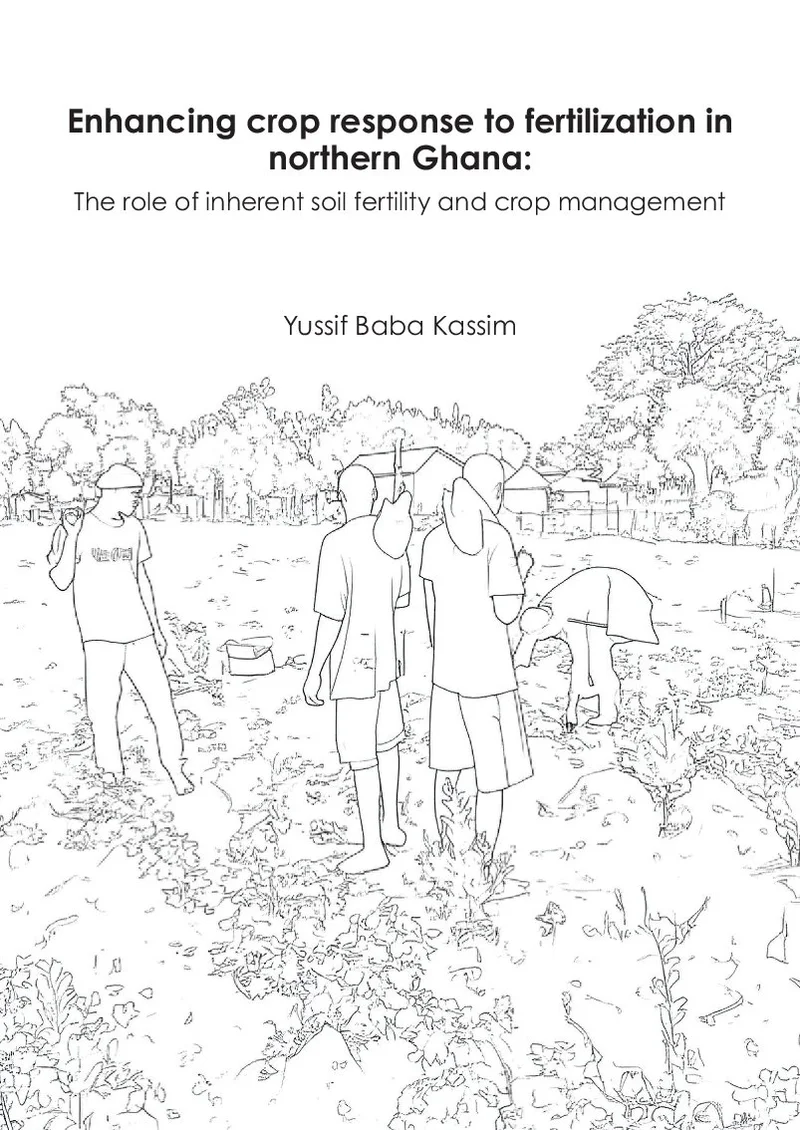
Yussif Baba Kassim
Enhancing crop response to fertilization in northern Ghana
4 september 2026
Wageningen University
Open Ebook
Share this project
Summary
Nanoparticles (NPs) can be produced in a variety of sizes and shapes. Each little detail of these characteristics may influence the toxicity of the NPs. This thesis aims to gather more information about the importance of the size and shape of a particle on its toxicity. I not only focused at standard apical endpoints like lethality and mobility, but also aimed to gain more insight in the effective exposure of embryos to NPs. By focusing on the uptake and biodistribution of NPs, it can be examined where particles end up in the organism after short-term exposure and where long-term effects may be expected to occur. As a final step, it was aimed to focus on the interactions nanoparticles experience in mixtures that are determinative of their fate. Being aware that the dissolution behavior of NPs is important with regard to the overall toxicity of the particle suspension, I wondered what would happen when a stable nanoparticle is added to different NP suspensions.
In Chapter 2, the aim was to investigate the effect of particle size on the uptake of the NPs, combined with an assessment of how the uptake route affects the uptake of NPs into the organism. It was found that only the small particles (≤ 50 nm) were able to penetrate the zebrafish embryos, spread through the body and eventually accumulate in specific organs and tissues such as the eyes. Particles larger than 50 nm were predominantly adsorbed onto the intestinal tract and outer epidermis of zebrafish embryos. Embryos exposed to particles via both epidermis and intestine showed the highest uptake and they eventually accumulated particles in their eyes, whereas uptake of particles via the chorion and epidermis resulted in marginal uptake.
In Chapter 3, the effect of particle shape on NP biodistribution was assessed. By assessing both the trafficking of the particles as well as the immune response of the embryo, it was possible to observe a shape-dependent trafficking of the particles, which resulted in a different distribution of the particles over the target organs. The differences across the distribution patterns indicate that the particles behave slightly different, although they eventually reach the same target organs – yet in different ratios. Macrophages were found to take up Au NPs from the body fluid, to be transferred into the veins and to be transported to digestive organs for clearance. The trafficking of the particles in the macrophages indicates that the particles are removed via the mononuclear phagocytic system. The different ratios in which the particles are distributed over the target organs, indicate that shape influences the behavior and eventually the toxicity of particles.
Testing nanomaterials may imply working with small amounts of materials. In order to be able to test NPs in low quantities, an adaptation to the standardized zebrafish embryo test was proposed in Chapter 4. Using this method, a variety of differently shaped NPs was tested. With the data generated, in combination with existing data, it was aimed to determine the best dose-metric to describe the toxicity of NPs. Subsequently, the aim was to develop translational models for dose-response predictions for those NPs that showed low responses at the highest exposure levels possible. The modeling efforts in Chapter 4 indicated that there is indeed an influence of shape on the toxicity, irrespective of the core-material. The parameter that explained the shift in toxicity the best was the minimal diameter of the particle: the smallest diameter that can be found on the particle.
In the study discussed in Chapter 5, the effect of TiO2 NPs on the fate and toxicity of other NPs was assessed. Given the common use of multiple NPs in nanomaterials, the urgency to investigate interaction effects in mixtures of NPs has increased as well. The aim of Chapter 5 was to investigate the joint effects of quickly dissolving NPs and chemically stable NPs based on the fate of the nanoparticles. No specific interactions between the particles were found and possible fate determining processes like co-agglomeration and adsorption of free ions were found not to be affected by addition of stable NPs.
In conclusion, it can be said that the studies in this thesis have yielded a more detailed knowledge about 1. Whether NPs adsorb or are being taken up, 2. How they distribute through the body of a zebrafish and into organs 3. Which characteristics the toxicity of NPs determine and 4. How NPs can be tested properly. This information is valuable for information for predicting long-term toxicity and for modeling efforts on predicting shape-related effects. These predictions are essential for the development of 'Safe by Design' nanoparticles, in which the planet is protected by means of preventive measures.