Share this project
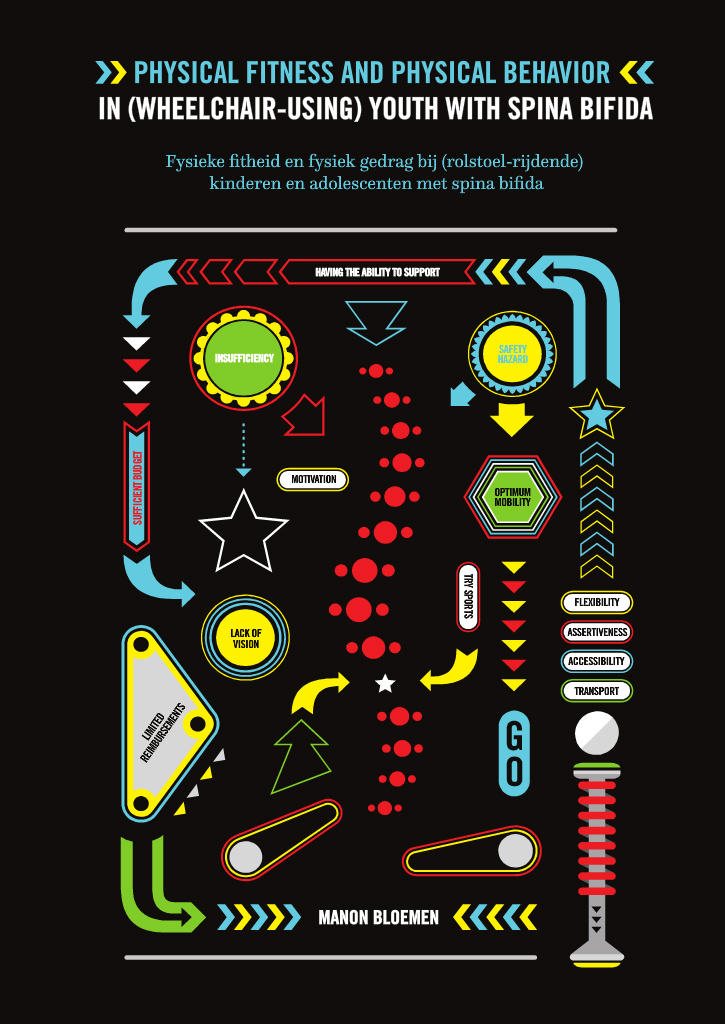
Manon Bloemen
Universiteit Utrecht
Publication date: 7 juni 2017
University: Universiteit Utrecht
ISBN: 978-94-6295-639-1
PHYSICAL FITNESS AND PHYSICAL BEHAVIOR IN (WHEELCHAIR-USING) YOUTH WITH SPINA BIFIDA
Summary
Chapter 1 described the introduction of this thesis. Spina bifida (SB) is the most frequently seen congenital deformity of the neural tube. The malformation of the spinal cord and often the brain can result in both motor and sensor impairment, incontinence for bowel and bladder and cognitive impairment. Depending on the type of SB and the height of the lesion level of the spinal cord, children and adolescents with SB experience difficulties with ambulation. The ambulation level is classified according to the Hoffer classification adjusted by Schoenmakers et al. and ranges from normal ambulatory (level 1) to non-ambulatory (Level 5). A large part of children and adolescents with SB will use a manual wheelchair for different purposes. In this thesis, “wheelchair-using” is defined as using a wheelchair for either daily activities but also as using a wheelchair for solely long distances or sports participation.
Due to advances in medical approach, most children with SB can now be expected to live to be adults. So we should not only focus on pathological aspects, but also at preventable medical and social consequences of the congenital disorder. In general, adults with SB have lower physical fitness and unfavorable physical behavior, higher prevalence of obesity and lower health-related quality of life compared to peers. Moreover, adults with SB who are not able to walk show lower physical fitness and more unfavorable physical behavior compared to ambulating adults with SB.
Physical fitness testing
Even though assessment and optimizing physical fitness in youth with chronic conditions like SB are important goals in pediatric rehabilitation, there are no valid and reliable tests available for clinicians to measure physical fitness in wheelchair-using children and adolescents with spina bifida. Physical fitness consists of health-related fitness and skill-related fitness. An important component of health-related fitness is cardiorespiratory endurance, with peak oxygen uptake (VO2peak) as the single best indicator of the cardiorespiratory system. Skill-related fitness consists of power, speed, agility, coordination, balance and reaction time and is reflected in activities such as playing outside or playing wheelchair sports.
In wheelchair-using adults, arm cranking protocols are often used to assess VO2peak. However, arm cranking protocols lack specificity compared to wheelchair propulsion and therefore the validity of these types of protocols are questioned. Consequently, wheelchair propulsion might be a more appropriate way of testing VO2peak in wheelchair-using youth with SB. Chapter 2 reported which laboratory test should be used to measure VO2peak in wheelchair-using youth with SB. The Graded Wheelchair Propulsion Test (GWPT) showed significantly higher heart rate peak and higher VO2peak values compared to the Graded Armcranking Exercise Test (GAET). Furthermore, the reliability of the GWPT was good. Based on these findings, we advised to use wheelchair propulsion and not arm cranking for measuring VO2peak in wheelchair-using youth with SB.
After determining the best laboratory test to measure VO2peak, chapter 3 analyzed the validity and reliability of the Shuttle Ride Test (SRiT) in wheelchair-using youth with SB, a field-based test using wheelchair propulsion to measure cardiorespiratory endurance. Results showed that the SRiT is highly valid and highly reliable. The clinical outcome measure “number of completed shuttles” represents aerobic fitness, while also being highly correlated with both anaerobic performance and agility. A mobile gas analysis system should be used to truly measure VO2peak as it was not possible to accurately predict VO2peak using the “number of completed shuttles”. The individual prediction intervals were too wide and thus indicating too much prediction error.
Chapter 4 described the clinimetric properties of four skill-related fitness tests, the Muscle Power Sprint Test (MPST), the 10x5 Meter Sprint Test (10x5MST), the slalom test and the One Stroke Push Test (NSPT). The MPST, adjusted to four sprints, is highly valid and moderately reliable to measure anaerobic performance. The 10x5MST and slalom test were both highly valid and highly reliable for measuring agility. The results for the NSPT showed that the validity and the reliability are not yet established.
Physical behavior
Physical behavior consists of sedentary activity and physical activity and is performed in a specific context with a certain motivation. Sedentary activity is defined as “sitting or lying during waking hours with an energy expenditure lower than 1.5 metabolic equivalent task (MET)” whereas physical activity has been defined as “any bodily movement that results in energy expenditure”. There is no evidence in the literature that presents an overview of physical behavior in wheelchair-using youth with SB. Also relations with VO2peak or other determinants such as age, gender and ambulatory status are lacking. Knowing the level of physical behavior in wheelchair-using youth with SB and understanding its relations with certain determinants will help us to tailor and optimize interventions specific for this population.
In Chapter 5 we showed that physical behavior (expressed as type of activities and intensity) of wheelchair-using youth with SB was unfavorable compared to typically developing peers, with weekend days being even more unfavorable compared to school days. The participants spent less time performing sedentary activities, more time performing physical activities and showed higher intensities during a school day compared to a weekend day. Of all participants, only 19% met the Guidelines of Physical Activity (> 60 minutes moderate to vigorous intensity of which 30 minutes > vigorous intensity) during school days and 8% during weekend days. We also evaluated the intensities of different activities, which varied extensively between participants. The different intensities during activities indicate the importance of individually tailored assessments and interventions.
The associations between physical behavior and age, gender, VO2peak and Hoffer classification were analyzed in Chapter 6. Results demonstrated that physical behavior was associated with age and Hoffer classification in wheelchair-using youth with SB, with older age and the inability to walk influencing physical behavior negatively. Gender and VO2peak were not associated with physical behavior in wheelchair-using youth with SB. Interestingly, still a large percentage of the variance in physical behavior remained unexplained (61%-86%), implicating that there are other important personal or environmental factors that should be explored regarding the improvement of physical behavior.
In Chapter 7 and 8 we presented a wide variety of personal and environmental factors that were either positively or negatively associated with physical behavior in both children with SB and in children with physical disabilities on all levels of the PAD (Physical Activity for persons with a Disability) model. Bowl and bladder care, medical events and the decreased intention to be physically active seemed to be negative personal factors specific for youth with SB. Overall, competence in skills, sufficient fitness and self-efficacy were important personal factors for youth with SB and for youth with physical disabilities. Environmental factors that were associated with physical behavior included the contact with and support from other people, the use of assistive devices for mobility and care, adequate information regarding possibilities for adapted sports and availability and accessibility of playgrounds and sports facilities.
Finally, the evidence of interventions for increasing physical activity was evaluated in chapter 9. This will help us to understand which aspects of interventions that are already used show effectiveness and which aspects not. Results showed that there is level-I evidence for no effect of training on improving physical behavior in children with physical disability. Furthermore, there is conflicting evidence for the effect of interventions with a behavioral component on short term physical behavior and level-II evidence for no effect of interventions with a behavioral component on long term physical behavior in children with physical disability. More research using innovative approaches are needed to develop and investigate interventions for improving physical behavior.
Conclusions
Chapter 10 presented the theoretical and clinical implications, methodological considerations, directions for future research and the conclusions. In this thesis, several valid and reliable field-based physical fitness tests have been developed for wheelchair-using youth with SB, which can be easily used by clinicians. Physical behavior of wheelchair-using youth with SB is unfavorable compared to typically developing youth. Furthermore, older age and the inability to walk influence physical behavior negatively in these children and adolescents. Moreover, there is a large variety of personal and environmental barriers and facilitators related to physical behavior in children and adolescents with SB or other physical disabilities. Up till now, no interventions succeeded in improving physical behavior in children and adolescents with physical disabilities. Individually tailored interventions, using the facilitators to overcome barriers, seem a starting point when aiming to improve physical behavior.
See also these dissertations


Mengxiao Sun
The role of service plants in promoting biological pest control and pollination in Xinjiang pear
3 juni 2026
Wageningen University
Open Ebook
Sherril Phyllis
Wild meat in the city, health risks and implications
1 juni 2026
Wageningen University
Open Ebook
Wisenave Arulvasan
Developing Breathomics for Clinical Application
29 mei 2026
Universiteit Maastricht
Open Ebook

Evi Koene
Pharmacological inhibition of ketohexokinase in inborn and acquired metabolic disorders
4 juni 2026
Universiteit Maastricht
Open Ebook
Isaura Wayop
Enhancing antimicrobial stewardship in veterinary medicine
4 juli 2025
Universiteit Utrecht
Open Ebook
Lidongsheng Xing
Identifying Sound Features from Brain Activity
6 mei 2026
Universiteit Maastricht
Open Ebook
Hongchen Li
Microbubble Oscillations and Microstreaming
21 mei 2026
Erasmus Universiteit Rotterdam
Open EbookWe print for the following universities