Share this project
Luciana Delgado Otero
Wageningen University
Publication date: 15 februari 2022
University: Wageningen University
ISBN: 978-94-6395-069-5
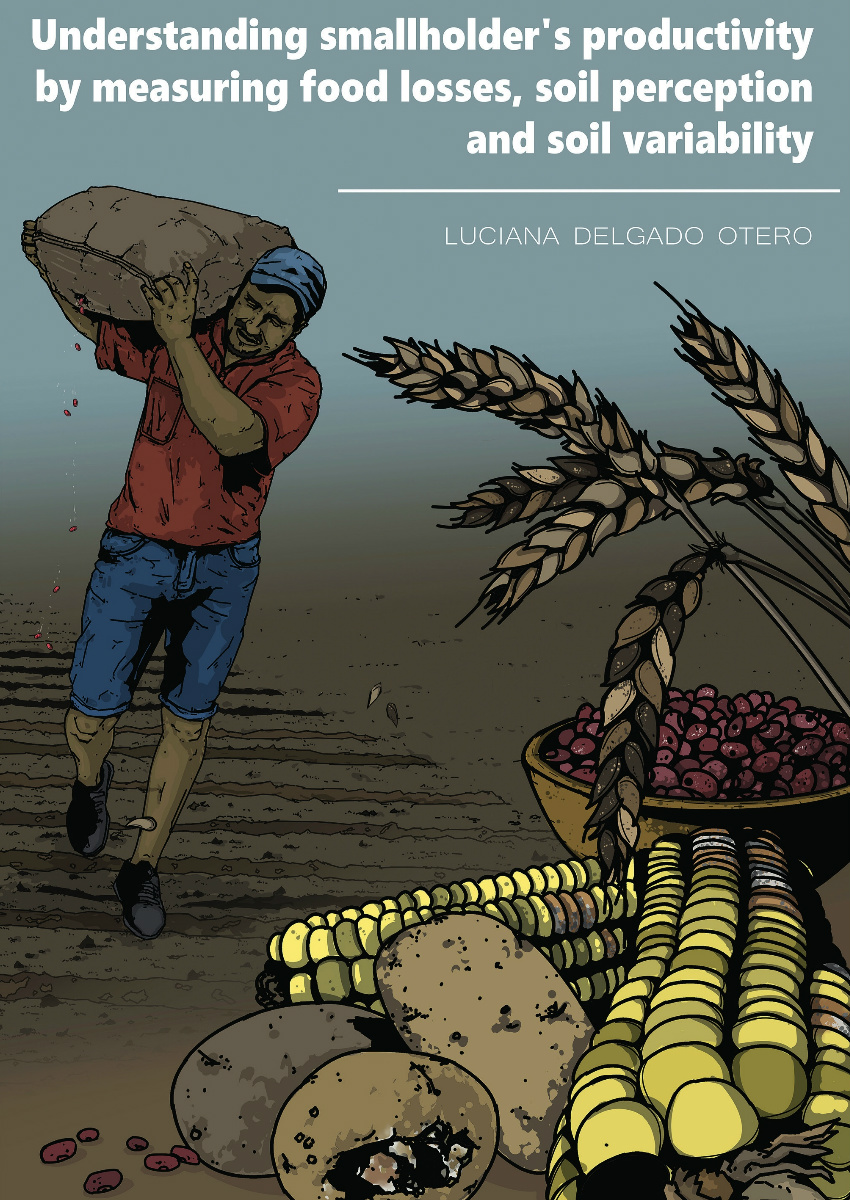
Understanding smallholder’s productivity by measuring food losses, soil perception and soil variability
Summary
Agri-food systems must be transformed to provide enough quantity of healthy food for everyone in a sustainable way, including those involved in the production chain, while dealing with the dynamics of local and global economies and the environment. Transforming the agri-food systems requires a combination of research, policies, and investments to manage complex trade-offs.
Food loss and food waste have become an increasingly important topic in the development community and in the transformation of the agri-food systems. Food losses represent 14% of the global production, according to FAO, 2019. This is equivalent to $400 billion annually. In fact, the United Nations included the issue of food loss and waste in the Sustainable Development Goal target 12.3, which aims to “halve per capita global food waste at the retail and consumer levels and reduce food losses along production and supply chains, including post-harvest losses” by 2030.
Growing populations and changing diets associated with greater wealth are increasing the pressure on the world’s available land, constituting serious threats to food security. Policies to reverse this situation have aimed mainly at increasing agricultural yields and productivity, but these efforts are often cost- and time-intensive. Greenhouse gas emissions linked with food losses are equivalent to about 1.5 gigatonnes of CO2. In addition, food loss entails excessive use of scarce resources. For example, each year 75 billion of cubic meters of water is used to produce fruits and vegetables that are not eaten. Finally, the loss of marketable food can reduce producers’ income and increase consumers’ expenses, likely having larger impacts on disadvantaged segments of the population. The losses of fruit and vegetables are equivalent to 912 trillion kilocalories and micronutrients. This is happening, as 3 billion people do not have access to healthy diets.
This dissertation focuses on smallholders and how the reduction of food losses can help resolve the challenges of low productivity they face today. To properly understand the magnitude of losses, the dissertation develops a definition of food loss. It then uses an innovative methodology to identify the quantity and quality of losses and where in the value chain they occur. Losses are quantified for a series of commodities produced by smallholders across several countries. The dissertation then examines the determinants behind losses across every stage of the value chain to find a solution to address them. Finally, a detailed analysis on perceptions is carried out to highlight farmers’ lack of information on soil characteristics, and how this might contribute to food loss. The following is a more detailed description of each chapter.
The dissertation is divided in six chapters and a conclusion. The first Chapter is the introduction. Chapter 2 presents a literature review of what is known on measurement and the determinants of food loss, and the different interventions to reduce food loss across the value chain. This chapter identifies that food loss has been defined in many ways, and disagreement remains over proper terminology and methodology to measure it. Although the terms “post-harvest loss,” “food loss,” “food waste,” and “food loss and waste” are frequently used interchangeably, they do not refer consistently to the same problem and the same aspects of the problem. Furthermore, none of these classifications includes pre-harvest losses, such as crops lost to pests and diseases before harvest, crops left in the field, crops lost because of poor harvesting techniques or sharp price drops, or food that was not produced because of a lack of proper agricultural inputs and technology. Consequently, figures on food loss are highly inconsistent and it is very difficult to compare them. In addition, the precise causes of food loss and where in the value chain they occur remain undetected, and success stories of reducing food loss are rare.
In chapter 3, we address the existing measurement gap by developing and testing three new methodologies to reduce measurement error and assess the magnitude, causes and costs of food loss, as well as the stages across the value chain where losses occur. Our proposed methods account for losses from pre-harvest to product distribution and include both quantity losses and quality deterioration. We apply the instrument to producers, middlemen, and processors in five staple food value chains in six developing countries. Comparative results suggest that losses are highest at the producer level and most product deterioration occurs before harvest. Aggregated self-reported measures, which have been frequently used in the
See also these dissertations

Mengxiao Sun
The role of service plants in promoting biological pest control and pollination in Xinjiang pear
3 juni 2026
Wageningen University
Open Ebook
Sherril Phyllis
Wild meat in the city, health risks and implications
1 juni 2026
Wageningen University
Open Ebook
Wisenave Arulvasan
Developing Breathomics for Clinical Application
29 mei 2026
Universiteit Maastricht
Open Ebook

Evi Koene
Pharmacological inhibition of ketohexokinase in inborn and acquired metabolic disorders
4 juni 2026
Universiteit Maastricht
Open Ebook
Isaura Wayop
Enhancing antimicrobial stewardship in veterinary medicine
4 juli 2025
Universiteit Utrecht
Open Ebook
Lidongsheng Xing
Identifying Sound Features from Brain Activity
6 mei 2026
Universiteit Maastricht
Open Ebook
Hongchen Li
Microbubble Oscillations and Microstreaming
21 mei 2026
Erasmus Universiteit Rotterdam
Open EbookWe print for the following universities