Yussif Baba Kassim
Enhancing crop response to fertilization in northern Ghana
4 september 2026
Wageningen University
Open Ebook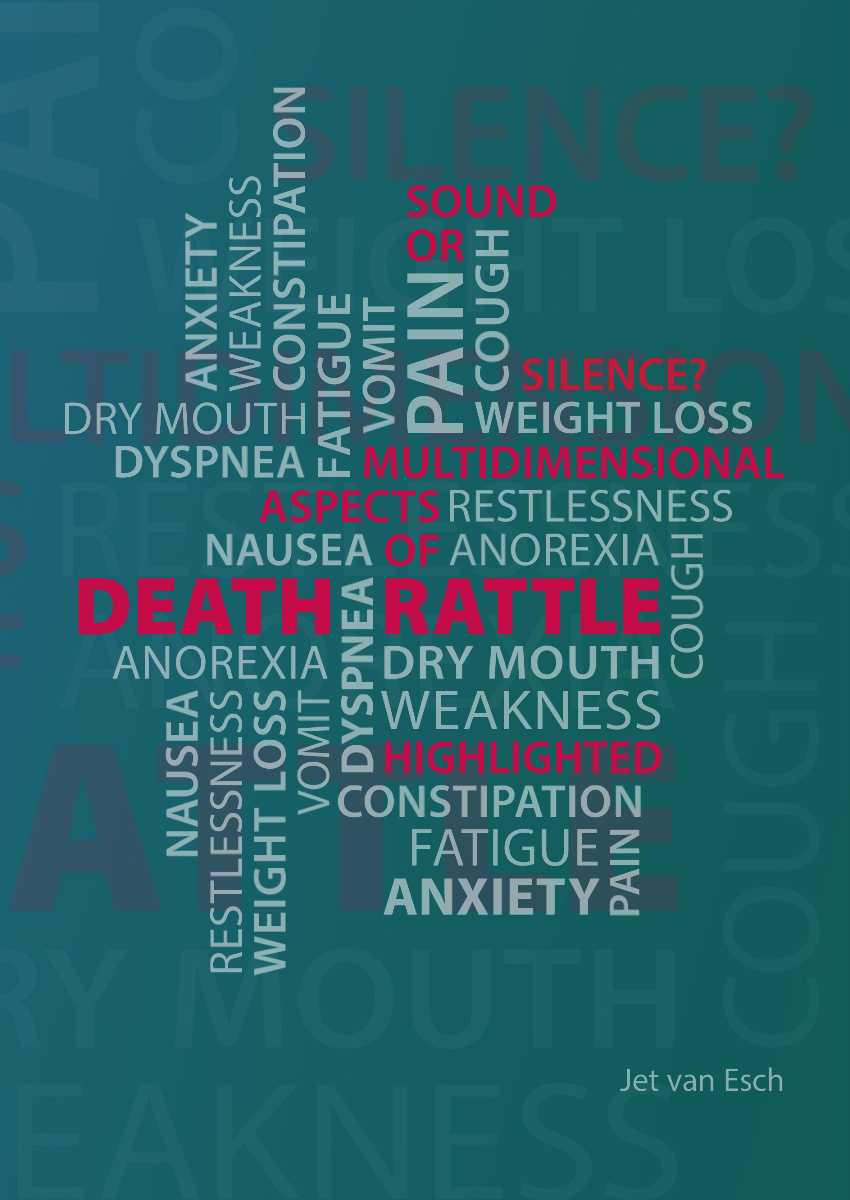
Share this project
Summary
In Chapter 1 the background and aim of this thesis is described.
Palliative care focuses on prevention and relief of suffering of patients and their relatives who are facing problems associated with a life-threatening disease. The palliative care approach can be distinguished in four (overlapping) stages: disease orientated (palliation by treatment of the underlying disease), symptom orientated (palliation by treatment of the symptoms), palliation in the dying phase (palliation by offering comfort) and aftercare (addressing grief and bereavement of relatives). Which symptoms are prominent differs from phase to phase: some can occur throughout the whole disease trajectory, others occur only in the last days and hours of life.
The dying phase starts when death is expected within days or hours according to the clinical judgment of the attending health care professionals. This assessment is based on a number of objective observations: the patient is bedridden, takes only sips of fluids, is no longer able to swallow and take oral medications properly, and/or has impaired consciousness. Specific signs that indicate impending death are alteration of respiration pattern (Cheyne Stokes), decreased response to verbal or visual stimuli, or death rattle.
Death rattle is noisy breathing caused by the presence of mucus in the upper respiratory tract. The burden of death rattle for the patient is unknown, due to a lower consciousness in the last days of life, but it is known to be disturbing for relatives and health care professionals. There is limited evidence that pharmacological treatment reduces the occurrence of death rattle. Anticholinergic medication is often given when the symptom is already present, whereas it is probably better given prophylactically.
The central aim of this thesis was 1) to understand the underlying factors of the various experiences of death rattle of bereaved relatives; 2) to study the effect of prophylactically administered scopolamine butylbromide on the occurrence of death rattle; and 3) to assess whether and to what extent a randomized, double-blind placebo-controlled trial in the dying phase is feasible.
Chapter 2 describes the results of a qualitative semi-structured interview study among relatives whose loved one had died and experienced death rattle. Our aim was to better understand the experience of relatives with their loved ones’ death rattle. This was a sub study from a larger study focused on hydration, death rattle and terminal restlessness. Patients with death rattle grade 1 or higher were identified by doctors or nurses and their relatives were invited for an interview. The interviews were structured using an interview guide and covered the following topics: the experience of death rattle; experiences with information and communication about death rattle; and previous experiences with dying and death rattle. Analyses were performed with the template analysis method using a phenomenological approach.
Nineteen family members of 15 patients were interviewed between February and June 2014.
Death rattle was experienced by relatives as neutral (‘it is not really annoying’) or negative (‘it is horrific’). The experience of death rattle did not seem to be influenced by the amount and quality of information given by healthcare professionals. Previous experiences with death rattle, insecurity about the burden for the patient and a longer duration of the death rattle seemed to negatively influence relatives’ experiences. When other symptoms such as pain, dyspnea or restlessness were also present, the experience of the sound of death rattle seemed less prominent.
This study indicates that death rattle can be a stressful symptom for relatives that is influenced by more factors than the intensity of the sound alone. Adequate information and communication cannot always relieve the burden for relatives.
Chapter 3 describes design of the SILENCE study (ScopolamIne butyLbromidE giveN prophylactiCally for dEath rattle). This randomized double-blind, placebo-controlled study aimed to assess the efficacy of prophylactically administered scopolaminebutyl to prevent death rattle in the dying phase and aimed to include four inpatient hospice facilities. When designing this study, it was important to consider barriers such as ‘vulnerability of the patients’ and ‘gatekeeping’ and to avoid disruptions in usual care where possible. To address patients’ ‘vulnerability’ we choose for an ‘advance consent’ procedure in which patients were asked for consent to participate in this study at admission to the hospices. ‘Gatekeeping’ was addressed by training and involving local medical doctors and nursing teams in the development of the study protocol.
At admission in the hospice facility, patients were screened for eligibility. Patients with a life expectancy of ≥ 3 days, who were able to understand the information about the study, and who were older than 18 years, were asked to give advance informed consent. When the dying phase was recognized, patients who did not have death rattle grade 1 or higher, did not receive systemic anticholinergic medication and did not have a respiratory infection, were randomized to receive subcutaneous scopolamine butylbromide 20 mg four times a day or placebo.
The primary outcome was the occurrence of grade ≥ 2 death rattle as defined by Back measured at two consecutive time points with a 4-hour interval. Secondary outcomes were time from the recognition of the dying phase until the occurrence of death rattle (in hours), the occurrence of adverse events, i.e. urinary retention, dry mouth and restlessness, the quality of life during the last three days of life and quality of dying. All observations and measurements were done by the attending nurse. We integrated the required observations and measurements in a well-known instrument, namely the Care Program for the Dying. Three months after the death of the patient, we sent the closest relative a questionnaire with questions about the quality of life during the last three days of life and quality of dying, bereavement of relatives, and the experience of relatives concerning the patient’s participation in a (double-blind, placebo-controlled) clinical trial.
Chapter 4 reports the results of the SILENCE study. From April 2018 till December 2020, 1097 patients were admitted to the participating hospices, 626 of them were eligible of whom 229 provided advance informed consent for participation. We ultimately randomized 162 patients. The study showed that death rattle occurred significantly less often in the scopolamine butylbromide group (13%) compared to the placebo group (27%; p=0.02). An analysis of the time to death rattle yielded a subdistribution hazard ratio (sHR) of 0.44 (95% CI: 0.20-0.92; p=0.03). The occurrence of restlessness, dry mouth, and urinary retention was not substantially different between the two groups. The dying phase was significantly longer in the scopolamine butylbromide group compared to the placebo group, with a median of 42.8 hours (IQR 20.9-80.1) versus 29.5 hours (IQR 21.1-41.7; p=0.04). There was no significant difference in the use of opioids, haloperidol, and sedatives between the two groups. Further, symptoms of pain, dyspnea, nausea, and vomiting were not significantly different between the two groups. This study showed that, among patients near the end of life, prophylactic subcutaneous scopolamine butylbromide significantly reduced the occurrence of death rattle.
Chapter 5 reports secondary outcomes regarding patients’ quality of life during the last three days and quality of death as assessed by nurses and relatives. Nurses were asked ‘How would you rate this patient’s quality of life during the last 3 days of life?’ and ‘How would you rate the quality of dying of this patient?’ both on a 0–10 scale with zero being “very poor” and ten “almost perfect.” A close relative of the patient was asked if they would be willing to fill in a questionnaire with comparable questions three months after the patient’s death. Of 157 relatives who received a questionnaire, 104 (64%) completed and returned it. Nurses evaluated patients’ quality of life during the last three days significantly better in the scopolamine butylbromide group as compared to the placebo group, with median scores of 7 versus 6, respectively (p= 0.02). Nurses’ evaluation of patients’ quality of death was not significantly different between both groups. Relatives’ evaluation of patients’ quality of life during the last three days and quality of death was not significantly different between both groups either.
These results suggest that scopolamine butylbromide may be beneficial for patients.
In Chapter 6 we reflect on including patients in the RCT. We analysed recruitment, participation, and strategies used. The vulnerability of patients was the most important barrier in this medication study at the end of life. In almost 3 years, 1097 patients were admitted of whom 626 were eligible at first assessment. Of these, 119 (19%) dropped out because of physical deterioration before they could be informed about the study (44) or sign informed consent (75).
Gatekeeping by health care professionals occurred for a small number of patients. Twenty-five (4%) patients were not asked to participate by the health care professionals. Although done with the best intentions, gatekeeping may overrule patients’ autonomy. Gatekeeping by relatives also occurred in a small number of patients. In 24 cases (4%), relatives advised the patient against participating.
Another barrier to conduct research in an end-of-life care setting described in literature lies in the organization of care. We addressed unfamiliarity of the hospices with research procedures by extensive on-site trainings and used a well-known instrument, the Care Program for the Dying, for collecting data. Careful implementation of the study procedures, generating enthusiasm among health care professionals and keeping them informed of developments within the study, led to a positive research climate in the hospices. Because the standard operating procedures were tailored to the workflows in each hospice, they were easy to follow for all staff involved in the study.
The robust design and applied strategies to facilitate patient recruitment in this study have resulted in a successful study with sufficient participants. This design could be exemplary for future research at the end of life.
Chapter 7 reports the results of a mixed-methods study among relatives, whose loved ones had participated in the SILENCE study. Our aim was to explore the experience of participating in this RCT from the perspective of relatives and hereby better understand the decision making on participation. Of the 157 relatives, who received a questionnaire, 104 (64%) completed and returned it. Seventeen relatives of sixteen patients were interviewed.
Participation of the patient in a randomized double-blind placebo-controlled trial had not been burdensome according to the majority of relatives, who considered this research to be valuable. Further, according to relatives, participation in this RCT did not negatively affect the patients’ quality of dying. Few patients in this study made the decision to participate in this study on their own; most consulted their relatives.
We conclude that, according to the relatives, patients’ participation in a double-blind placebo-controlled medication trial at the end of life need not be burdensome and does not interfere with the dying process.
Chapter 8 summarizes the key findings of the studies presented in this thesis, provides some methodological considerations and gives reflections on some overarching topics. We discuss the rationale and the timing of prophylactic scopolamine butylbromide to prevent death rattle. We reflect on views of a good death in relation to symptom control, especially focused on death rattle. Our findings show that, in the hospice population, when patients or their loved ones feel that preventing death rattle will result in a comfortable death, providing prophylaxis is an option when based on a careful process of shared decision-making. It is possible to perform an RCT in hospices. The chapter concludes with some reflections for future research.