Isaura Wayop
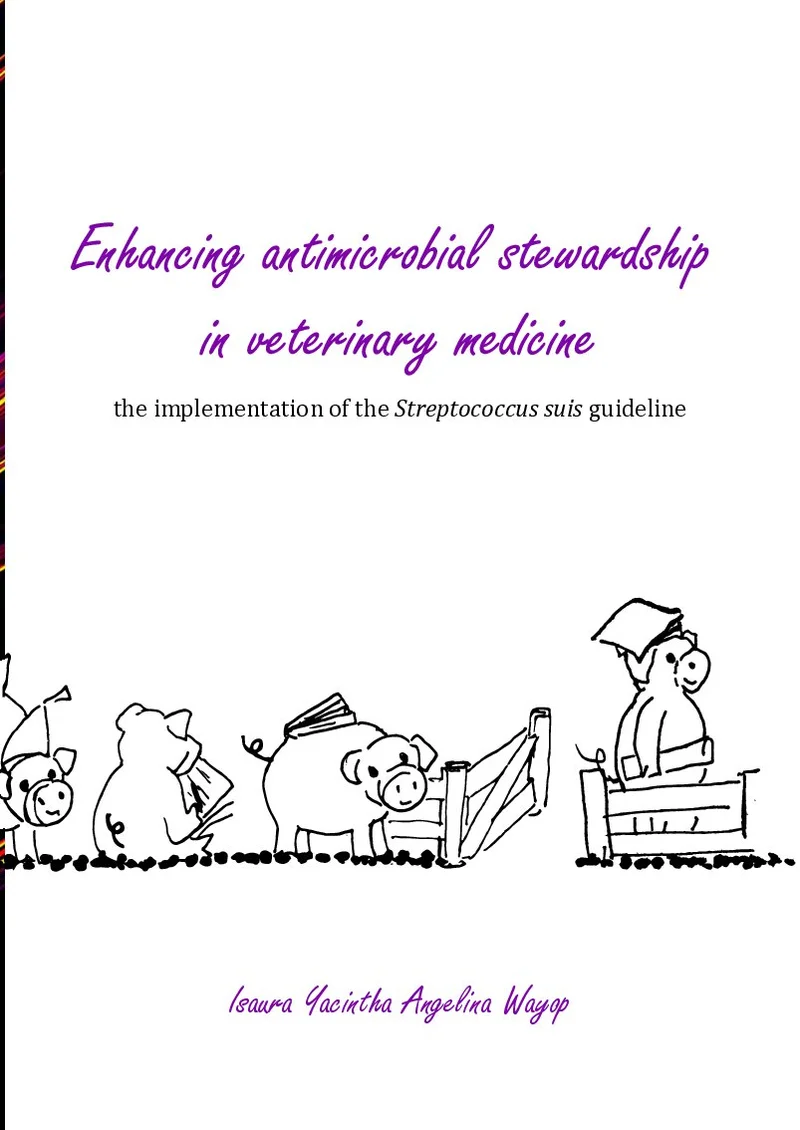
Enhancing antimicrobial stewardship in veterinary medicine
4 juli 2025
Universiteit Utrecht
Open Ebook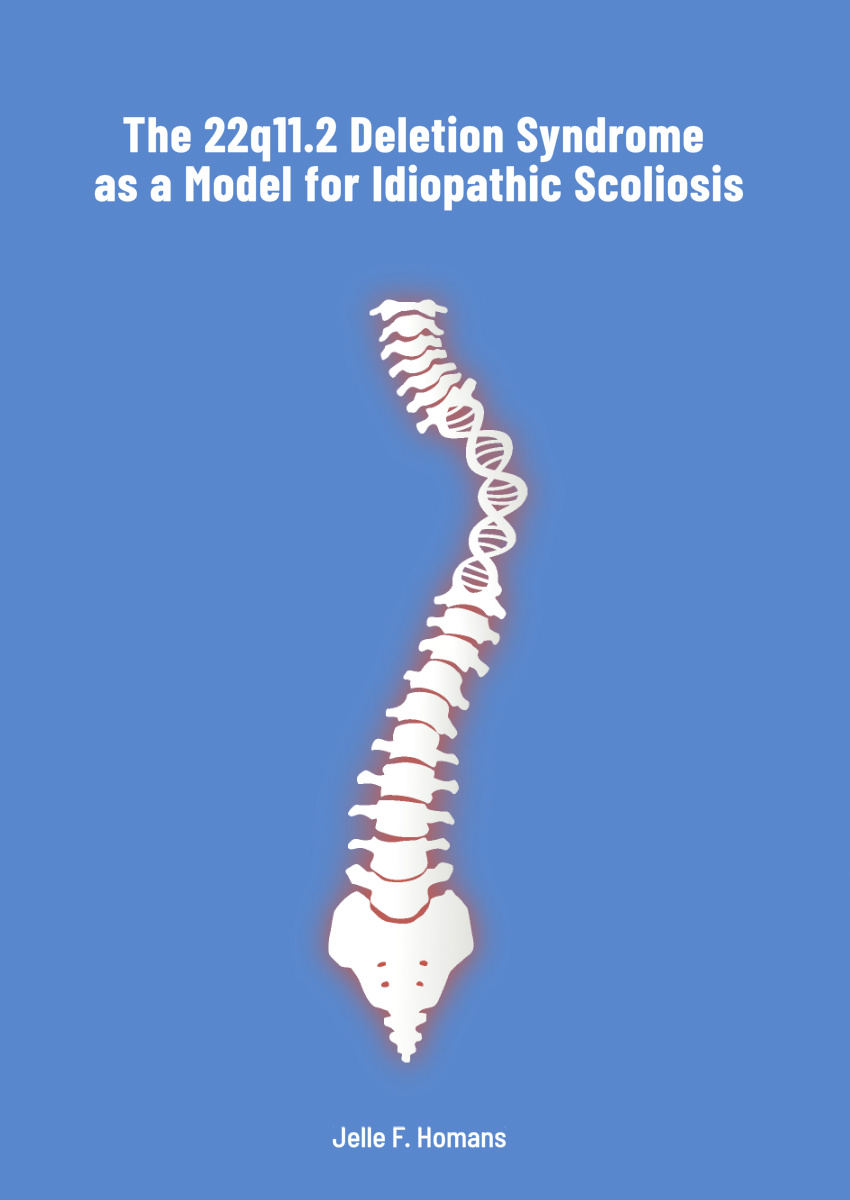
Share this project
Summary
Future Perspectives and Final Conclusions
The 22q11.2 Deletion Syndrome as a Model for Scoliosis in the General Population
An important question towards the etio-pathogenesis of idiopathic scoliosis is the interaction between biomechanical, central nervous system, environmental, genetic and metabolic factors. In order to truly investigate the interaction between protective and provocative factors we believe we should analyze the very early and initiating factors in humans. Elaborating on this idea, given the relatively low prevalence of scoliosis, and the ~50% scoliosis prevalence in 22q11.2DS the second section of this thesis focuses on the question whether, from a scientific perspective, 22q11.2DS could be used as model to study the development of scoliosis in the general population.
In chapter 6 the hypothesis that 22q11.2DS can be used as a model to study the development of scoliosis in the general population is introduced. Moreover, multiple questions were formulated that should be answered in order to determine whether 22q11.2DS can be used as a scoliosis model:
1. Does scoliosis in 22q11.2DS behave in a comparable manner as idiopathic scoliosis?
2. What is the prevalence of intraspinal anomalies in 22q11.2DS as compared to idiopathic scoliosis?
3. How is the neuromuscular status of patients with 22q11.2DS as compared to the general population?
4. What is the condition of the essential tissue structures (such as IVD) in patients with 22q11.2DS?
The goal of chapter 7 was to answer the first two questions. In order for 22q11.2DS to be possibly suitable as a model for scoliosis, the curve characteristics should be similar to idiopathic scoliosis. We identified all ambulant patients with 22q11.2DS with non-congenital scoliosis and scoliosis onset of at least juvenile age. First, we determined the characteristics of the curve. Second, we determined the prevalence and rate of progression in 22q11.2DS scoliosis. Last, we identified the prevalence of intraspinal anomalies in pre-operative and fast progressive 22q11.2DS scoliosis cases. We showed that, in our included sample, nearly all patients had an idiopathic-like curve pattern (98.4%). Moreover, approximately half of the 22q11.2DS population had a progressive curve (54%, defined as progression of >5 degrees Cobb angle) with a median progression in that group of 2.5 degrees/year. The prevalence and rate of progression was comparable with idiopathic scoliosis. Last, the type and frequency of intraspinal anomalies seen in 22q11.2DS were comparable with idiopathic scoliosis.
Which arm position provides the most “functional representation” of the natural sagittal standing position?
Already in chapter 1 we introduced the importance of the sagittal shape of the spine in relation to scoliosis. In chapter 8, we showed the first explorative results implying that 22q11.2DS might be used as a model to study the development of scoliosis in the general population. This study was performed in two 22q11.2DS clinics (CHOP and UMCU). In these two clinics there is different positioning protocol during radiography. In CHOP, radiographs are made with biplanar radiography (EOS®) and patients stand in the hands-on-wall position (Figure 1, chapter 9). In UMCU, with conventional radiography, patients have the arms on the hands-on-cheek position (figure 1, chapter 9). In order to truly compare sagittal results between multiple centers we should use the same position. This will make collaborative, multicenter, research easier and enlarge the chance on identifying causative mechanisms. We showed, in healthy volunteers, that the sagittal spinal alignment differs between the positions and the natural position. Although the differences are small, the hands-on-cheek position had the most overlap with the natural standing position.
Are there sagittal alignment differences between thoracic scoliosis, (thoraco)lumbar scoliosis and controls before the development of scoliosis?
After validation of 22q11.2DS as a model for scoliosis the ultimate goal is to find true etiological factors and subsequently identify possible preventive measurements. Chapter 10 provides an example of such research. According to the dorsal shear force theory there should be sagittal alignment differences before the onset of scoliosis. The proof-of-concept in chapter 10 is the first prospective sagittal alignment study before the onset of scoliosis and indicates that there are indeed sagittal alignment differences between thoracic scoliosis versus (thoraco)lumbar scoliosis versus controls before onset of scoliosis. Patients with thoracic scoliosis had a longer and more proximally extending posteriorly inclined segment, before the development of scoliosis (Figure 3). Moreover, patients with (thoraco)lumbar scoliosis had a steeper posterior inclined segment as compared to thoracic scoliosis and controls (Figure 3). This study was performed in 31 patients with 22q11.2DS, based on the power calculation a study of 60 patients would be needed to prove a causal relationship between sagittal profile and scoliosis. Last, the posterior inclination triangle surface (PITS) reflects an overall risk factor for scoliosis: it was considerably higher in the group of scoliosis (thoracic and thoracolumbar scoliosis combined) as compared to controls.
Ethical considerations
A question that should be asked is whether it is ethical to use a subset of the population as a scientific model for the general population. All knowledge acquired in this thesis is based on data that was gathered by means of good clinical practice. However, if we intend to gather (more) data before onset of scoliosis (i.e. balance parameters, muscle strength) by means of research activities, this will be an extra burden for patients that can already have many medical issues. Importantly, the first patients that will benefit from the obtained knowledge, are patients with the 22q11.2 deletion. It is imperative that as soon as research (especially in this group of patients) has revealed differences between certain patients and or has revealed etiological factors, we take the next step: focus towards treatment and/or prevention.
If the “model” approach works, it is very likely that more grants and research time will be devoted towards patients with this condition, which will lead to more knowledge (and hopefully better care) for patients with 22q11.2DS. For our care and research we try to minimize the burden for the patient and constantly evaluated the need and intensity of the screening program. In CHOP and the UMCU (Wilhelmina’s Children’s hospital) we have a dedicated multidisciplinary 22q11.2DS team and dedicated 22q11.2DS outpatient clinic in order to give the patients (and parents) optimal care. By means of this specialized outpatient clinic we try to improve efficiency of the care for this vulnerable group of patients. Last, both in CHOP and the UMCU we have a weekly multidisciplinary 22q11.2DS scientific meeting in which we discuss past, current and future research, including the possible impact for patients.
Differences in sagittal alignment between thoracic and lumbar scoliosis before curve onset: Differences in sagittal alignment between a patient with a thoracic scoliosis (left) and a lumbar scoliosis (right) before (top) the development of scoliosis (bottom). In the middle you can see an overlay of the differences between the thoracic (orange) and lumbar (blue) scoliosis before the onset of scoliosis: Thoracic scoliosis patients have a longer, more proximal, posterior inclined segment. Lumbar scoliosis patient have a steeper, shorter, posterior inclined segment. Last, the patients with thoracic scoliosis had another shape of the posterior inclined triangle surface (PITS, triangle with black and white dashed lines) as compared to patients with lumbar scoliosis.
Future Perspectives
Section A: Orthopedic Manifestations in the 22q11.2 Deletion Syndrome
Whereas our research on the orthopedic manifestations in 22q11.2DS was only observational, future research should focus on the true implications of this knowledge. For example, multiple studies are performed on the cervical spinal anomalies of patients with 22q11.2DS and as a result, in general, all patients with 22q11.2DS are screened between four and eight years of age. Yet, in the few case reports in which a patient with 22q11.2DS developed neurological symptoms based on cervical anomalies, the patients were older. This obviously lead to the question whether patients with 22q11.2DS should be screened (only) at a later age and/or whether patients should have a second screening at a later age. Since there is possible cervical instability in a subset of the patients, screening is important: in some hospitals, based on the anomaly, patients are advised to refrain from collision sports. Therefore, if needed, it seems more appropriate to perform a second screening at a later age instead of postponing the first moment of screening. Although the anomalies are congenital, the effect of these anomalies seems to have the possibility to develop over time throughout growth and development. Elaborating, it is important that patients (and parents) know the (subtle) effects of slowly developing myelopathy.
Although it will be challenging to have sufficient power, it is important to investigate whether current gold standard treatments for certain orthopedic manifestations, i.e. club foot and scoliosis, have the same effectiveness in 22q11.2DS as in the general population. These results would have important implications; at first for the healthcare provider; should there be more follow-up appointments? Should there be another (post-)treatment? Do we provide false (high) expectations to patients and parents? On the other hand, this will be important for patients and parents; can we expect the same results from a certain treatment as in the general population? For example: It is unclear whether conservative (brace) treatment for scoliosis in the 22q11.2DS population leads to the same results as in AIS. If conservative treatment does not lead to a slower progression and or stop of curve progression the need for scoliosis screening will become different. At this moment, with CHOP and UMCU data combined, we do not have the power to determine whether brace treatment is effective in 22q11.2DS scoliosis.
The CHOP and UMCU are one of the few centers in the world in which the orthopedic surgeon is a standard member of the multidisciplinary team who sees the patient with 22q11.2DS multiple times between the age of six to 18 years. The musculoskeletal system is an important part of the body. Therefore it is important to make sure that the patients are in an optimal physical condition. Based on this thesis and the large number of possible musculoskeletal manifestations in 22q11.2DS, an orthopedic surgeon as a (standard) member of the specialized 22q11.2DS teams throughout the world should at least be reconsidered if not mandated.
Section B: The 22q11.2 Deletion Syndrome as a Model for Idiopathic Scoliosis
In section B of this thesis, we worked on the first two questions to answer the hypothesis whether 22q11.2DS can be used as a scientific model for scoliosis. The last two questions (IVD properties and neuromuscular status) should still be answered. For example, we know from existing literature that the deformation of AIS is mostly in the disc (and not in the vertebral body). Logically, the same phenomenon should be seen in 22q11.2DS scoliosis. The same accounts for the neurological status of patients with 22q11.2DS and how/if this relates to scoliosis.
All-in all, we know that scoliosis in the general population is the result of an interaction between multiple pathways and risk factors. Most likely, different risk factors have a different contribution in the overall risk of development of scoliosis (i.e. in the AIS population, being female, is clearly a risk factor). If we consider all factors as being on a balance; you will have risk factors on the one side and protective factors on the other side. It is very likely that the fulcrum of these factors is different in 22q11.2DS as compared to the general population (for example, in 22q11.2DS there is no difference in scoliosis prevalence between gender), however it can still shed light on different protective and risk factors. In the proof-of-concept study we do show that the previously identified relation between sagittal pattern and the early forms of scoliosis is also present before onset of scoliosis. This finding indicates that we are on the right track and that we can use 22q11.2DS as a model for scoliosis in the general population.
An intriguing factor of 22q11.2DS is that scoliosis and schizophrenia, which at first sight seems to be very distinct, both occur 25 times more often as compared to the general population. Moreover, both phenotypes in 22q11.2DS have large similarities with that disease in the general population and both diseases are natural to humans only, there are no existing natural animal models to date. Interestingly, in the general population there is a clustering of scoliosis and schizophrenia. Within 22q11.2DS it is unknown whether there is clustering of scoliosis and schizophrenia. This is important to investigate: If there is indeed a clustering of scoliosis and schizophrenia in 22q11.2DS, this would lead to the suspicion of a combined etiological pathway. The other way around, if there is no clustering, this is more evidence that the 22q11.2DS itself is a multiplier effect on disease(s) that are exclusive to humans. This multiplier effect might be derived from the development of low copy repeats during evolution from hominids to human and which contributes to de novo cases of the 22q11.2 deletion.
This thesis focused on whether 22q11.2DS could be used as a model for idiopathic scoliosis from a phenotypic and biomechanical perspective. Another approach is to focus on this question from a genotypic perspective. Currently, nearly 40% of all current etiological AIS research is focused on genetics. It is evident that genetics play a role in the development of scoliosis; there is a higher concordance of scoliosis in monozygotic twins (73%) than dizygotic twins (36%). Moreover, first-degree relatives of AIS patients have an increased risk (6-11%) of developing AIS as compared to the general population.
Genetic research in the cohort of scoliosis patients with 22q11.2DS could focus on a number of aspects. As discussed in the introduction, the typical deletion occurs between LCR22A and LCR22D, which involves ~3 Mb. The remaining 15% have “nested” deletions. To date, most of the variable effects of the deletion remain unexplained. A first step would be to identify whether the length of deletion has an effect on the development of scoliosis. Second, we can investigate whether there are variants at the other 22nd chromosome (on the 22q11.2 region) that causes the scoliosis (recessive condition). Last, we can investigate whether the common sequence variants as found in current genetic AIS studies occur more often in patients with 22q11.2DS with scoliosis as compared to patients with 22q11.2DS without scoliosis.
Despite the multiple large genetic studies that are ongoing, the genetic variants for the development of AIS are poorly understood. It is most likely a complex polygenic model, in which there is also large genotypic heterogeneity. In current genetic (AIS) studies, the genome is considered in two-dimensional (2-D) linear fashion: There are very long lists of the genome and its variants and it is investigated whether there are less or more variants in the cases as compared to the controls. The same 2-D approach accounted for a long period of time in scoliosis (research), with the introduction of radiograph. Moreover, the official diagnosis of scoliosis is only in 2-D (a Cobb angle of at least 10 degrees). However, in recent years, it was shown (again) that it is important to analyze scoliosis in a 3-D fashion. The same reasoning can be applied to genetic research: Two meters of DNA has to be folded into the nucleus and therefore sequence and interactions should be considered in 3-D.
Recently there is more interest in this 3-D organization of the genome and the role of the 3-D organization towards the functionality of genes. In 2-D certain regions can be very far apart; yet in 3-D, the genome is actually folded and thus regions can be very close. This folding of the genome is nonrandom and results in structural units called topologically associating domains (TADs). These TADs are conserved among species, cell types and tissue and it is thought that they actually represent structural units of genome. A possible explanation for the role of the 22q11.2 deletion in the development of scoliosis could be that not the specific genes itself, but the whole 22q11.2 region plays a role in the development. For example, in AIS, there can be many variants at the location at the 22q11.2 deletion, that may not be identifiable with genome-wide association studies (GWAS), but does have an effect on the TAD and thus on the functionality of a set of genes. Due to the 22q11.2 deletion the TAD can be changed and thus this deletion can have effects beyond the 2-D location of the 22q11.2 deletion. In general, future research on genetics in AIS will most likely focus more on the 3-D architecture of the genome. Moreover, it is very well possible that in there, there lies a special role in the 22q11.2 deletion, since it is a prime example of a copy number variant, it can possibly change a TAD and the scoliosis associated with 22q11.2DS scoliosis has large similarities with idiopathic scoliosis.
In this thesis we focused on the question as to whether or not 22q11.2DS could be used as a model for scoliosis in the general population. This line of thought was derived from our collaborating partners in the field of schizophrenia research. Genetic schizophrenia research is far ahead as compared to genetic scoliosis research; in a recent schizophrenia GWAS there were over 40,000 patients with schizophrenia included, while in recent scoliosis GWAS there were <8,000 included. By collaborating with psychiatric genetic experts we have the possibility to learn from their research and possible accelerate the genetic research in scoliosis. We showed that, phenotypically, 22q11.2DS can be used as a model for scoliosis in the general population. There are multiple syndromes (including Down and Prader-Willi syndrome) in which there is a higher prevalence of scoliosis. Moreover, in Prader-Willi the majority of the patients have an idiopathic curve pattern as well. The trajectory performed as in this thesis can be explored for other conditions: Interestingly in section A we showed that there was no association between CHD and scoliosis, whereas there is a higher prevalence of CHD in Down’s syndrome as well. In the end, combining different (syndromic) patient groups could shed light on common etio-pathogenesis pathways, such as CHD and scoliosis and provide insights into the development of scoliosis that are not possible to derive if you only study idiopathic scoliosis patients. Final Conclusions Over a century of dedicated research has been performed on the etiology of scoliosis. One of the main problems in that research is that patients only present following the onset of scoliosis and thus truly causative research is impossible. In this thesis, we introduced a new way of research in orthopedics that is already applied in other fields of medicine: using a subset of patients with a common condition as a model for the general population. We started this thesis with a more general section concerning orthopedic manifestations in 22q11.2DS. This thesis shows that there are at least 58 musculoskeletal manifestations present in 22q11.2DS, of which multiple possibly need (surgical) intervention. The presence of club foot and scoliosis occurs 25-30 times more often as compared to the general population. Already for over forty years it has been shown that there is a clear association between CHD and scoliosis. However, we showed that the 22q11.2 deletion might actually be a confounder in this presumed association. The second part of this thesis focuses on the question whether 22q11.2DS might be used as a model for scoliosis in the general population. This research clearly is not complete; however the first steps have been taken. We revealed that, phenotypically, 22q11.2DS can be used as a model for scoliosis in the general population.