Share this project
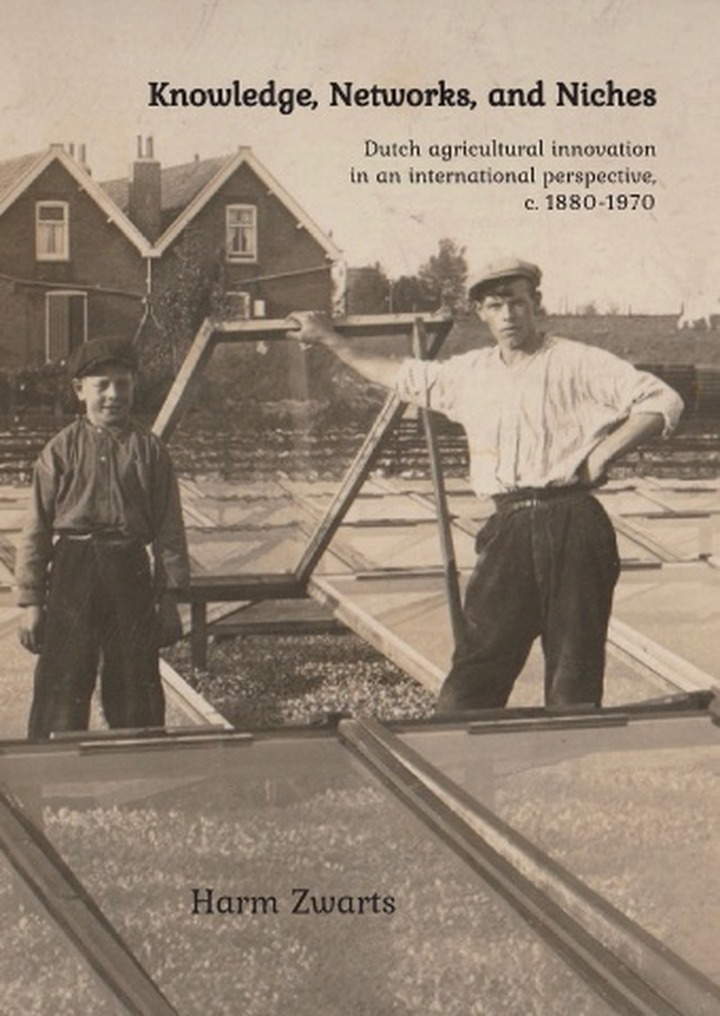
Harm Zwarts
Wageningen University
Publication date: 4 juni 2021
University: Wageningen University
ISBN: 978-94-6395-341-2
Knowledge, Networks, and Niches
Summary
The September 2017 issue of the National Geographic magazine contained an article wondering why the Netherlands, this small, urbanized, and densely-populated country in Western Europe, is the second world exporter of food. The answer is found in the innovativeness of Dutch agriculture. With drones, GPS, and artificial intelligence, Dutch arable farmers detect the progress of individual crops and measure, per square meter rather than per plot, the required inputs. But why is Dutch agricultural innovation world leading?
This study explains the success of Dutch agricultural innovation by looking at its historical roots. Why and how, this dissertation asks, were Dutch farmers able to become among the most innovative in Europe? This dissertation points out, firstly, that preconditions in the Netherlands were favourable. With their close location to the port of Rotterdam (the main transportation hub of Europe) and urban-industrial agglomerations in Britain and Germany, Dutch farmers could fully profit from the growing demand for higher-value agricultural products. In combination with growing international competition, this lead to ongoing specialization and diversification, which brought Dutch farmers at the technological frontier. Secondly, since the late nineteenth century the Dutch government facilitated the Dutch farming population in operating at the technological frontier by stimulating agricultural R&D, more than elsewhere in Europe, where protectionism was often the norm. Publicly funded research institutes and public agricultural consultancy were all vehicles through which knowledge and innovation was exchanged. Thirdly, the high level of self-organization of the Dutch agricultural sector compared to its international counterparts, most clearly visible in the high density and variety of Dutch agricultural cooperatives, resulted in a horizontal exchange of knowledge between farmers themselves. The public institutions and farmer organizations jointly enabled the Dutch agricultural sector, increasingly active in market niches, to adapt foreign innovation to the specific Dutch conditions and, once the high level of specialization had made importing innovation insufficient, to generate innovation and knowledge itself. In short, the public-private networks provided the knowledge exchange necessary to successfully farm at the technological frontier, which Dutch farmers are still doing today.
With these findings, this dissertation makes two important contributions. Firstly, whereas many scholars see agricultural innovation as a product of changing land-labour ratios or as a product of the need to lift ecological constraints, this dissertation has shown that also proximity to markets is an important determinant for the course of agricultural innovation. For Dutch farmers, the need to innovate was very much driven by the fact that they were closely located to the centre of the Von Thünen model (which prescribes that the closer a farmer is located to an urban market, the more specialized, intensified, and diversified his farming becomes) and that they had to secure their position on German and British urban markets. Secondly, a number of agricultural historians claim that the knowledge-intensive growth of agriculture in large parts of the world during the twentieth century was driven by an ‘industrial paradigm’, which prescribed that agriculture should follow the methods, goals, and productivity growth of the industrial sector. This paradigm, allegedly spread among farmers by agricultural experts, disregarded the tacit knowledge of the individual farmer on, for instance, local conditions. However, evidence from the Dutch case suggests that the knowledge-intensive growth of Dutch agriculture, though certainly driven by a kind of ‘industrial paradigm’, was supported by the Dutch farming population, as an intensification of agriculture was one of the ways to cope with international competition. The access to knowledge improved, which made Dutch farmers more resilient to deal with competition and crises and to safeguard their livelihood.
The main part of the inquiry is conducted through case studies, focusing on specific innovations or particular subsectors within Dutch agriculture. These case studies are put into larger perspective by an analysis on the national level. This enables a comparative approach, which works two ways. Firstly, findings from the Dutch case are compared with the historical examples of Belgium, Denmark, Germany, Britain, and in some cases the United States. Secondly, this study compares regions within the Netherlands, to clarify how and to what extent agricultural innovation differs locally. Because of this diversity of approaches this study uses a wide range of data and sources. The quantitative data consist of Dutch national trade statistics and Dutch agricultural statistics, while qualitative material comes from agricultural periodicals and archival records, such as minutes, annual reports, and correspondence from agricultural cooperatives, research institutes, and other actors.
Chapter 1 is the introductory chapter that presents the relevant literature, discusses the methodology and approach, and demarcates the main concepts. Important to note is that agricultural innovation differs from general innovation in two ways. Firstly, agricultural innovations do not have a high degree of portability and have to be fine-tuned to specific local conditions. Secondly, because agricultural innovations are usually human interventions in biological processes, they often cause new problems that have to be solved. Farmers are the actors having to adapt agricultural innovations to local conditions and having to detect new problems, which brings them at the heart of the innovation adoption process. Yet, because farmers have little options to organize their own research and development (R&D), they are heavily dependent on suppliers, extension services, and research institutes (agricultural innovation, in other words, is heavily ‘supplier-dominated’). Agricultural innovation, this chapter points out, is largely determined by the success of knowledge exchange between farmers and other actors.
After the introductory chapter, part I of this dissertation places Dutch agricultural innovation in its wider context. Chapter 2 studies the international economic context and uses insights from New Economic Geography to show that Dutch agriculture profited greatly from its proximity to expanding markets in Western Europe. Dutch farmers were close to urban consumers, mainly in Germany and Britain, but also had good connections to foreign suppliers of various inputs and innovations. Trade statistics reveal that the imports of seeds and artificial fertilizers increased massively since the late nineteenth century. However, ongoing specialization and diversification brought Dutch farmers at the technological frontier, which made that importing knowledge and innovation from abroad was no longer sufficient. The Netherlands started generating its own innovation and gradually transformed into an exporter of knowledge.
Chapter 3 puts focus on the national political context. How can it be explained that the Dutch state, having ignored the agricultural cause during most parts of the nineteenth century, heavily invested in agricultural education and R&D during the twentieth century? Using agricultural periodicals, parliamentary minutes, and government documents as primary sources, this chapter finds the answer in the changing nature of agricultural innovation. For centuries, Dutch farmers had used innovations and inputs that were locally available. Since the mid-nineteenth century, however, Dutch farmers started relying heavily on imported fertilizers, seeds, and animal feed. Because of their lack of knowledge on these imported inputs, many individual farmers had a weak bargaining position with regard to their suppliers. Subsequent market failures caused the Dutch government to step in and improve access to knowledge, funding agricultural education and setting up agricultural experiment stations and an agricultural consultancy system. ‘Protectionism of knowledge’ was seen as a good alternative to the shunned ‘protectionism of prices’.
Whereas part I of this study discusses the economic and political context, part II concentrates on case studies. Chapter 4 explains why the Netherlands transformed from a relatively small user of artificial fertilizers at the end of the nineteenth century to one of the largest users of artificial fertilizers a few decades later. Besides land-labour ratios and the high level of specialization of Dutch farmers, the enormous growth in artificial fertilizer usage in the first decades of the twentieth century should also be attributed to the improved exchange of knowledge. Although other knowledge channels were also important, this chapter finds that the Dutch public agricultural consultancy system was pivotal. An international comparison shows that the Dutch agricultural consultancy system was one of the most elaborate of its time. The growing number of Dutch agricultural consultants improved knowledge exchange at the local level. The case of Jakob Elema, agricultural consultant for the province of Drenthe from the 1890s to the 1930s, exemplifies how individual consultants improve local networks and professionalized the ‘on the ground’ knowledge exchange. They often had a long-lasting effect on local agriculture through the education and press they helped set up.
Chapter 5 discusses the role of agricultural cooperatives. The case of the sugar beet cooperatives shows how agricultural cooperatives had a comparative advantage as knowledge networks with regard to networks provided by, for instance, agricultural consultants. Within cooperatives, individual farmers were part of a larger peer group, in which they were pressured to follow the production methods and participate in the knowledge exchange of the larger group. The archival records of the sugar beet cooperatives reveal how these groups continuously balanced between the freedom of the individual members and the uniformity and quality of the products the cooperative delivered. The sugar beet cooperatives contributed to the innovation capacity of their members by distributing knowledge and by giving access to inputs, particularly seeds. Since the late 1920s the sugar beet cooperatives jointly conducted R&D, eventually setting up their own research institute.
Chapter 6 explains why the usage of greenhouses for the production of flowers, vegetables, and fruits increased massively since the 1910s, a development referred to as the ‘Dutch Greenhouse Revolution’. A network of cooperative auctions and the proximity of the South Holland glass district, where most of the Dutch greenhouses were located, to the port of Rotterdam resulted in a quick shipment of Dutch horticultural products to the German and British urban consumers, which was extremely important for these perishable goods. The concentration of Dutch greenhouse acreage in South Holland resulted in a high density of experiment fields, study clubs, suppliers, and researchers, which improved knowledge exchange. Together with the willingness of cooperative rural banks and state guarantee funds to invest in greenhouse horticulture, this explains why the Dutch greenhouse horticultural sector became the largest of its kind and became a world leader in greenhouse horticultural technology.
Chapter 7 concludes by summarizing the main findings of this dissertation and reiterating the main line of argumentation. It shortly recaps the main contributions of this dissertation and reflects on its main two shortcomings. Firstly, because this study is largely based on archival material from formal networks (mainly cooperatives and public institutes), the significance of informal networks (family ties, villages communities, etc.) are still unclear. Secondly, as the approach of this study mainly consisted of actor-based case studies, some parts of Dutch agriculture have not been extensively studied. Chapter 7 also presents possible pathways for future research. The success of Dutch agricultural innovation, this study shows, can be partly attributed to the high level of self-organization of the Dutch farming population. But where does this social capital come from? Why did the Netherlands see such a rapid and expansive growth in agricultural cooperatives? Comparable questions can be raised concerning the relatively large Dutch agro-food industry. How can the swift rise of the Dutch agro-food industry since the mid-nineteenth century be explained? In sum, a deeper understanding of the economic development of Dutch agriculture is still required.
See also these dissertations

Mengxiao Sun
The role of service plants in promoting biological pest control and pollination in Xinjiang pear
3 juni 2026
Wageningen University
Open Ebook
Sherril Phyllis
Wild meat in the city, health risks and implications
1 juni 2026
Wageningen University
Open Ebook
Wisenave Arulvasan
Developing Breathomics for Clinical Application
29 mei 2026
Universiteit Maastricht
Open Ebook


Evi Koene
Pharmacological inhibition of ketohexokinase in inborn and acquired metabolic disorders
4 juni 2026
Universiteit Maastricht
Open Ebook
Isaura Wayop
Enhancing antimicrobial stewardship in veterinary medicine
4 juli 2025
Universiteit Utrecht
Open Ebook
Lidongsheng Xing
Identifying Sound Features from Brain Activity
6 mei 2026
Universiteit Maastricht
Open Ebook
Hongchen Li
Microbubble Oscillations and Microstreaming
21 mei 2026
Erasmus Universiteit Rotterdam
Open EbookWe print for the following universities