Share this project
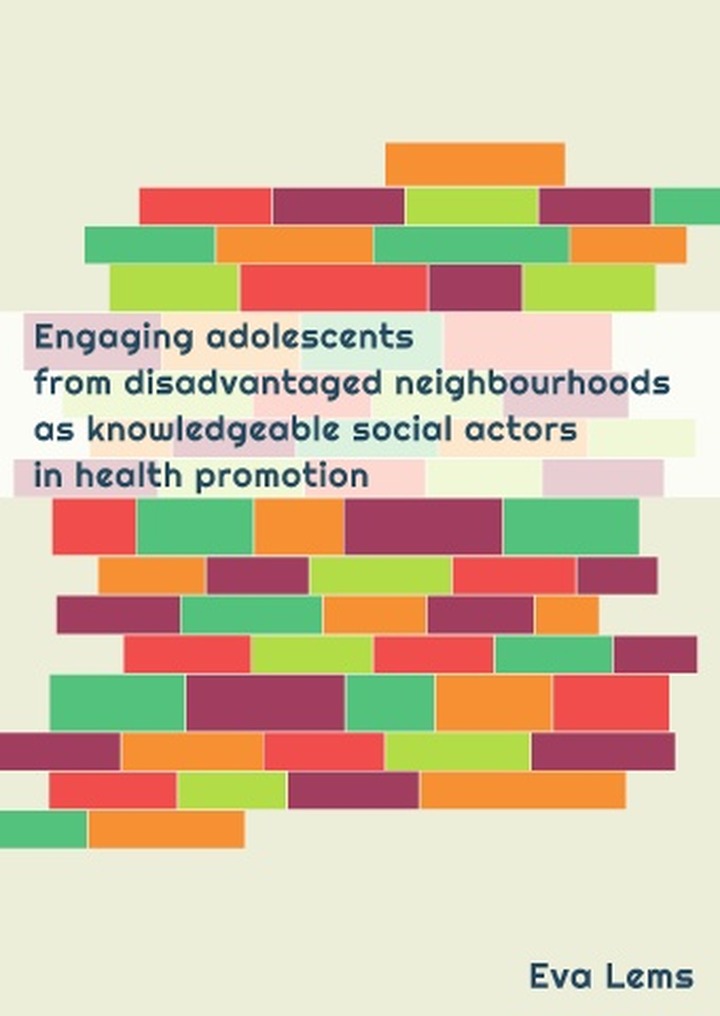
Eva Lems
Vrije Universiteit Amsterdam
Publication date: 15 december 2020
University: Vrije Universiteit Amsterdam
ISBN: 978-94-6423-018-5
Engaging adolescents from disadvantaged neighbourhoods as knowledgeable social actors in health promotion
Summary
Background
Adolescents (aged 12-18 years) have long been overlooked in the field of (public) health (policy) worldwide. This is a missed opportunity, since health promotion during adolescence has lasting positive effects on adolescents’ health and wellbeing that endure into adulthood. Especially adolescents with a low Socio-Economic Position (SEP) are overlooked, while they are most in need for health promotion. They are for instance disproportionally affected by overweight and obesity. Effective strategies to enhance the health and wellbeing of adolescents with a low SEP are lacking. One of the reasons for this might be a mismatch between the lifeworld and the needs of adolescents with a low SEP and the interventions.
For (adolescent) health promotion we know that it is vital to not only address individual behaviour but also to focus on the interaction of the individual with their socioeconomic, sociocultural, and physical environments in a ‘systems approach’. Moreover, to improve the health and wellbeing of adolescents with a low SEP, many studies show that it is vital to engage these adolescents in health promotion intervention and policymaking. First, it is the right of adolescents to participate in matters affecting their health and lives. Second, former research shows that adolescents are ‘knowledgeable social actors’, who hold unique and essential knowledge that helps to develop e.g. policy and interventions that better suit their needs. Third, participation contributes to the personal development and self-efficacy of adolescents, because they reflect on their lives and take shared action.
Participatory action research (PAR) is a research approach to engage adolescents with a low SEP. The focus of PAR is on shared learning and action for social change. In PAR participants have an active role; they are involved in all phases of a research, as well as in the dissemination of research findings and in creating change. There is a general consensus that PAR is of added value in the field of public health, however, PAR in the field of adolescent health promotion has however yet seldom applied.
To address the gaps mentioned above, this thesis aims to: (a) to gain insights into the daily reality of adolescents with a low SEP and their perspectives on health and health promotion, and (b) to improve health promotion practices and policy according to their daily reality, perspectives, and ideas by involving adolescents in a participatory action research as knowledgeable social actors in order to contribute to the improvement of the health and wellbeing of adolescents with a low SEP.
Research design
This study is guided by the main research question: How can health promotion and health policy better align with the daily reality and perspectives of adolescents with a low SEP?
This question is followed by four sub-questions:
1. What are the perspectives of adolescents with a low SEP on health and current health promotion initiatives and on how health promotion could be improved?
2. What are the perspectives of professionals on adolescents and health promotion for this specific group and on how health promotion could be improved?
3. What lessons can be learned regarding the facilitation of meaningful participation in health promotion (development) for adolescents with a low SEP?
4. How can PAR contribute to enhance the healthy living of adolescents with a low SEP in a systems approach?
This thesis mainly builds on a PAR project (2015–2018) that aimed to improve health promotion (policy) with and for adolescent boys and girls with a low SEP living in two disadvantaged neighbourhoods in Amsterdam. In this thesis, the main focus is on adolescents with a low SEP. In addition, professionals who work with these adolescents on a daily basis and policymakers are involved. To engage the adolescents a PAR approach is applied wherein the co-creation of health promotion products was central. PAR is complemented with qualitative research methods: interviews, group-interviews, focus groups and dialogues.
Results
The findings of this thesis (Chapter 4-8) are summarized below.
Understanding adolescent girls’ perspectives and co-creation
There is limited knowledge about how to enable adolescent girls with a SEP to adopt a healthy lifestyle. Chapters 4 elaborates on a PAR study that aims to gain insights into the perspectives of adolescent girls with a low SEP on a healthy lifestyle, and moreover how to develop health promotion that fits these girls’ daily realities and perspectives by using PAR in which 26 girls from disadvantaged neighbourhoods developed their own health promotion material. In group meetings, the girls discussed and developed a healthy lifestyle magazine and two videos for their peers. Results show that having fun, friendships and looking good are key to the girls. Girls want to have a say in health promotion programs, while these programs are often fixed. Although the girls attribute an unhealthy lifestyle to themselves, it appears that poverty, family problems and an unsafe and unhealthy environment hinder living healthy.
Understanding adolescent boys’ perspectives and co-creation
Adolescent boys from disadvantaged neighbourhoods are hard to reach for health promotion. Chapter 5 includes a PAR study with 63 adolescent boys from disadvantaged neighbourhoods in Amsterdam. The study aims to understand perceptions of health and health promotion strategies of adolescent boys from disadvantaged neighbourhoods in order to identify opportunities for health promotion that are better tailored to their needs. The boys participated in semi-structured interviews, participant observations, and co-creation sessions. Results highlight that boys associate the consumption of large portions of junk-food and meat, with masculinity and autonomy. Buying junk food is an important part of their social life. The boys stress that current health promotion does not fit their needs. They plead for fun, active health promotion activities, and cheap, satisfying, tasty and healthy food options in their neighbourhood. This study shows that there is an emerging acceptance of boys taking care of their body and health, but that the social norm of unhealthy consumption dominates. For health promoters, it is vital to gear health messages to who the boys are and wish to be, especially in relation to their peers.
Understanding professionals’ perspectives and ideas for change
The perspective of professionals who work with adolescents with a low SEP on a daily basis is often overlooked in the development of health promotion interventions and policy. Chapter 6 elaborates on a study that provides insights into (a) the challenges that these professionals face and their ideas concerning health promotion for these adolescents and (b) how these relate to the new systems approach in the field of health promotion. In total 60 professionals were consulted through dialogue sessions and (group) interviews. The findings highlight that professionals are eager to collaborate with adolescents, parents and other professionals. However, the results also show that professionals have a rather negative image of adolescents and perceive them as difficult instead of knowledgeable. Although the need for a systems approach is widely recognized in the public health domain, this study shows that the daily practices of professionals who are involved in the health promotion of adolescents living in disadvantaged neighbourhoods do not always match this ideal. To apply a new way of working, professionals and their organizations need to develop ‘new’ competencies.
Reflection on the implications and impacts of the use of vlogs in PAR
The use of vlogs is promising in PAR that aims to enhance the health and wellbeing of adolescents. The promises of vlogs as a creative research method within PAR are to engage citizens in disadvantaged circumstances and to stimulate shared learning between these citizens and professionals. Chapter 7 includes a study that aims to explore the value of co-creating vlogs by investigating two exploratory studies involving adolescents and women from disadvantaged neighbourhoods in Amsterdam. In the PAR project with 12 adolescents, created health promotion vlogs for peers. The makers of the vlogs, as well as peers not involved in the vlog creation and professionals, reflected on the vlog co-creation. The results show that co-creating vlogs enabled meaningful engagement and promoted shared learning. Although adolescents who were not involved in the vlog creation were critical of the vlogs, watching the vlogs stimulated discussion and reflection. Despite the popularity of vlogs, this study highlights the need to carefully consider the use of vlogs in relation to a study’s aims and to respond to (ethical) concerns.
Assessing impact
Little is known about the impacts of PAR with adolescents in public health research. Chapter 8 discusses the impacts of the PAR with the adolescent girls (Chapter 4) for the participating girls, professionals, and policymakers. The central questions are: what were the impacts for the different stakeholders? Which aspects of the process contributed to these impacts and what were the main challenges? Main impacts were: (1) For the girls the project was an enjoyable experience, moreover the PAR contributed to their self-awareness and self-efficacy regarding healthy living. (2) The project changed policy and professionals’ practices, and contributed to a more positive image of adolescents. Key facilitators were having an enjoyable, sociable time together while working on tangible products. Main challenges included balancing the girls’ needs, professionals’ guidelines, and the researchers’ personal values. The study demonstrates short-term and long-term impacts of PAR and how health promotion (policy) can be improved by co-creation.
Discussion
Although the field of adolescent health promotion is on the rise, most adolescent health promotion strategies do not sufficiently fit the daily reality and perspectives of adolescents with a low SEP and therefore are not able to enhance the health and wellbeing of these adolescents sufficiently. This thesis provides several insights to enhance health promotion policy and interventions for adolescents with a low SEP. Above all, a holistic and participatory (open and flexible) approach is needed. Moreover, it is vital to adjust the approach to the daily context and needs of the adolescents and to approach them with an open, positive, and respectful attitude.
The results highlight that in contrast to the general idea that adolescents have a low level of interest in health (promotion)-related topics, the adolescents who were involved consider healthy living to be important. Most of the adolescents’ ideas to improve health promotion relate to the problem that they do not recognize themselves in current health promotion and that their social and physical environment is unsupportive. Despite the many barriers in their environment the adolescents see being healthy primarily as their own responsibility, reflecting neoliberal notions. Another main finding is that many of the consulted professionals do not (unconsciously) regard adolescents with a low SEP as knowledgeable social actors, preventing them to work in a more participatory way. The negative appraisals of adolescents by the professionals can be explained by the overall negative framing of adolescents in Western society.
This thesis also shows that systems thinking and a PAR approach can be synergetic in order to create (systems) change. Findings discussed in this thesis suggest that PAR can be used as an intervention in youth development and the socio-ecological systems that affect it. Systems approaches and PAR produce complementary information about systems that has the potential to improve these systems by involving and acknowledging all stakeholders in the process of identifying optimal strategies for adolescents’ health promotion. PAR could help to engage adolescents and align health promotion with their needs. Results show the policy of the AHWA was informed, from the bottom up, by the adolescents’ perspectives and suggestions.
In conclusion this thesis shows that the input of adolescents themselves in health promotion development is crucial. How best to approach adolescents (with a low SEP) depends on many factors such as gender, age, culture, education level, peer group, interests, neighbourhood, timing, parents, etc. There are no fixed steps to take; the most important aspect is the attitude of the researcher (or other professional), which needs to be open, flexible, reflexive, and respectful and knowledge about the theoretical underpinnings of what participation entails and needs in order to be meaningful.
To align health promotion with the needs of adolescents with a low SEP, researchers and other professionals need to gain a better understanding of, and respect for, the daily reality of adolescents, their thinking, challenges, and ideas. Participatory and systems approaches are needed to study, address, and enhance the health and wellbeing of adolescents (with a low SEP). This requires long-term efforts of all actors involved and by paying positive attention to this group of adolescents.
See also these dissertations

Mengxiao Sun
The role of service plants in promoting biological pest control and pollination in Xinjiang pear
3 juni 2026
Wageningen University
Open Ebook
Sherril Phyllis
Wild meat in the city, health risks and implications
1 juni 2026
Wageningen University
Open Ebook
Wisenave Arulvasan
Developing Breathomics for Clinical Application
29 mei 2026
Universiteit Maastricht
Open Ebook
Evi Koene
Pharmacological inhibition of ketohexokinase in inborn and acquired metabolic disorders
4 juni 2026
Universiteit Maastricht
Open Ebook
Isaura Wayop
Enhancing antimicrobial stewardship in veterinary medicine
4 juli 2025
Universiteit Utrecht
Open Ebook
Lidongsheng Xing
Identifying Sound Features from Brain Activity
6 mei 2026
Universiteit Maastricht
Open Ebook
Hongchen Li
Microbubble Oscillations and Microstreaming
21 mei 2026
Erasmus Universiteit Rotterdam
Open EbookWe print for the following universities