Share this project
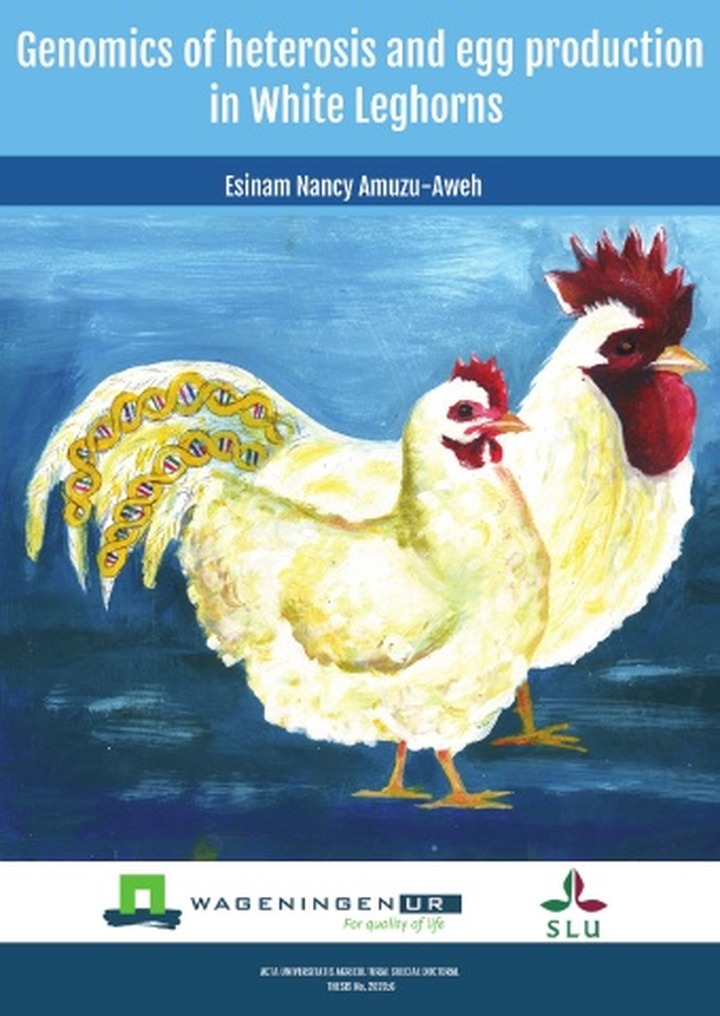
Esinam Amuzu Aweh
Overig
Publication date: 6 maart 2020
University: Overig
ISBN: 978-91-7760-530-0
Genomics of heterosis and egg production in White Leghorns
Summary
Heterosis is one of the most important benefits of crossbreeding. In situations where there are many different pure lines, breeders are faced with the challenge of identifying the best combinations of pure lines to produce crossbred products that express the best overall performance, which requires knowledge of heterosis. Currently, selection of parental pure lines is based on the results of field tests, during which the performance of their crossbred offspring is assessed under typical commercial settings.
Field tests are time-consuming, and also represent a large percent of the costs of commercial crossbreeding programs. This thesis therefore set out mainly to explore the possibilities and develop models for the accurate prediction of heterosis in White Leghorn crossbreds, using genomic information from their parental pure lines. Predicted heterosis could then be used to pre-select a subset of crosses to be assessed through field trials, thereby substantially reducing the costs of crossbreeding programs. We also hoped to gain insight into the genetic basis of heterosis. In addition, we explored the genetic architecture of egg number and egg weight in White Leghorns, both at the pure line and crossbred levels.
In Chapter 2, we studied egg number (EN), egg weight (EW) and survival days in 47 different White Leghorn crosses produced from 11 pure lines. Based on the theory that heterosis in a crossbred is proportional to the squared difference in allele frequency (SDAF) between its parental pure lines, we calculated a genome-wide squared difference in allele frequency (SDAF) between parental pure lines using 50K SNP genotypes. Results show that SDAF predicts heterosis in EN and EW at the line level with an accuracy of ~0.5, and that with this accuracy, one can reduce the number of field tests by 50%. We also showed that an SDAF model predicts heterosis whereas a combining ability model does not, which indicates that dominance is one of the important contributors to the genetic basis of heterosis. SDAF did not predict heterosis in survival days.
Moving beyond the line level, we aimed to predict heterosis at the individual sire level, in order to identify sires within the same (pure) line whose offspring would be superior in heterosis. Individual predictions would allow breeders to utilise the within-line genetic variation between sires, and potentially maximise heterosis in the offspring generation. Therefore, in Chapter 3, we derived the theoretical expectation of the amount of heterosis expressed by the offspring of an individual sire. Further, using 50K SNP genotypes of 3427 purebred sires and 16 types of crosses, we showed that individual sire genotypes can indeed be used to predict heterosis in their offspring. In our data however, the proportion of variation in genome-wide predicted heterosis due to sires from the same pure line was small (0.7%); most differences were observed between lines (99.0%). This led us to conclude that considering the genotyping costs involved, prediction of heterosis for individual sires would only be beneficial if sire genotypes are already available.
Quantitative genetic theory shows a clear proportionality between the dominance effect at a locus, SDAF and heterosis. This theory made us curious to explore the possibility of using dominance effects to improve the prediction of heterosis. Thus, in Chapter 4, we used 50K SNP genotypes and phenotypes of 11,119 females from four White Leghorn pure lines to estimate variance components, breeding values and dominance deviations for EN and EW. We then back-solved the dominance deviations to obtain estimated dominance effects of the SNPs. Next, we calculated a dominance-weighted SDAF for each trait. Our expectation was that a dominance-weighted SDAF will give trait-specific – and possibly more accurate – heterosis predictions than a raw genome-wide average SDAF.
We found that dominance variance accounted for up to 37% of the genetic variance in EN, and up to 4% of that in EW. Results showed that for both EN and EW, negative and positive estimated dominance effects are spread rather evenly across the genome. The relative values of the dominance effects were much larger at some
See also these dissertations


Mengxiao Sun
The role of service plants in promoting biological pest control and pollination in Xinjiang pear
3 juni 2026
Wageningen University
Open Ebook
Sherril Phyllis
Wild meat in the city, health risks and implications
1 juni 2026
Wageningen University
Open Ebook
Wisenave Arulvasan
Developing Breathomics for Clinical Application
29 mei 2026
Universiteit Maastricht
Open Ebook


Evi Koene
Pharmacological inhibition of ketohexokinase in inborn and acquired metabolic disorders
4 juni 2026
Universiteit Maastricht
Open Ebook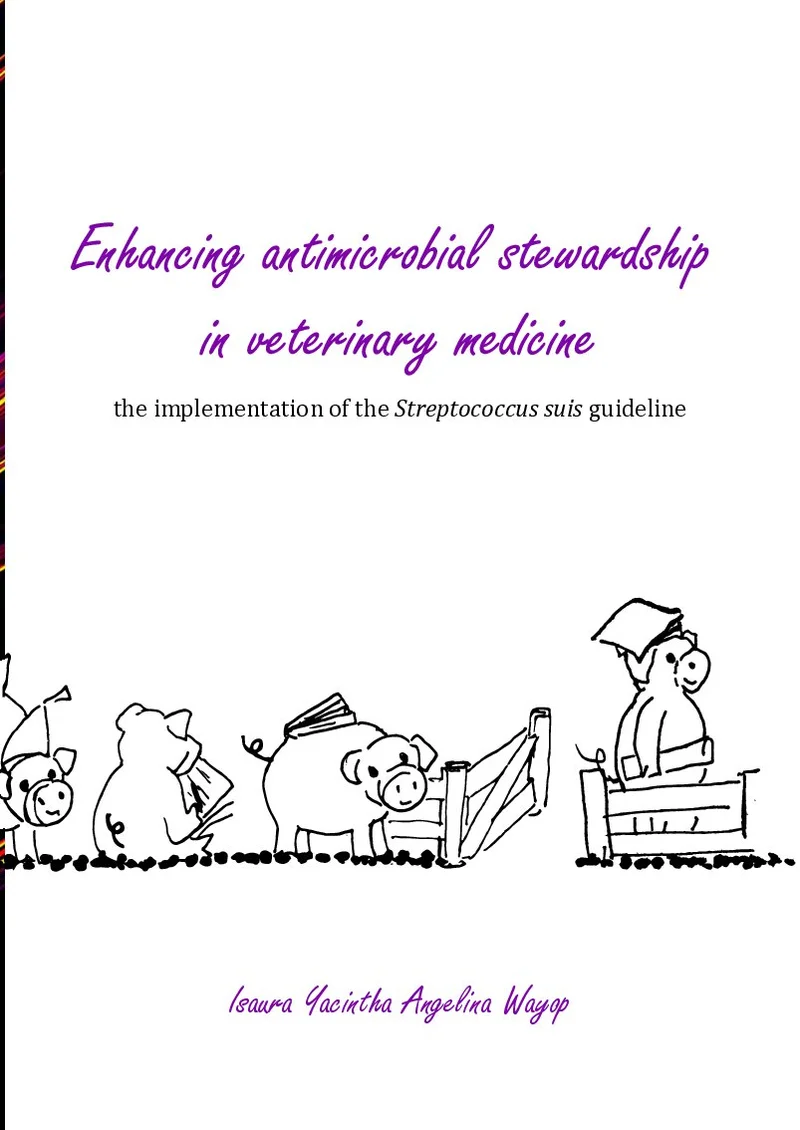
Isaura Wayop
Enhancing antimicrobial stewardship in veterinary medicine
4 juli 2025
Universiteit Utrecht
Open Ebook
Lidongsheng Xing
Identifying Sound Features from Brain Activity
6 mei 2026
Universiteit Maastricht
Open Ebook
Hongchen Li
Microbubble Oscillations and Microstreaming
21 mei 2026
Erasmus Universiteit Rotterdam
Open EbookWe print for the following universities