Andries Janse van Vuuren
Survival in the face of danger
18 september 2026
Wageningen University
Open Ebook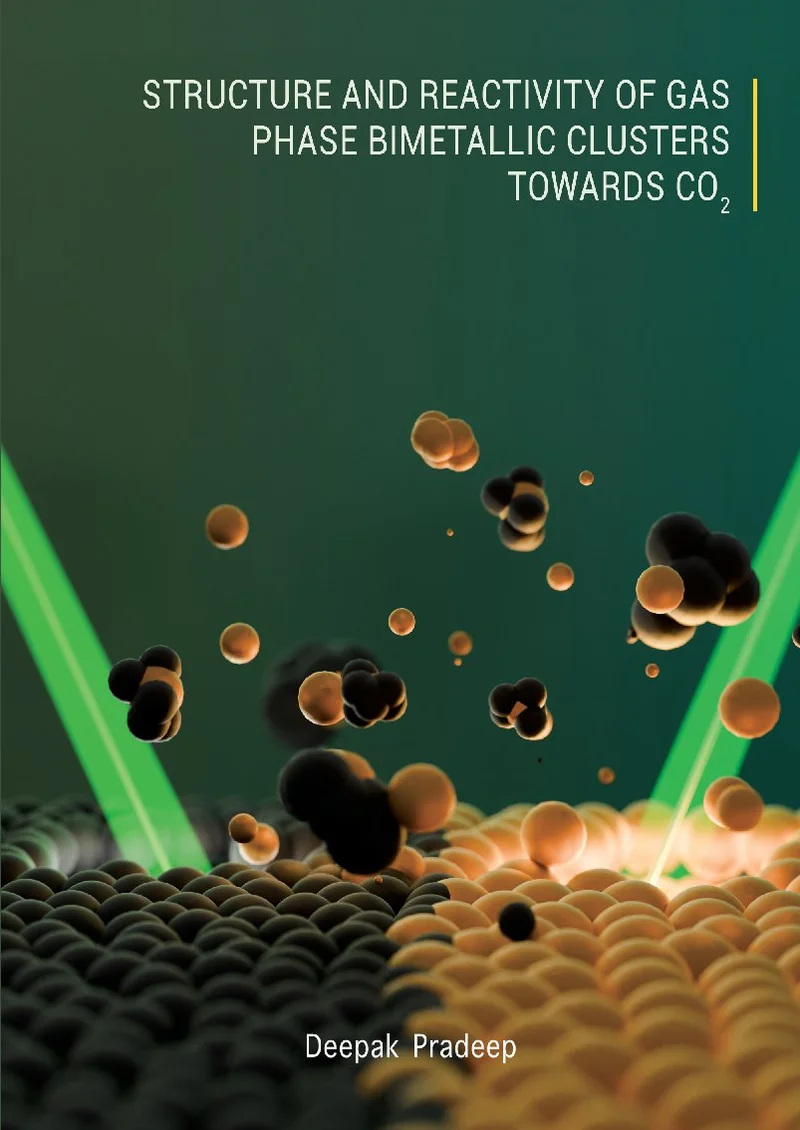
Share this project
Summary
The composition dependence of gas-phase metal clusters had not yet been experimentally explored in the context of CO2 activation. Therefore, this thesis explored the bimetallic nature of the clusters and how they reacted when exposed to CO2. The geometric structure of the clusters and cluster-CO2 complexes was studied using infrared multiple photon dissociation spectroscopy in combination with density functional theory calculations.
Chapter 1 establishes the environmental context of the research, highlighting the urgent need to address rising atmospheric CO2 levels through carbon capture and utilisation. Converting CO2 into valuable chemicals like methanol is challenging due to the chemical inertness of the CO2 molecule. This chapter introduces the gas-phase clusters as ideal model systems for studying these reactions, as they allow for precise control over size, charge and composition. The scope of the thesis is to investigate how doping cationic metal clusters with foreign atoms can facilitate CO2 activation, a process usually seen only on anionic species.
Chapter 2 details the experimental and theoretical methods employed in the research. It begins with the fundamentals of infrared spectroscopy, detailing how molecular vibrations are modelled and detected through action spectroscopy techniques like infrared multiple photon dissociation (IRMPD) spectroscopy. The experimental section describes the FELICE molecular beam setup, where bimetallic clusters are produced via a dual-target dual-laser ablation source, reacted with molecules, irradiated with IR laser beam and detected using a reflectron time-of-flight mass spectrometer. The experimental results are complemented by density functional theory (DFT), which allows for the structural assignment of clusters and cluster-molecule complexes to understand the mechanisms for CO2 activation.
Chapter 3 reports how the chemical activation of CO2 can be achieved on cationic metal clusters, if they are modified with oxophilic dopants. The CO2 adsorption on pure cationic cobalt clusters and vanadium-doped cobalt clusters has been studied. Experimental observations via infrared spectroscopy reveal that adsorption on pristine Con+ clusters only leads to intact physisorption, in which the CO2 molecule remains linear and weakly bound. However, Co4+ constitutes a unique exception, exhibiting a mixture of physisorbed and activated CO2 species. The introduction of a single vanadium atom enables the clusters to activate or even dissociate the CO2 molecule. Mass spectrometry and infrared spectroscopy reveal that VCo3+ and VCo4+ can fully dissociate CO2, leading to CO elimination, whereas smaller complexes form stable O-VCon+-CO complexes. These experimental findings are quantitatively supported by reaction pathway calculations, which confirm that the presence of vanadium significantly lowers the rate-limiting barrier for C-O bond cleavage. The results demonstrate that the oxophilic nature of the vanadium dopant is key to breaking the symmetry of the CO2 molecule and facilitating its activation on a cationic center.
Building on the findings of the previous chapter, Chapter 4 examines the impact of different 3d transition metal dopants—iron, manganese, and chromium—on the activity of cobalt clusters. By measuring the infrared spectra of these various bimetallic complexes, the study aims to identify periodic trends in CO2 activation. Iron doping of cobalt clusters does not affect their activity towards CO2. However, a slight increase in activity is observed when a manganese atom is doped onto cobalt clusters, with one cluster size fully activating CO2. Chromium doping on cobalt clusters increases the activity even better, enabling CO2 dissociation in sizes such as CrCo2+ and CrCo4+. Density functional theory indicates that, for the Cr-doped system, the barrier is reduced to a level at which room-temperature thermal energy is sufficient to drive dissociation in a fraction of the cluster population. The results reveal that while several dopants influence the clusters, vanadium remains the most effective for promoting CO2 activation among the tested elements. This systematic comparison helps elucidate how the electronic structure of the dopant dictates the chemical behaviour of the entire cluster.
Since vanadium performs well among the dopants discussed, Chapter 5 focuses on characterising the underlying geometric structures of the cationic bare and vanadium-doped cobalt clusters using far-infrared messenger tagging spectroscopy with argon. By comparing experimental spectra with theoretical predictions, the research identifies the lowest energy isomers for both pure and vanadium-doped cobalt clusters. The study assigns the geometries of Co4+ and Co5+ to a distorted tetrahedron and a distorted trigonal bipyramid based on the literature. Interestingly, the study concludes that substituting a cobalt atom with vanadium typically does not lead to a major geometric reorganisation. Instead, the dramatic shift in activity observed in earlier chapters is primarily attributed to changes in the electronic properties and the intrinsic oxophilicity provided by the vanadium site.
The work presented in this thesis demonstrates that CO2 activation on transition-metal clusters can be significantly modified by changes in cluster composition, size, and electronic structure. The results obtained for Con+, VCon+, CrCon+, MnCon+, and FeCon+ show clear metal-dependent activity trends and further expand the current understanding of CO2 interaction with cationic transition-metal clusters.
While several anionic clusters (Con-, Ptn-, Rhn-, AlRhn-, CCun-, OCun-, MgnOm-) reported in the literature favour activated or dissociative adsorption over broad size ranges, the present cationic systems exhibit more selective size-dependent activity. These differences suggest that subtle changes in electronic structure strongly influence the cluster's ability to transfer charge to the antibonding orbitals of CO2. Such findings demonstrate that controlled modification of the electronic structure through doping may provide an effective strategy for tuning catalytic activity.
Building on these results, one of the most important directions for future work is investigating subsequent hydrogenation reactions after the initial activation of CO2. Although the present thesis focuses primarily on adsorption and activation, catalytic CO2 conversion involves a complex network of elementary reaction steps. It would therefore be highly valuable to study the reactivity of the activated complexes toward hydrogen in order to identify intermediates relevant to methanol synthesis. In particular, future studies could focus on the formation of formate (HCOO), hydroxymethyl, formaldehyde-related, and methoxy (CH3O) intermediates, which are frequently proposed in CO2 hydrogenation pathways. Detecting such species under controlled gas-phase conditions would help establish direct mechanistic links between the activated adsorption structures identified in this work and industrially relevant catalytic cycles.
Another promising extension would involve time-resolved or kinetics-based investigations of the activation process. The present work identifies the adsorption products formed after reaction with CO2, but the detailed reaction mechanisms and intermediates remain largely unexplored. Future experiments combining variable collision energies, temperature-dependent studies, or ion-trap approaches could provide insight into reaction barriers, intermediate lifetimes, and possible competing reaction channels. Complementary quantum-chemical calculations and reaction pathway analyses could clarify the transition states and electronic rearrangements involved in activation and bond cleavage.
A particularly relevant long-term perspective is the application of the present findings to copper-based catalytic systems. Copper remains one of the most important industrial catalysts for CO2 hydrogenation to methanol, yet many details of the reaction mechanism remain unclear at the atomic scale. The gas-phase cluster approach employed in this thesis provides a well-defined platform for isolating individual elementary reaction steps without the complexity of extended surfaces or supports. Applying the insights gained here to doped copper clusters may therefore improve understanding of how electronic modifications influence CO2 activation and hydrogenation on industrially relevant catalysts. Such investigations may also help identify new dopant combinations capable of enhancing catalytic efficiency, selectivity, or stability.