Share this project
Vernon Cail
Erasmus Universiteit Rotterdam
Publication date: 7 september 2026
University: Erasmus Universiteit Rotterdam
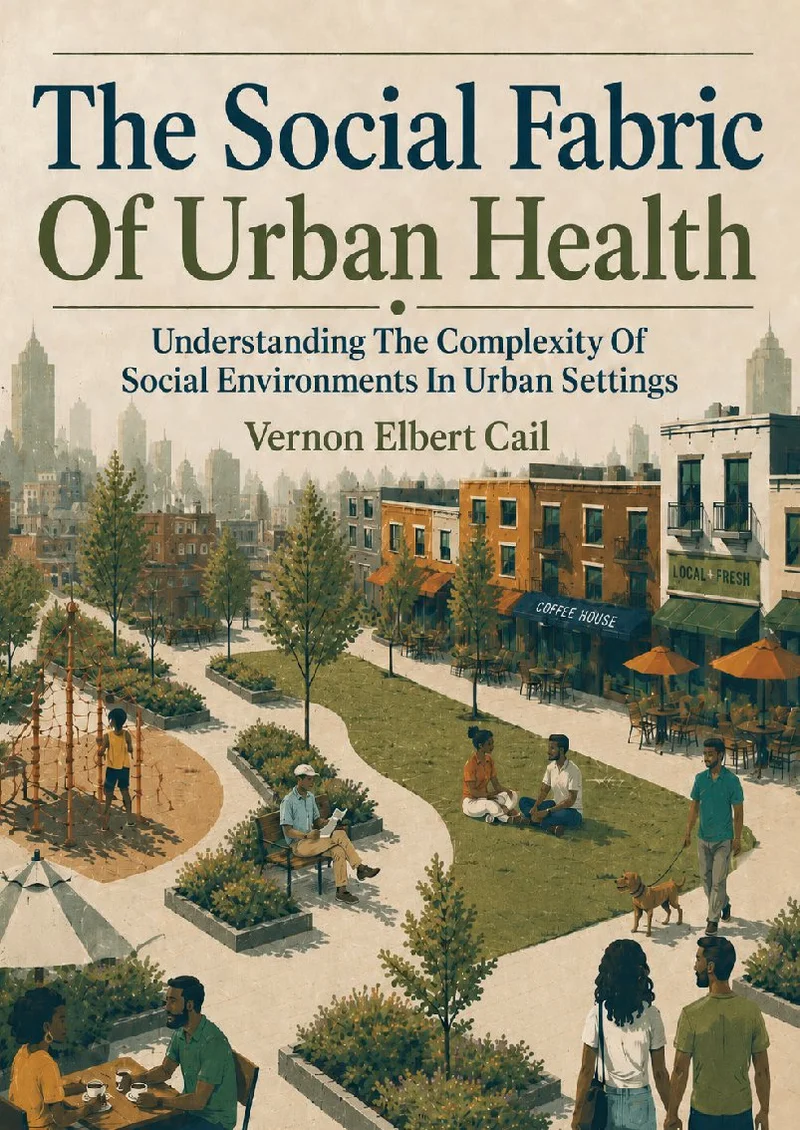
The Social Fabric of Urban Health
Summary
Introduction
Over half of the world’s population currently resides in urban areas, with projections indicating that two-thirds of people will live in cities by 2050. Europe has become one of the most urbanized regions, with 75% of its population living in urban areas. Urbanization has significant public health implications since living in urban areas brings both health benefits and risks. Urban areas can provide access to economic opportunities, healthcare, and other essential services. However, rapid urban growth can also result in overcrowded living conditions, inadequate infrastructure, and increased exposure to environmental pollutants, which disproportionately affect disadvantaged neighborhoods. As urban populations continue to grow, it is crucial to identify the key drivers of health in urban areas for informing effective public health interventions.
Empirical research indicates that both the physical and social environment are associated with urban health. The physical environment includes aspects such as air pollution, noise, climate, and the physical infrastructure; the social environment involves social cohesion, trust, and community organization. While research on the physical environment and its impact on health is well-established, studies examining the social environment’s influence on health are rapidly advancing for two reasons. First, urbanization trends have made urban areas denser and more diverse than ever before, which have affected the way residents form new relationships and interact with one another. Second, with advances in digital technology people now rely on the internet and communication devices to build and maintain social relationships through. These changes to the social environment underscore the need for further research into how modern social environments shape public health.
Another critical concern of growing urban populations is the persistence of health inequities, particularly systematic differences in health outcomes within cities. These inequities remain prevalent across Europe despite ongoing efforts to address them. Within-city health inequities primarily stem from the unequal distribution of material and social resources, as well as environmental conditions. These disparities are reinforced by socioeconomic residential segregation, where higher-income households are able to access better infrastructure and services compared to lower-income households. Understanding the complex interactions between these factors is crucial for developing interventions that address the root causes of urban health inequities.
While research on the social environment to health is extensive, there are areas to build upon these findings. This research would benefit from examining these relationships from a longitudinal perspective as both the social environment and health are dynamic. Additionally, public health researchers have turned to complex systems approaches, as a complement to conventional epidemiological methods, to better understand the complexity underlying public health issues.
Research aim
The overarching aim of this thesis is to further understand how the social environment contributes to urban health and urban health inequities.
To address this aim, this thesis adopted a mixed-methods approach to examine how various aspects of the social environment shape health and contribute to inequities in urban contexts. Each empirical chapter focuses on a different aspect of the social environment and employs a different methodological approach. Collectively, these chapters offer a comprehensive understanding of how social contexts influence urban health and contribute to urban health inequities.
Summary of findings
Chapter 2 explored the relationship between perceived neighborhood social cohesion and self-assessed health (SAH) in a cohort of Dutch adults over a 17-year follow-up period. The study aimed to determine whether higher levels of perceived social cohesion were associated with better SAH and whether changes in individuals' perceptions of neighborhood cohesion were linked to changes in their health over time. Additionally, it examined how these relationships varied by age, socioeconomic position (SEP), and gender. The findings revealed that individuals with higher perceptions of social cohesion in their neighborhoods were less likely to report poor SAH. However, no conclusive evidence was found to suggest that improvements in perceived social cohesion within individuals led to corresponding improvements in their health. The analysis also found no differences in these associations across age, SEP, or gender.
Chapter 3 investigated the extent to which the relationship between perceptions of neighborhood unsafety and disorder and SAH is explained by mediation, interaction, or a combination of both through perceived neighborhood social cohesion in Dutch cohort of 5,650 respondents over a 10-year follow-up. Log-linear regression analyses were used to estimate the total effects of feeling unsafe and perceived neighborhood disorder with poor SAH. A four-way decomposition approach was used to decompose the total effects into four components: controlled direct effect (neither mediation nor interaction), pure indirect effect (mediation only), reference interaction effect (interaction only) and mediated interaction effect (both mediation and interaction). The results indicated that feeling unsafe had a positive estimated total effect on poor SAH. For perceived neighborhood disorder, the estimated total effect was smaller. Decomposition analysis indicated that the majority of the estimated effect of perceived unsafety was attributed to the controlled direct effect, with no evidence of mediation or interaction through social cohesion. None of the estimated decomposition components were significant for neighborhood disorder. These findings suggest that perceived neighborhood disorder and unsafety and perceived neighborhood social cohesion appear to influence health through independent pathways, rather than through their interplay.
Chapter 4 analyzed ecological momentary assessment (EMA) data to examine how social network characteristics relate to momentary depressive symptoms and their daily fluctuations in older adults. Social network characteristics included network size and frequency of in-person and digital interactions per week. Depression symptoms were measured using a daily smartphone survey based on the Center for Epidemiological Studies-Depression (CES-D8) scale over the course of a week. The results showed that the size of the network and the frequency of contact from digital communications per week were not associated with fewer depressive symptoms. There was a suggestion that the frequency of in-person contact was associated with slightly fewer depressive symptoms, as the 95% interval included the value of 1 just on its upper side. The study also found that having a larger social network and more frequent in-person interactions were associated with less fluctuations in daily depressive symptoms. The findings from this study suggest that providing older adults the opportunity to increase in-person interactions and to increase the size of their social networks may promote mental health.
Chapter 5 employed a systems thinking approach to explore the underlying mechanisms contributing to urban neighborhood health inequities. A causal loop diagram (CLD) was developed to illustrate how the dynamic interplay of various neighborhood factors shapes health inequities in high-income European countries. The diagram was created using Group Model Building (GMB), a participatory method that brings together stakeholders to build a shared understanding of the system. A scoping review of international literature complemented the insights gathered during the GMB sessions. The modeling team identified three overarching themes. The first theme of our systems model suggests that imbalances in neighborhood influence in decision-making can lead to an unequal distribution of resources and services across neighborhoods. The second theme reflects the processes that drive residential segregation of socioeconomic groups. The third theme highlights the reciprocal relationship between elements of the physical environment such as urban green space and the development of social connections within a neighborhood. These interconnected themes reveal how neighborhood factors reinforce one another, driving the socioeconomic sorting of residents over time. To address urban health inequities, the study suggests the need for an integrated, inclusive approach that empowers communities and involves them in decision-making processes.
Interpretations of findings
The findings from this thesis indicate that high levels of social cohesion are linked to better health outcomes. However, it does not find conclusive evidence that increasing perceptions of social cohesion leads to improved health. This finding was unexpected and may be due to the inherent challenges in detecting changes in perceived social cohesion, as there was little variation in the levels of social connections and extended timeframes between follow-up periods.
Additionally, findings of this thesis indicate that in-person contact is associated with better mental health outcomes among older persons, while digital interactions showed no such effect. This might suggest that not all forms of social interaction impact well-being equally. Although the world is becoming increasingly digital, it remains important to engage in meaningful in-person interactions when possible.
Using a systems thinking approach, this thesis identified three underlying mechanisms that perpetuate these inequities. Within these vicious cycles, income inequality and socioeconomic segregation were found to play a significant role in driving health inequities. High-income residents have greater freedom to choose to live in neighborhoods with better resources and more influence in shaping their environments, than lower-income households who are often confined to deprived areas with fewer opportunities. This ongoing cycle of poverty and inequality contributes to poorer health outcomes, and if not addressed, can heightened social unrest, and further reinforce segregation.
Policy implications
Policymakers and urban planners face significant challenges in creating healthy and equitable urban environments. A key focus must be placed on improving the living conditions of deprived areas and fostering neighborhood social cohesion. Additionally, policymakers must be mindful of social isolation among migrants and low SEP populations. Finally, it is important that policymakers include residents from marginalized communities in the decision-making process in shaping their communities, as this promotes empowerment and trust in institutions. Empowering those shaped by social disadvantage is essential for building more inclusive and equitable societies.
See also these dissertations


Punit Makani
Gray matter volumes in tinnitus and hyperacusis
14 september 2026
Rijksuniversiteit Groningen
Open Ebook
Lisa Trommelen
Diagnosing and treating adenomyosis
1 september 2026
Vrije Universiteit Amsterdam
Open Ebook
Sebastiaan van Doornik
PATIENT-CENTRED, EVIDENCE-BASED ORTHODONTICS
16 september 2026
Rijksuniversiteit Groningen
Open Ebook
Vanessa Broker
Vascular Remodeling in Thrombo-Inflammation
7 september 2026
Universiteit Maastricht
Open Ebook

Xuecong Li
Nanoscale Chemical Characterization of Polymers and Functional Surfaces
3 september 2026
Wageningen University
Open Ebook
Barano Sulistyawan
Greening the implementation of spatial planning regulation
11 september 2026
Universiteit Utrecht
Open Ebook
Zhiyong Zhang
Chemoenzymatic Synthesis and Functional Studies of O-Acetylated Sialoglycans and N-Glycan Derivatives
16 september 2026
Universiteit Utrecht
Open Ebook
Gijs Wijngaard
DATA AND SEMANTIC REASONING IN AUDIO-LANGUAGE LEARNING
7 september 2026
Universiteit Maastricht
Open EbookWe print for the following universities