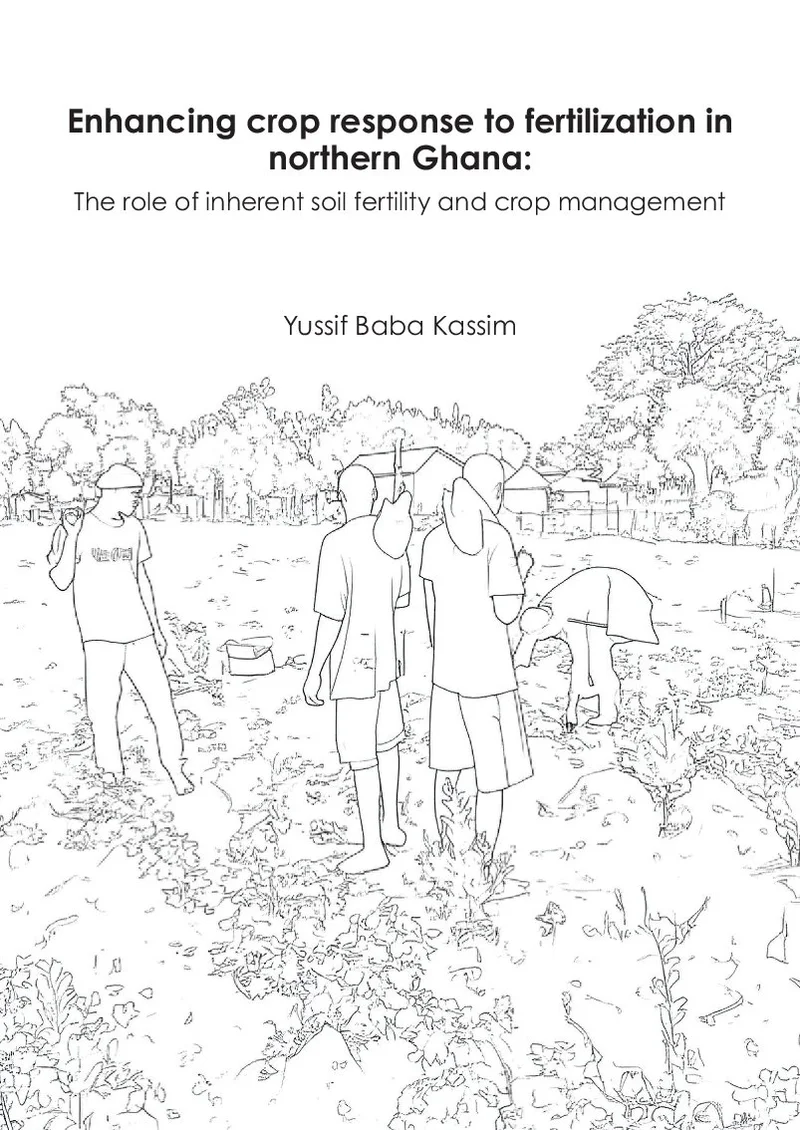
Yussif Baba Kassim
Enhancing crop response to fertilization in northern Ghana
4 september 2026
Wageningen University
Open Ebook
Share this project
Summary
Contemporary population nutrition patterns harm both human and planetary health, which underlines the need to improve diets. Over the past decades, there has been a rise in the consumption of unhealthy and unsustainable food, which has been related to the rise of unhealthy and unsustainable food environments, consisting of political, physical, economic, and socio-cultural factors. A population-based approach, targeting the food environment as opposed to an individual-based approach, has been advanced by experts to be the most effective strategy to benefit human and planetary health. While (local) governments are responsible for the public health of their citizens, there are insufficient (inter)national policies targeting food environments. Because of this lack of policies, municipalities have limited (legal) instruments to shape local food environments.
In response to the above, some Dutch municipalities have called on the national government to develop policies giving them the leverage to take action. In addition, municipalities (in the Netherlands and worldwide) are exploring ways to improve local food environments despite the lack of legal instruments. Municipalities may improve the local food environment in different ways, including: regulating outdoor food marketing in public spaces, regulating the type and number of food outlets (e.g., zoning laws), collaborating with local stakeholders (e.g. retail outlets) to encourage them to improve the healthiness and sustainability of their food offer, and implementing policies addressing the food environment in particular settings (e.g. at planned public events).
To support municipalities in implementing efforts to improve local food environments, collaboration with citizens, insights into their perspectives, and understanding of their opinion on potential food environment policies are needed. Besides, given the complexity of food environments, there is a need for a comprehensive understanding of the factors and mechanisms influencing local food environments, after which a range of coordinated systemic efforts (e.g. via a systems-based approach, or collaborative governance (CG)) can be developed and implemented. Moreover, insights into the process and impact of implementing systemic efforts are needed to explore the complexity of such a process and determine the challenges faced when seeking to improve local food environments. Overall, an increased understanding of citizens’ perspectives on their food environment and insights into the implementation process and impact of systemic efforts will facilitate the development of appropriate, acceptable and effective efforts targeting the system underlying the local food environment. Therefore, this constituted the central focus of this thesis.
As introduced in Chapter 1, the main aims of this thesis were:
1. To gain insight into the (perceived) healthiness and sustainability of local food environments, as well as the perceived factors and mechanisms shaping these food environments and
2. To gain insight into two systemic efforts to structurally improve local food environments with stakeholders and identify challenges encountered.
Chapters 2 to 5 contributed to the first main aim of this thesis, while chapters 5 and 6 addressed the second main aim.
Chapter 2 aimed to gain insight into the (un)healthy food cues residents notice in outdoor public spaces in Dutch municipalities. It also aimed to explore their perceptions of food cues’ influence on eating behaviour, and to gain insight into the acceptability of food cues. An exploratory study was conducted among 101 adults.