Tomasz Jerzyniak
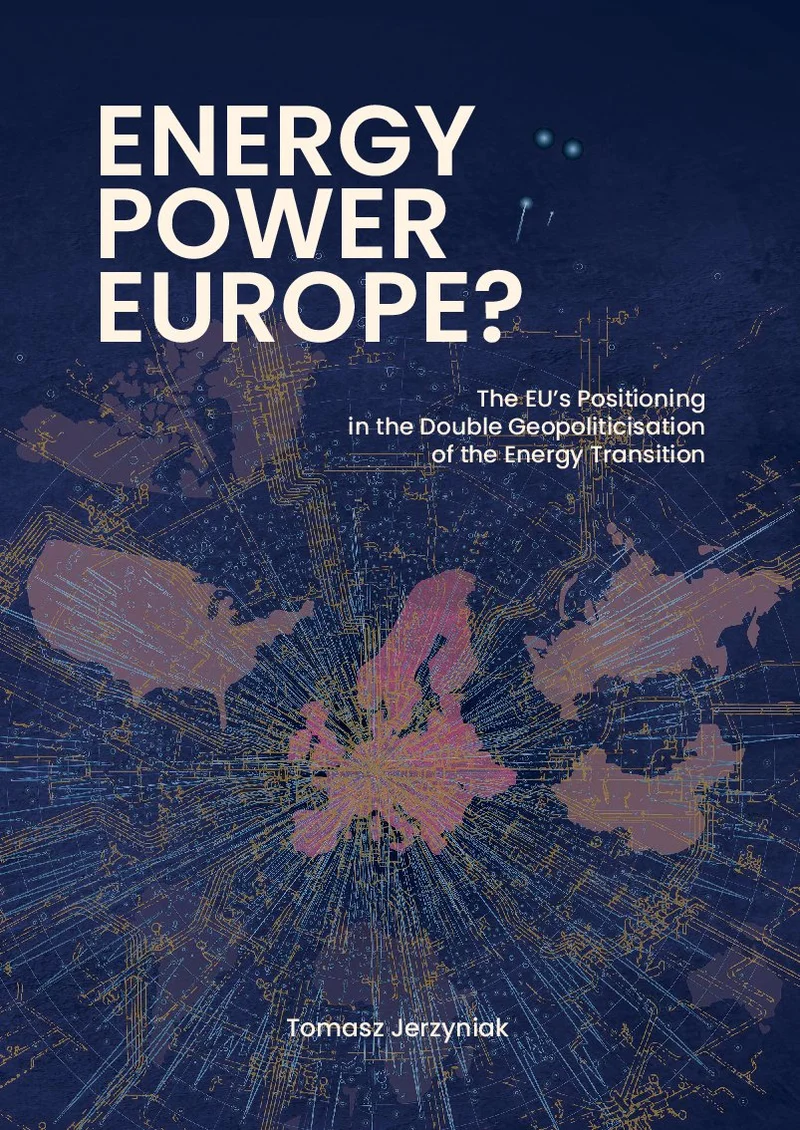


ENERGY POWER EUROPE?
Energy is central to everyday life, economic activity, and statecraft. Access to oil, natural gas, and the minerals essential for clean technologies plays a crucial role in shaping national security, economic security, and international power relations. Although the shift towards cleaner energy has begun, it remains slow, contested, and is generating new dependencies. The clean energy transition is already reshaping international relations, yet the pursuit of fossil fuels continues to structure global politics. At the same time, worldwide tensions are weakening the liberal international order and accelerating the shift towards a geoeconomic order. Political attention is increasingly directed towards protecting strategic economic interests, while trade, investment, and supply-chain networks are more frequently used as instruments of influence. As a result, the world is undergoing a significant geoeconomic transformation, with the energy transition at its core. This evolution underscores the growing importance of relative advantages over absolute gains. In response, major powers are pursuing economic decoupling, technological sovereignty, and new forms of transactional partnership. This dissertation explores how the European Union is positioning itself within the evolving geopolitics of the clean energy transition, and whether, and under what conditions, the EU has the capacity to influence the global energy transition. The central research question is addressed through four distinct articles, each employing its own theoretical framework but unified by a focus on the EU’s responses to external pressures arising from the new geoeconomic order in energy, particularly the double geopoliticisation of the clean energy transition. This concept captures both the intensified competition for hydrocarbons as alternatives to Russian fossil fuels, primarily natural gas, and the need to advance clean energy technologies while managing increased competition for critical minerals. The dissertation adopts a whole-system approach to energy issues by treating fossil fuel dependencies and the clean energy transition as deeply interconnected dimensions of contemporary energy geopolitics. It understands the transition not only as essential for mitigating environmental risks but also as a multifaceted challenge involving industrial competitiveness, national and economic security, and energy resilience. This perspective reflects the complexity of contemporary energy geopolitics and its simultaneous effects across multiple fuels and technologies. The dissertation shows that the new energy geopolitics has shifted the goals and instruments of EU external energy policy, marking a geoeconomic turn. It further finds that the EU is seeking to shape a new clean energy geopolitical order through its evolving international relations. The dissertation presents four main findings. First, the EU has significantly transformed the goals and instruments of its external energy policy, and the extent of the EU’s geoeconomic power depends on a combination of domestic factors and increasingly dominant external factors. Second, the EU has begun redefining its international relations by establishing new partnerships and reconfiguring existing ones as part of its de-risking strategy. Despite strong geopolitical pressures surrounding energy, the EU is attempting to build a new clean energy geopolitical order. Third, the partnerships concluded between the EU and its partners serve as strategic assets in the EU’s geoeconomic toolkit. However, these collaborations differ in structure, governance, and effectiveness, leaving considerable scope to improve the EU’s international energy engagement. Fourth, EU-Asian relations illustrate the growing complexity of international relations. This complexity, intensified by the double geopoliticisation of the energy transition, requires tailored and carefully considered approaches to individual countries. The dissertation makes substantial theoretical contributions to academic debates on the European Union as a power, the influence of the geoeconomic order on EU behaviour, and the impact of the global energy transition on the reconfiguration of international relations. Empirically, the articles examine the scope, characteristics, and parameters of the EU’s response to these geopolitical changes. The findings contribute to ongoing scholarly debates by conceptualising and investigating new geopolitical phenomena, while also offering practical insights for policymakers navigating the evolving geoeconomic landscape.
| Publicatiedatum | 5 oktober 2026 |
| Universiteit | Universiteit Maastricht |
| Auteur | Tomasz Jerzyniak |
| ISBN nummer | 978-94-6534-712-7 |