Samantha Elkhuizen
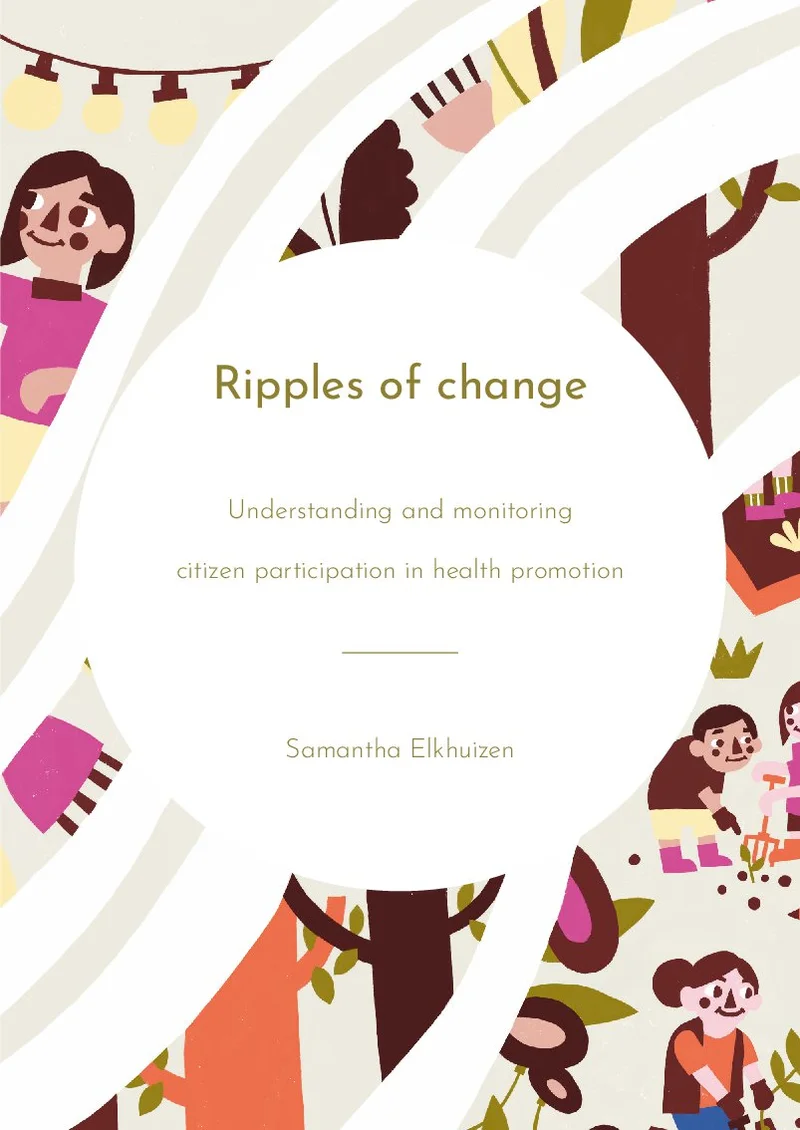


Ripples of Change
Background and aim This dissertation explores how citizens can actively participate in health promotion. Health promotion focuses on strengthening citizen’s ability to influence the conditions that affect their health, moving beyond disease prevention toward broader goals such as well-being, resilience, and social equity. Involving citizens in health promotion is increasingly seen as valuable because it brings everyday experiences, local insights, and diverse perspectives into the development of health-related actions and policies. Such involvement has the potential to enhance relevance, fairness, and sustainability. However, there is still limited understanding of how citizen participation works in practice, and how collaborative processes can be followed, supported, and evaluated in meaningful ways. The research question of this dissertation is: How can citizens actively participate in health promotion initiatives? To address this question, two interrelated research questions were formulated: 1. What factors influence the implementation, collaboration, and experienced impacts of citizen participation in health promotion? 2. How can citizen participation in health promotion be monitored and evaluated? Methods This dissertation adopted a Participatory Action Research (PAR) approach to co-create knowledge and action with all relevant actors. Data collection methods and tools were developed collaboratively with participants and aligned with existing local initiatives to ensure feasibility, ownership, and contextual relevance. Throughout the process, emerging insights were continuously fed back into practice to refine both the research design and local interventions, establishing a dynamic cycle of mutual learning, reflection, and change. The principles of Appreciative Inquiry were applied throughout all research activities to foster a positive and inclusive environment, to build on participants’ existing strengths and past achievements, and to encourage a constructive, forward-looking perspective. Various qualitative research methods were applied, including document analysis, interviews, participatory observations, and numerous interactive workshops. One frequently used method for the workshops was Ripple Effects Mapping, a participatory evaluation technique that brings together a diverse group of participants, to collectively explore the direct and indirect effects of their collaboration on a timeline. Results Chapter 2 explores the enabling conditions needed to effectively engage citizens in knowledge development for pandemic preparedness. We conducted an exploratory qualitative research design consisting of 14 interviews (n=20) and four workshops (n=25). Each workshop built on the results of previous workshops and used interactive methods such as dynamic brainstorming, citizen science journeys, and world cafés. Two overarching preconditions were identified: 1) public and professional recognition of citizen science, and 2) an accessible infrastructure for knowledge sharing and collaboration. We concluded that investing in a solid social, material and technological infrastructure before a crisis is necessary to realize citizen engagement in knowledge development for pandemic preparedness. Chapter 3 describes the effective factors for cross-sector collaboration with citizen participation in priority neighborhoods. We combined participatory action research and realist evaluation in three Dutch neighborhoods, in both rural and urban municipalities. Data collection included document analysis (n=25), interviews (n=23), Ripple Effects Mapping sessions (n=3), and observations (n=113). We identified effective factors by analyzing the relationship between context, interventions, mechanisms, and outcomes, thereby explaining how and why interventions work in a specific context. Six key factors for cross-sector collaboration with citizen participation identified were: 1) room for cross-sectoral collaboration and resident participation, 2) cross-domain facilitators and key figures from the neighborhood as health brokers, 3) personal contact and presence in the neighborhood, 4) equality and expectation management, 5) open and regular communication, and 6) visible results. We have experienced that treating the study design as a learning process contributed to sustainable relationships, local impact, and joint ownership. This process was facilitated by an action researcher and through local process guidance. Chapter 4 addresses the impacts of being an expert-by-experience or peer-expert within the social domain on the experts themselves. We used a Participatory Action Research approach, and conducted seventeen participatory observations and nine semi-structured interviews with two peer-experts, one expert-by-experience, and nine professionals in a Dutch city. We identified four impacts of the expert-by-experience and peer-expert role: 1) feeling connected – through mutual recognition and community engagement; 2) feeling valued – by contributing meaningfully and being respected; 3) personal growth – gaining self-reflection, self-acceptance, and self-confidence; and 4) acquiring transferable skills and future prospects – such as language skills, boundary-setting, and employment opportunities. In those key impacts also several challenges for experts-by-experience and peer-experts were presented, these included difficulties in setting boundaries that may affect work-life balance; mistrust and stress regarding financial compensation; and the resurfacing of painful memories. To address these challenges and ensure positive impact, researchers and professionals were advised to provide supportive supervision and organizational recognition. This included offering clear guidance, defined role descriptions, opportunities for development, and promoting reciprocal learning. Chapter 5 describes the lessons learnt from applying a participatory systems approach to the planning and implementation of an overall evaluation of a program aimed at enhancing the health of families in vulnerable positions in the Netherlands. We evaluated four projects across four municipalities. We studied the processes and results of the overall evaluation in four iterative steps: 1) conducting participatory action research with the four projects, 2) semi-structured interviews with the four case managers, 3) three consortium reflection and learning sessions and document analysis, and 4) formulation of the themes. The five main lessons learnt from applying a participatory systems approach were: 1) flexibility is needed to realize stakeholder participation; 2) balance research tools and methods with practice; 3) ensure adequate research capacity; 4) define the roles of stakeholders; and 5) explore system boundaries continuously. The perceived added value of a systems approach was that it fostered a culture of shared learning and co-creation, adaptability, and enhanced overview and understanding of the broader system. Chapter 6 reflects on the use of Ripple Effects Mapping (REM) as a participatory method to facilitate action, stimulate learning, and monitor progress of health promotion initiatives in co-creation with all stakeholders. To make REM suitable for citizen participation, we adapted the Nobles et al. (2022c) workshop format by: reintroducing one-on-one interviews as a warm-up; using an open timeline centered on personal highlights, successes, and meaningful moments; conducting a single REM workshop per case; working in groups of five to seven participants; explicitly incorporating participants’ experiences, feelings, responses, and underlying mechanisms. Across 16 case studies within three programs, 18 REM workshops were conducted. Reflection revealed four overarching themes: 1) flexibility, as REM proved adaptable across diverse contexts, topics, initiative phases, and group compositions; 2) openness and positive framing of dialogue, with the open timeline eliciting rich insights into contextual influences and ripple effects while fostering a constructive atmosphere; 3) collective exchange and mutual learning, enabled by bringing together diverse stakeholders and sharing of perspectives and non-regular forms of dialogue; and, 4) overview, insight, and action, as the visual timeline supported reflection, made achievements visible, identified leverage points for change, and generated momentum for follow-up action. General conclusions and recommendations In this dissertation various forms and levels of citizen participation in health promotion were examined. These ranged from participation in processes initiated by professionals to citizen-led initiatives. These forms of participation operated across different levels, from regional programs to neighborhood-based projects, and addressed a wide range of topics. By engaging with this diversity, the research reflects the plurality of ways in which citizens participate in health promotion practice. For citizens to actively participate in health promotion, both relational and structural conditions that enable equitable and recognized participation needed to be in place. This dissertation highlighted the importance of factors such as trust, equitable dialogue, and mutual recognition, alongside enabling structures including accessible digital and physical infrastructures, the institutional embedding of participation within professional and organizational structures, and adequate financial arrangements. Citizen participation emerged as a dynamic and relational process that evolved in response to local contexts, relationships, and changing needs. Consequently, meaningful participation required flexibility in both research design and practice, including an open and reflexive attitude, balancing research methods with practice, and actively ensuring that diverse voices are heard. To support this, the dissertation presented lessons learned from applying a Participatory Systems Approach and provided a methodological guide for Ripple Effects Mapping, including adaptations to support the simultaneous monitoring and facilitation of participatory processes. Based on these insights, practical recommendations were formulated for policymaker, practitioners, researchers and citizens. Recommendations for policymakers concern creating supportive structural conditions that enable citizen participation to flourish. This includes embedding participation within organizational and governance structures, investing in integrated digital and physical infrastructures, as well as accessible funding for health promotion initiatives initiated by citizens and financial compensation of citizens for participation. For practitioners, the findings highlight the importance of making deliberate choices about participation, investing in relationships and community key figures, and providing adequate support for both citizens and professionals. With regard to researchers, this dissertation advocates for a hybrid research design that combines tailored research methods to capture projects’ context-specific findings and overall research methods that are applied across multiple projects. Research approaches should be participatory, context-sensitive, and sufficiently flexible, while also being accessible and engaging for participants. Citizens and community groups also play an important role in shaping participatory practices, by advocating for supportive conditions such as clear roles, fair compensation, transparent communication, and respectful collaboration. Meeting these recommendations will strengthen citizens’ capacity and opportunities to actively participate in health promotion.
| Publicatiedatum | 9 oktober 2026 |
| Universiteit | Wageningen University |
| Auteur | Samantha Elkhuizen |
| ISBN nummer | 978-94-6534-571-0 |
| DOI nummer | 10.18174/681887 |