Marzieh Kordnejad
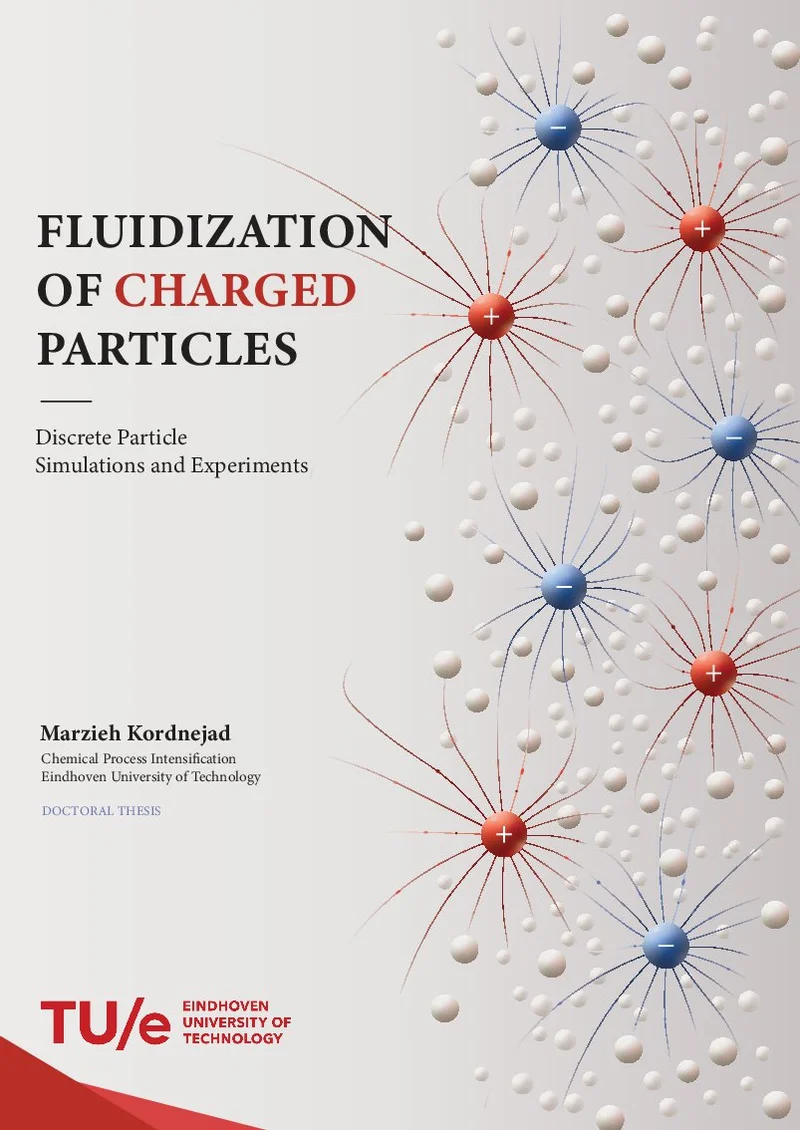


Fluidization of Charged Particles
Electrostatic charging caused by triboelectrification is an inherent phe nomenon in gas–solid fluidized beds containing insulating particles and can significantly influence hydrodynamics, particle motion, fouling, and heat transfer. Although electrostatic effects are frequently observed in industrial fluidized-bed processes such as polymer drying, coating, and granulation, they are often treated as secondary disturbances rather than as governing forces that directly influence reactor performance. This thesis combines numerical modeling and experimental investigations to improve the under standing of electrostatic phenomena in fluidized beds and their implications for industrial applications. The thesis begins by reviewing the physical mechanisms responsible for triboelectric charging, including conductor–conductor, conductor–insulator, and insulator–insulator contact electrification. The influence of electrostatic interactions on fluidization behavior is discussed together with existing experimental and numerical studies, highlighting the remaining challenges in accurately predicting charged particulate systems. The first part of the thesis focuses on the numerical modeling of electrostatic interactions in CFD–DEM simulations. Because direct Coulomb force calculations scale quadratically with the number of particles, they rapidly become computationally prohibitive for industrial-scale simulations. To overcome this limitation, a hierarchical particle-cell method is developed in which short-range electrostatic interactions are evaluated directly using Coulomb’s law, while long-range interactions are efficiently approximated using lumped charges within computational cells. Validation against exact Coulomb-force calculations for a three-dimensional fluidized bed containing 70,000 charged particles demonstrates that the proposed method substantially improves the accuracy of electrostatic force predictions while maintaining computational efficiency. Consequently, the method provides an efficient and reliable framework for incorporating long-range electrostatic interactions into large-scale CFD–DEM simulations. The developed numerical framework is subsequently applied to investigate the influence of electrostatic charging on fluidized-bed hydrodynamics. The simulations demonstrate that electrostatic interactions increase the minimum fluidization velocity, delay bubble formation, reduce the measured bubble area, modify particle circulation patterns, and increase bed voidage. The contour plots further indicate that charged bubbles become more elongated while their boundaries become increasingly diffuse because of particle penetration. These changes arise because electrostatic forces become comparable to gravitational and drag forces, fundamentally altering the force balance governing particle motion. Experimental investigations using a pseudo-two-dimensional fluidized bed containing Geldart B glass particles confirm the numerical observations. Charge accumulation measured using a Faraday cup resulted in an approximately 33% increase in the minimum fluidization velocity under dry conditions compared with humidified conditions, where electrostatic charging was largely suppressed. Bubble characteristics were also significantly modified. Bubble-area analysis showed a reduction in the measured bubble area, while contour analysis revealed more elongated bubbles with increasingly diffuse gas–solid interfaces due to particle penetration. Together, the numerical and experimental results demonstrate that electrostatic charging has a pronounced influence on fluidization behavior. The final part of the thesis investigates the consequences of electrostatic charging for fouling and heat-transfer performance in fluidized beds containing HDPE particles. Measurements of charge density, fouling mass, and heat-transfer coefficient demonstrate a clear relationship between electrostatic charging, particle deposition, and thermal performance. Particle groups exhibiting higher charge accumulation, particularly smaller particles (fines) or with a larger particle size distribution produced greater fouling on the grounded heating element and consequently lower heat-transfer coefficients. The measured heat-transfer coefficient progressively decreased during operation to less than half of the theoretical value predicted by the Molerus correlation for a clean fluidized bed. Comparison of particle groups further demonstrates that increased electrostatic charging promotes fouling formation, thereby increasing the thermal resistance between the heating surface and the fluidized particles and reducing heat-transfer performance. Overall, this thesis demonstrates that electrostatic interactions cannot be regarded as secondary effects in gas–solid fluidized beds. Electrostatic charg ing directly influences fluidized-bed hydrodynamics, fouling formation, and heat-transfer performance. By combining an accurate and computationally efficient electrostatic modeling framework with comprehensive experimental validation, this work provides new insight into the mechanisms governing charged particulate systems and establishes a foundation for more predictive CFD–DEM simulations and improved industrial fluidized-bed design and operation.
| Publicatiedatum | 8 oktober 2026 |
| Universiteit | TU Eindhoven |
| Auteur | Marzieh Kordnejad |
| ISBN nummer | 978-90-386-6792-8 |