Lars Binkhorst
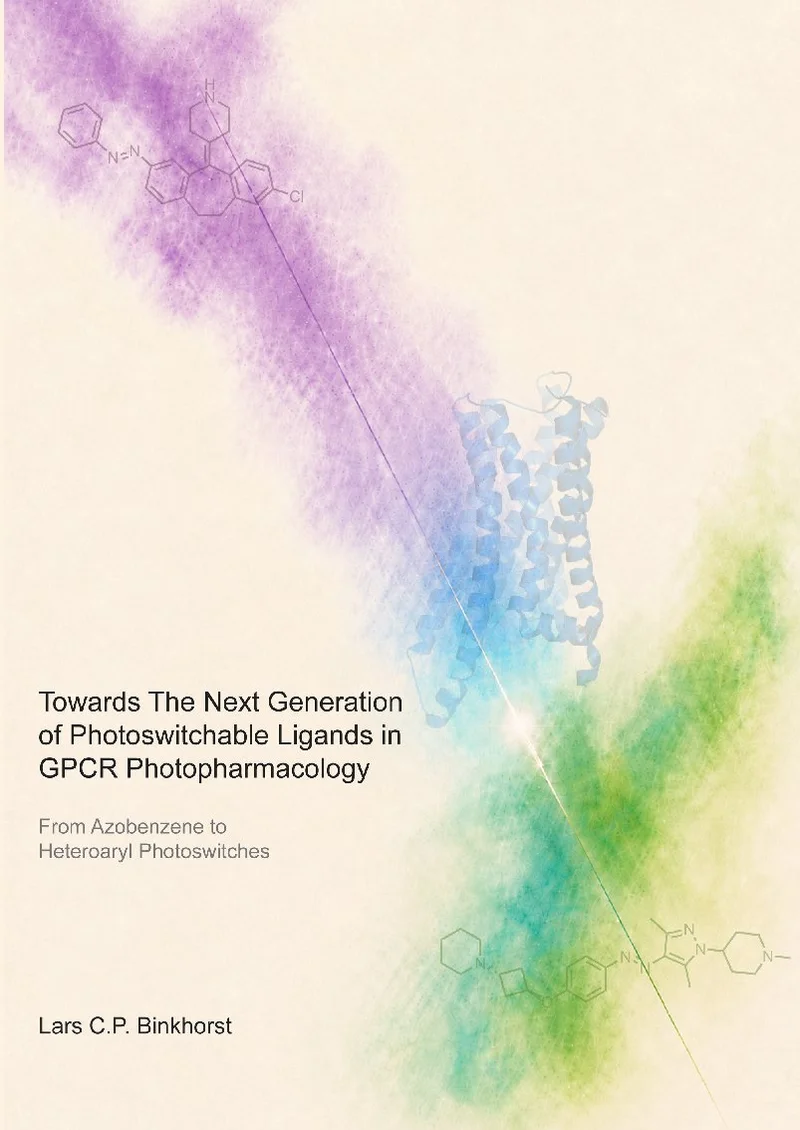


Towards the Next Generation of Photoswitchable Ligands in GPCR Photopharmacology
The ability to control biological processes with high spatial and temporal precision remains a major challenge in modern drug discovery. Light-based approaches have emerged to address this challenge, enabling dynamic control of biological targets while reducing off-target effects. Among these approaches, photopharmacology uses light-responsive ligands the biological activity of which can be reversibly controlled through irradiation with light. Photoswitchable ligands offer the possibility to modulate protein function with high precision, making them attractive compounds for research. Despite substantial advances in the field, many photoswitchable ligands still rely on the azobenzene scaffold, and switching this group from its trans to its cis configuration generally calls for ultraviolet (UV) irradiation. As a result, their applicability in living systems is limited, since UV wavelengths are absorbed before they can reach deeper tissue layers. G protein-coupled receptors (GPCRs) constitute one of the most important classes of drug targets and have become a major focus of photopharmacological research. Several photoswitchable ligands for histamine receptors have already been developed in the past. Building on this foundation, this thesis explores the design, synthesis, and characterization of next-generation photoswitchable GPCR ligands. Particular emphasis is placed on expanding the photopharmacological toolbox beyond conventional azobenzenes by exploring alternative heteroaryl photoswitches and evaluating how these structural modifications influence both photochemical and pharmacological properties. Together, these studies aim to contribute to the development of more effective and biologically compatible photoswitchable ligands for GPCR photopharmacology. Chapter 2 describes the development of a second-generation series of arylazopyrazole-based histamine H3 receptor (H3R) antagonists, designed to improve properties compared to the earlier azobenzene photoswitchable ligands. Introducing the arylazopyrazole photoswitch led to more efficient photoswitching, better solubility, and improved binding to H3R than the azobenzene-based template ligand. The optimization process led to the identification of key compound VUF26063, which combines picomolar H3R binding in its trans isomer with a pronounced erosion of affinity upon conversion to the cis state. A key structural feature of this ligand also made it possible to introduce a tritium label, generating the first radiolabelled photoswitchable ligand. This tool was used to study the kinetics of this ligand, indicating that it photochemically isomerizes while residing inside the receptor pocket. Chapter 3 introduces a 'photoswitch hop' as a design strategy. The phenyl ring of an azobenzene-based H3R antagonist is substituted with a range of heteroaryl azo (HAA) groups to examine how the incorporation of heteroaromatic rings affects the photochemical, physicochemical and pharmacological properties of the resulting ligands. The study revealed that exchanging the photoswitch scaffold can profoundly influence properties, yielding compounds with red-shifted switching wavelengths, improved photostationary states, and a wide range of thermal relaxation times. Chapter 4 targets the histamine H1 receptor (H1R), a clinically important GPCR for which no sufficiently effective photoswitchable ligand has yet been developed. Desloratadine was used as the template scaffold for an "azoscan" approach. Among these, the 2-substituted analogue emerged as the most promising candidate. Chapter 5 examines how the position and orientation of an arylazopyrazole photoswitch affects the photochemical and pharmacological properties of a ligand. The loss of affinity indicates the steric demands of the dimethyl-substituted pyrazole ring as the likely cause. Chapter 6 discusses the overall findings. This thesis explored the design, synthesis, and characterization of next-generation photoswitchable ligands for the histamine receptors, with particular emphasis on photoswitch scaffolds beyond the azobenzene.
| Publicatiedatum | 30 september 2026 |
| Universiteit | Vrije Universiteit Amsterdam |
| Auteur | Lars Binkhorst |
| Order nummer | 19451 |
| DOI nummer | 10.5463/thesis.1683 |