Justin Du Toit
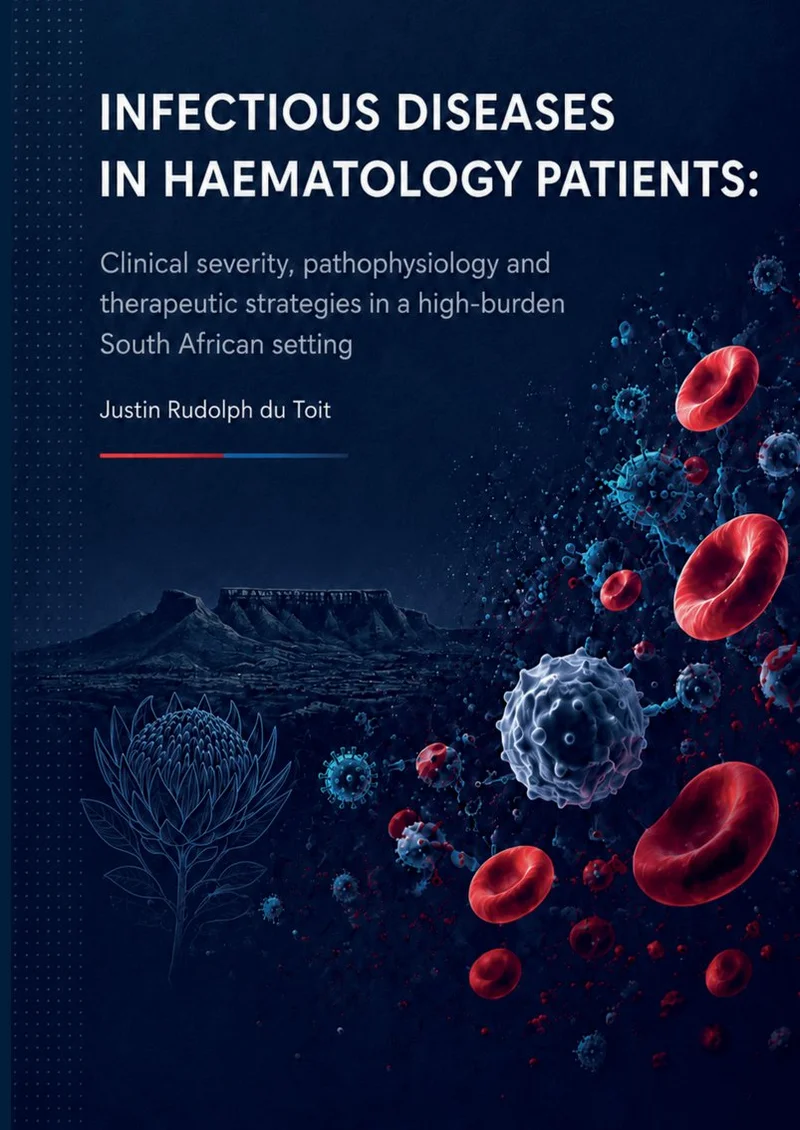


Infectious Diseases in Haematology Patients
SUMMARY OF THESIS This thesis presents a comprehensive evaluation of infectious, haematological, immunological and transplantation-related complications affecting patients with haematological malignancies and those undergoing haematopoietic stem cell transplantation (HCT), with a strong focus on the Southern African context and direct comparison to international practice. Central to this work is the bidirectional interplay between virology and haematology: viral pathogens contribute directly to haematological pathology through immune-mediated and immunothrombotic mechanisms, while patients with haematological diseases are uniquely vulnerable to severe viral infections due to underlying and treatment-related immunosuppression. The thesis was designed to address three broad aims: First aim To determine how infectious disease burden influences outcomes among haematology patients undergoing transplantation in South Africa compared with international centres. In Part II, respiratory viral infections, including respiratory syncytial virus (RSV), were shown to occur infrequently and to be associated with relatively low morbidity and mortality across geographically and economically diverse HCT centres, including the Wits Donald Gordon Medical Centre in South Africa and collaborating centres in the Netherlands. These findings indicate that universal pre-transplant RSV prophylaxis might be unnecessary for most patients. Instead, prevention strategies should be risk-adapted and targeted toward clearly defined high-risk subgroups to maximise clinical benefit while preserving healthcare resources. Although diagnostic awareness of community-acquired respiratory viruses among clinicians is high, substantial variation in treatment approaches, prevention strategies and testing policies was observed. This heterogeneity reflects the absence of harmonised international guidelines, as well as rapidly evolving evidence related to emerging antiviral agents and vaccines. Collectively, these findings highlight the pressing need for guideline alignment, improved clinician education and optimisation of testing strategies across centres locally and internationally. Bloodstream infections emerged as a major contributor to morbidity and disease severity among South African HCT recipients, particularly in the allogeneic transplant setting. Colonisation with carbapenem-resistant Enterobacteriaceae (CRE) was identified as a strong independent risk factor for subsequent bloodstream infection, underscoring the critical importance of robust infection-prevention measures, enhanced antimicrobial stewardship and the development of targeted prophylactic or pre-emptive strategies in this highly vulnerable population. Second aim To investigate how viral infections drive haematological pathology through immune-mediated and immunothrombotic mechanisms. In Part III, the complex interplay between viral infections, immune dysregulation, thrombocytopenia and coagulation abnormalities was explored. Through a comprehensive literature review, thrombocytopenia was demonstrated not to be merely a passive consequence of viral illness, but rather a manifestation of dynamic virus–platelet interactions involving both innate and adaptive immune responses. Platelets increasingly appear to function as active mediators of antiviral defence and immune signalling, reframing their role in viral pathogenesis and supporting their potential utility as biomarkers of disease severity and clinical outcomes. In critically ill patients with COVID-19, identification of a procoagulant phenotype among peripheral blood mononuclear cells, combined with assessment of the end-tidal to arterial carbon dioxide gradient (ETCO₂–PaCO₂), showed promise as a non-invasive approach for early detection of pulmonary embolism in the intensive care environment. This strategy may facilitate earlier diagnosis and therapeutic intervention when conventional imaging is delayed or impractical, potentially improving outcomes in critically ill patients. Within the spectrum of rare bleeding disorders, acquired haemophilia A (AHA) was characterised as a potentially life-threatening but treatable condition. In this cohort, patients with HIV-associated AHA presented with markedly higher inhibitor titres and required more prolonged immunosuppressive therapy to attain remission. Early recognition and prompt initiation of treatment were associated with excellent survival outcomes, whereas delayed diagnosis or limited initial resource utilisation increased morbidity and overall management costs. These findings reinforce the importance of maintaining a high index of suspicion regarding AHA and establishing formal registries to strengthen clinical understanding and optimise future management pathways for this rare disorder. Third aim To evaluate how key treatment processes, namely haematopoietic stem cell mobilisation, donor selection via haploidentical transplantation strategies, and transfusion practices can be optimised to improve patient outcomes and resource utilisation in South Africa. In Part IV, contemporary transplant practices and supportive-care strategies were evaluated within the South African setting. Poor mobilisation of haematopoietic stem cells occurred in 17% of patients undergoing autologous transplantation, however, true mobilisation failure remained uncommon at 2%. A notably high rate of super mobilisation (68%) was observed, particularly among patients with multiple myeloma, suggesting unnecessarily aggressive upfront mobilisation strategies. These findings directly informed clinical practice, leading to the adoption of lower-dose etoposide mobilisation protocols and updated standard operating procedures across both public and private transplant centres. Predictive factors for poor mobilisation were identified, enabling refined risk stratification and more cost-effective use of plerixafor for rescue mobilisation. Selective deployment of rescue agents allows optimisation of limited therapeutic resources while maintaining favourable patient outcomes. The feasibility and efficacy of haploidentical transplantation were also demonstrated in South Africa, representing the first study of its kind reported from sub-Saharan Africa. Use of unmanipulated haploidentical grafts, particularly from younger parent or offspring donors, yielded effective transplant outcomes in adults with acute leukaemia or myelodysplastic syndrome lacking matched related or unrelated donors, although non-relapse mortality remained high. While the underlying contributors to this elevated non-relapse mortality remain incompletely defined and warrant further investigation, the data establishes a critical baseline for future programme development, quality-improvement initiatives and outcome optimisation strategies. Overall, haploidentical transplantation is confirmed as a highly valuable approach for expanding access to curative therapy in regions with constrained donor availability. Finally, marked national variation in blood transfusion practices and blood-product modification requests was identified among South African haematology providers. This variability reflects inconsistent education, heterogeneous institutional protocols and limited standardisation. The findings support the urgent need for focused clinician education initiatives, including expanded training in patient blood management principles and increased exposure to transfusion medicine during oncology training, and for the development of standardised national transfusion guidelines. Such measures are essential to improve patient safety, promote consistent evidence-based practice, optimise utilisation of blood products, reduce healthcare costs and ultimately strengthen overall health-system efficiency.
| Publicatiedatum | 7 oktober 2026 |
| Universiteit | Erasmus Universiteit Rotterdam |
| Auteur | Justin Du Toit |
| Order nummer | 19603 |