Chloe de Mortier
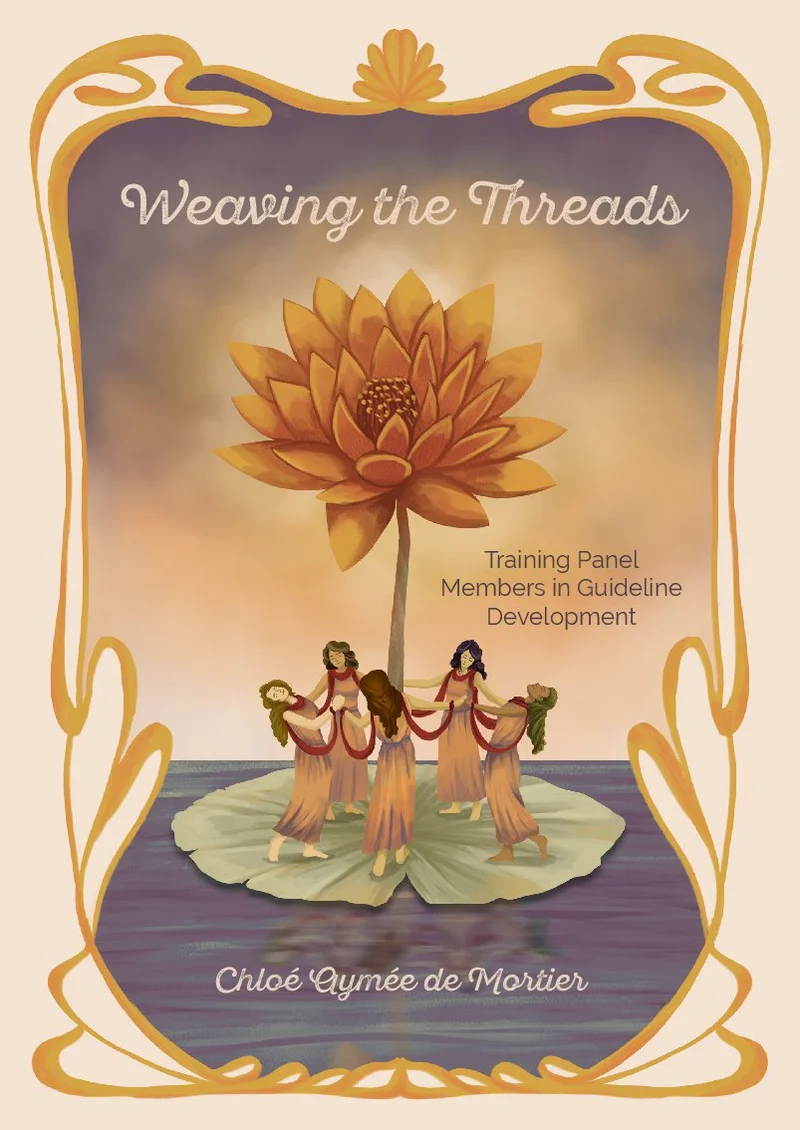


Weaving the Threads
Guidelines are an essential part of health care. They support healthcare professionals and patients in making decisions about appropriate care. They can also help reduce needless practice variation and promote cost-conscious practice. The latter is increasingly important with limited resources and rising healthcare costs. Developing guidelines is complex and done by guideline panels. These panels may include healthcare professionals from various disciplines, patient representatives, and researchers; they are called panel members. These panel members are supported by project leads and guideline methodologists. Over the past decades, guideline development has become more transparent and methodologically underpinned by approaches such as the GRADE methodology and the GRADE Evidence to Decision framework. This framework encourages guideline panels to consider not only scientific evidence but also patient values and preferences, acceptability, feasibility, equity, and cost considerations when developing recommendations. While such developments have strengthened the methodological foundation of guidelines, they have also increased the complexity of guideline development. Additionally, studies have shown that in practice it remains challenging to the meaningful integrate of patient perspectives and economic considerations into guidelines. Despite the increasing complexity of guideline development, many panel members have not had formal education to prepare them for their role, even though they are expected to make difficult decisions together. Research on how to support panel members in guideline development through education remains scarce (chapter 1). This PhD dissertation aimed to investigate how education can support panel members in guideline development. To do this, we studied the experienced challenges and learning needs of panel members and designed, implemented, and evaluated a training that was used during real guideline development projects. In the first part of this dissertation, we examined the challenges panel members experience and what learning needs they have. In Chapter 2 we explored the learning needs of panel members with a survey amongst people involved in Dutch guideline development. We developed this survey in collaboration with Dutch patient and healthcare professional organisations involved in guideline development. This survey showed that panel members often feel insufficiently prepared for their role. Prior experience with guideline development, guidance during the process and education were indicated to help panel members in their role. Panel members said that educational programmes should explain what guideline development entails, what is expected of them, and how different perspectives, such as those of patients, can be included. Many respondents also indicated that considering costs in guidelines is important, but that they lacked knowledge and guidance on how to do this in practice. Moreover, panel members said educational programmes should not only focus on content-related knowledge but also on process-related aspects, such as collaboration. In Chapter 3, we conducted a literature review to better understand the challenges and stimulating factors to include economic considerations in guidelines. This showed several challenges: limited available economic evidence, translating available evidence from one healthcare setting to another, discussion on the role of economic considerations in guidelines, uncertainty about how to include economic considerations (methods), and a lack of resources (e.g. time). At the same time, we found factors that could help improve the inclusion of economic considerations: greater acceptance of discussing economic considerations in guidelines, better methodological guidance and basic education concerning economic concepts. Chapter 4 explores the experiences of patient representatives who participate in guideline development, specifically patient representatives for rare conditions. They considered guidelines to be valuable tools to help them navigate health care and support patient advocacy. However, they often found it difficult to participate fully in deliberations. Medical language, unclear expectations, and unfamiliarity with guideline development made it difficult to contribute. They emphasised that guidelines should reflect the diversity of patients’ experiences and address daily life issues, not only medical outcomes. Additionally, they argued that good collaboration and equal partnership in panels requires explicit attention. In the second part of the dissertation, we developed and evaluated a training for panel members based on the found learning needs. Chapter 5 describes how we determined the training format based on the identified learning needs. We did this together with guideline methodologists, educators, and health economists. Educational theory (principles of active, collaborative, contextual, blended and just-in-time learning) guided the development of the training. We implemented and evaluated the training with six ongoing guideline projects. The training combined e-learning modules with joint in-person sessions during panel meetings. Panels followed training modules just-in-time, meaning they received the content when required during the development process so that they could directly apply the learned knowledge in their own guideline project. Panel members said the training helped them better understand the guideline development process, made them feel better prepared and encouraged the incorporation of economic considerations. The in-person sessions were important to create a shared understanding and support collaboration within the panel, indicating that online learning alone would not be enough. During the implementation of the training, it became clear that no guideline development project was the same. Chapter 6, therefore, explored how the learning needs of panel members were shaped across and within these different projects. We interviewed the panel members and project leads of the guideline projects which followed the training. We found that learning needs were shaped by three closely connected factors: the topic of the guideline, how tasks were divided, and how panel members interacted and were able to participate. First, the topic of the guideline influenced which knowledge was important. For example, a guideline that does not include diagnostic questions would not benefit from education focused on diagnostics. Additionally, the topic affected whether scientific evidence was available, as some topics are less (scientifically) researched than others. Second, the way tasks were divided influenced what panel members needed to learn. For example, when panel members were not expected to assess scientific literature themselves, specific education on these activities was less useful for them. Finally, how panel members interacted played an important role. Factors such as experience in research or guideline development, hierarchy, confidence, and feeling safe to speak up influenced whose perspectives were heard and integrated into the guideline. Chairs were seen as having an important role in supporting inclusive dialogues and collaboration within the panel. This showed that methodological knowledge on guideline development alone is not enough to participate meaningfully. Overall, these findings indicate that educational programmes cannot be the same for every panel. Instead, they should be flexible and adaptable to the specific needs of guideline projects. Overall, Chapter 7 reflects upon the findings in the dissertation and the research approach we took. First, a shared understanding of how guideline development works is important, but education cannot have a one-size-fits-all approach. Because guideline projects differ in topic, task division, and how people participate, education needs to be flexible and adaptable to project-specific needs. Second, education can help panel members better understand and discuss economic considerations in guidelines. This is important to support future-proof health care in times of rising healthcare costs and limited resources. However, education alone is not enough. Clear agreements are needed about who is responsible for addressing economic aspects, what information should be included in guidelines, which methods should be used, and better availability of economic evidence is needed to support this effort further. Third, we learned that providing knowledge at the right moment for everyone is challenging. Panel members often work on different tasks at different times, making it difficult to fully align individual learning needs with learning together as a group. Additionally, differences in experience and knowledge, as well as changes in panel composition, could influence the educational timing needs of panel members. Fourth, guideline development is not only a methodological process, but also a social one. Supporting collaboration, clear communication, and equal participation is just as important as teaching the guideline development methodology. Overall, this dissertation showed that education grounded in educational theory, using active, collaborative, contextual, blended, and just-in-time learning, can support guideline panel members during guideline development. This made the complex process of guideline development, including the discussion of topics such as economic considerations and patient values, more feasible in practice.
| Publicatiedatum | 26 oktober 2026 |
| Universiteit | Universiteit Maastricht |
| Auteur | Chloe de Mortier |
| Order nummer | 18964 |
| ISBN nummer | 978-94-6534-602-1 |