Ahmad Alrefaei
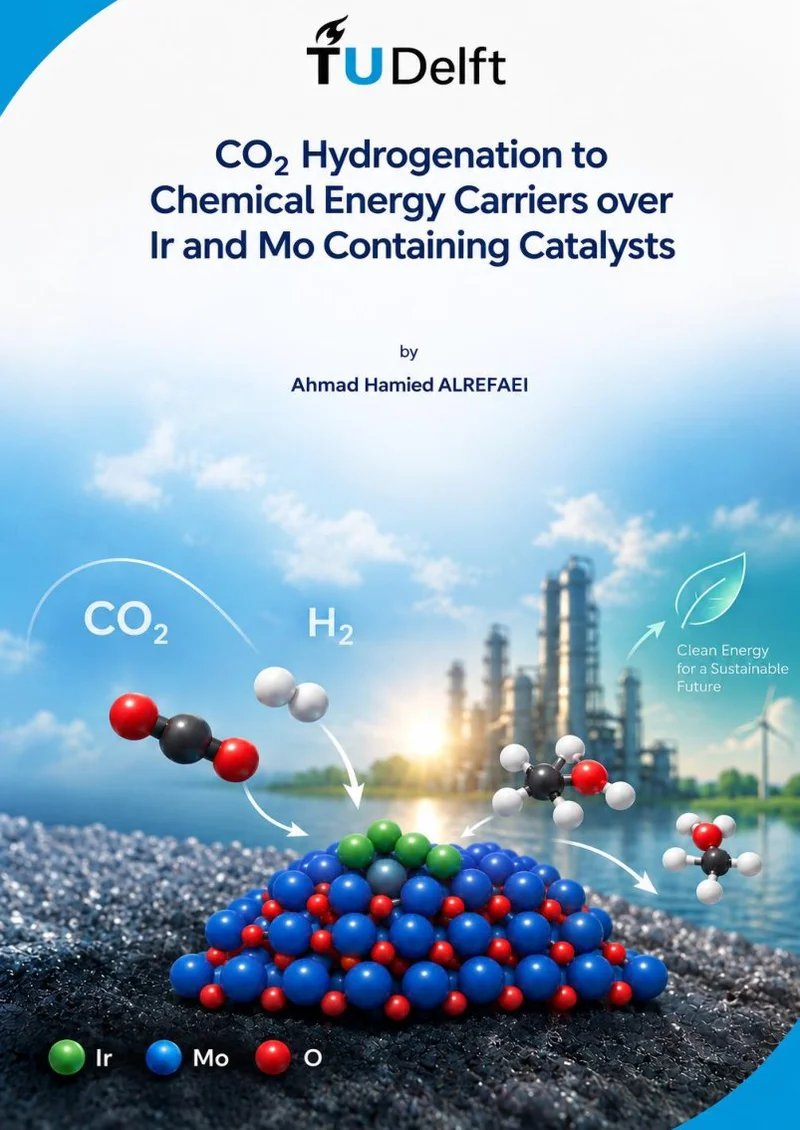


CO2 Hydrogenation to Chemical Energy Carriers over Ir and Mo Containing Catalysts
The increasing global energy demand, driven by population growth and industrial development, remains heavily reliant on fossil fuels, contributing significantly to climate change. Carbon capture, utilization, and storage (CCUS) has emerged as a critical strategy to mitigate CO2 emissions while enabling the production of sustainable fuels and chemicals. Among CCUS pathways, catalytic CO2 hydrogenation to methanol (MeOH) and MeOH derived products represents a promising route for carbon recycling, particularly when coupled with green hydrogen. However, achieving high activity and selectivity under industrially acceptable conditions requires a deep understanding of catalyst structure and reaction mechanisms. This thesis investigates iridium–molybdenum-based catalytic systems for CO2 hydrogenation to MeOH and its derived products, with the last study focusing on the reverse water–gas shift (RWGS) reaction. The first part of this work examines Ir supported on different reducible oxides for CO2 hydrogenation to MeOH and MeOH-derived products. Among the investigated systems, Ir/MoO3 demonstrated superior activity toward MeOH-derived products, reaching 15 mg·h-1·gcat-1 at 225 °C and 20 bar. The catalytic performance was found to be highly sensitive to the reduction temperature. Moderate reduction at 200 °C produced partially reduced Mo species (predominantly Mo4+), while reduction at 400 °C generated more metallic Mo (Mo0). These changes significantly altered MeOH selectivity. The in situ X-ray absorption near-edge structure (XANES) confirmed that Ir was fully reduced at 200 °C and that variations in MeOH selectivity were primarily linked to changes in the Mo chemical state. Repeated reaction cycles were found to lead to additional in situ Mo reduction, correlating with enhanced MeOH formation. These findings highlight that the catalytic behavior of Ir/MoO3 is governed primarily by the redox and structural dynamics of the MoOx support. The second part of the thesis investigates the effect of Mo loading in (1.5)Ir/xMo/Al2O3 catalysts (19, 32, and 48 wt% Mo). Structural characterization showed that low Mo loading resulted in highly dispersed amorphous Mo species, while higher loadings promoted the formation of crystalline MoO3 phases. Interestingly, IrO2 crystallites were prominent at low Mo loading but became negligible at higher Mo loading, indicating stronger Ir-Mo interactions. Catalytic testing at 300 bar revealed that low Mo loading yielded the highest MeOH-derived product selectivity (48% at 150 °C), whereas increasing Mo loading suppressed MeOH formation. Operando diffuse reflectance infrared Fourier transform spectroscopy (DRIFTS) analysis revealed that higher Mo loading diminished Lewis acid-associated bidentate formate species, while monodentate formate remained unaffected. The suppression of these Lewis acid-associated intermediates directly correlated with reduced MeOH selectivity, establishing Mo loading as a critical parameter controlling surface chemistry, intermediate stabilization, and catalytic performance. In the second part of the investigation, the low Mo-loading catalyst yielded the highest selectivity for MeOH-derived products. However, it remains unclear whether the high selectivity is primarily due to Mo loading or dispersion, as lower loadings often led to higher dispersion. To decouple the effects of dispersion, the third part of this study focuses on catalysts with identical Mo loading (32 wt%) but different Mo dispersions (high and low). The catalytic activity result demonstrated that highly dispersed Mo species enhance MeOH and MeOH-derived product selectivity. Using a reduction temperature of 400 °C for 1.5 h (R400), the highly dispersed catalyst achieved 97% MeOH-derived product selectivity, whereas the low-dispersion catalyst predominantly produced CO. Operando DRIFTS identified one of the bidentate formate and the monodentate formate species as essential intermediates for MeOH formation. The Ir/Mo-based system is flexible, and its role and function can be tuned based on the condition used. To show the flexibility of the Ir/Mo-based system, the final part of the thesis explores the RWGS reaction over Ir/MoO3 and Ir/MoO3/Al2O3 catalysts under atmospheric pressure. Both systems exhibited complete selectivity toward CO across the investigated temperature range, confirming their suitability for RWGS. However, Ir/MoO3 showed partial deactivation at elevated temperatures due to its low surface area and associated Ir sintering. In contrast, Ir/MoO3/Al2O3 displayed excellent thermal stability with negligible deactivation. A detailed kinetic study was conducted for the stable Ir/MoO3/Al2O3 catalyst. The reaction was modeled assuming direct CO2 dissociation with C–O bond cleavage as the rate-determining step. Oxygen vacancies in MoOx were identified as the active sites for CO2 activation, while Ir facilitated H2 activation and oxygen vacancy regeneration through hydrogen spillover. Kinetic parameter estimation yielded a model that accurately described the experimental data. Sensitivity analysis was performed, and based on the analysis result, it was hypothesized that CO and H2O adsorption is negligible, allowing simplification of the model without compromising predictive capability.
| Publicatiedatum | 24 september 2026 |
| Universiteit | Overig |
| Auteur | Ahmad Alrefaei |
| Order nummer | 19696 |